Giulio Occhionero on Why Option Pricing Theory Still Has Unfinished Business
How renormalisation, payoff-based modeling, and mathematical physics are reshaping modern derivatives pricing
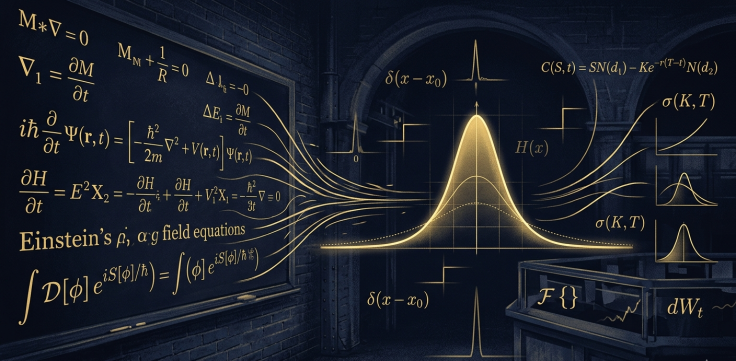
Option pricing is one of those disciplines whose surface stability disguises a more restless reality underneath. The Black-Scholes-Merton framework has been treated as settled science for so long that the textbook chapters describing it look largely unchanged from how they appeared in the late 1970s. Read the working papers and the trading desks more carefully, however, and the field has spent four decades quietly addressing the points at which the original framework either understates risk, mis-specifies the underlying process, or produces prices that diverge from what the market actually delivers. The question of which corrections have genuinely been absorbed into practice, and which the discipline still treats more comfortably in theory than in execution, is the more honest version of the conversation.
Giulio Occhionero, an Italian nuclear engineer turned quantitative finance researcher and currently Head of Quantitative Research and Development at IRH Global Trading, has spent much of the last decade publishing in this territory. His SSRN papers on the Boltzmann equation in finance, the probability distribution of call options, and what he terms Black-Scholes renormalisation sit in a tradition that takes the original framework seriously enough to ask where it requires repair. The work is technically demanding, but the underlying intuition is straightforward. A pricing model is only as good as the probability distribution it implicitly assumes, and the assumed distribution in classical Black-Scholes does several things that the data, on close inspection, do not.
What has the field actually learned about option pricing since 1973?
Several things, and not always the ones a textbook treatment would emphasise.
The most consequential change is the recognition that the choice between modeling asset prices directly and modeling their logarithms is not a cosmetic decision. The original Black-Scholes derivation moves between these representations as if they were interchangeable, but the transition introduces what Occhionero has called volatility inflation, a systematic distortion that grows with both volatility and time to maturity. The practical effect is that long-dated options on volatile underlyings, exactly the contracts where pricing precision matters most, are the contracts where the unrenormalised framework is least reliable. Trading desks have known about this for years, often patching the problem with implied-volatility surfaces that absorb the discrepancy without naming it. The more candid version of the work, which Occhionero's renormalisation papers attempt, is to identify the source of the inflation and correct it at the level of the probability density itself, rather than papering over it downstream.
A second change concerns what is being priced. Classical option pricing models the underlying asset and derives the option price as a function of it. A more recent and arguably more honest approach, developed in Occhionero's functional framework, models the option payoff distribution directly. The shift sounds technical and is in fact philosophical. If the analyst's actual question is what the contract is worth, then the contract's payoff distribution is the natural object of study, not a derived quantity sitting downstream of an assumed underlying process. The functional approach also handles discontinuous payoffs, binary options being the cleanest example, that the smooth-payoff assumptions of the original framework were never designed to accommodate.
A third change, less visible in the textbook tradition, concerns the use of generalised functions in pricing work. The Dirac delta and the Heaviside step function, both standard equipment in physics for the better part of a century, allow option payoffs and probability distributions to be written with full mathematical precision rather than approximated. The point is not that these tools are exotic. The point is that the discipline of option pricing has been quietly importing the analytical apparatus of mathematical physics for some time now, and the imports have not yet fully reshaped the textbooks. The cleaner derivations the imports allow, and the asset classes they make tractable, are the parts of the field where the working practice is most clearly ahead of the curriculum.
A fourth change, and the one Occhionero's renormalisation work is most direct about, concerns the relationship between pricing models and observable mispricings. The renormalised Black-Scholes framework predicts that put-call parity, the bedrock identity that ties European put and call prices together, will exhibit small but systematic inconsistencies when the underlying is high-volatility or the maturity is long. Those inconsistencies are tradable. The practical implication is that a more careful treatment of the underlying mathematics is not merely academically tidier. It identifies the conditions under which standard quotes diverge from what a corrected model would predict, and the divergences are exploitable through put-call parity strategies on liquid leveraged ETFs and high-volatility single names. The discipline that built option pricing on no-arbitrage foundations has, on this reading, been carrying small arbitrages inside its standard formulas the whole time.
These developments are not abstract. The same framework that produces the renormalised pricing formulas also yields probability distributions for option payoffs at any point in the contract's lifecycle, which matters for risk management work that has historically been forced to rely on Monte Carlo approximation or rough analytical surrogates. Closed-form payoff distributions, derived without approximation, are the kind of tool the discipline has wanted for a long time and has rarely had in usable form.
The broader point, for portfolio managers and risk officers whose work depends on option pricing being something more than a convention, is that the quality of pricing varies in ways that are not always visible from the screen. The work that withstands a careful mathematical audit is the work that treats the choice of representation with care, integrates the appropriate generalised functions where the payoff structure requires them, models what is actually being priced rather than what is convenient to price, and is honest about where the residual mispricings live. That is the standard the discipline has been moving toward since the original framework was published. It is also, on any honest reading, the standard that distinguishes pricing work that holds up from pricing work that does not.
Giulio Occhionero is Head of Quantitative Research and Development at IRH Global Trading and the author of several SSRN papers on stochastic processes, option pricing, and yield-curve construction. His research applies the analytical tools of mathematical physics to problems in quantitative finance.
© Copyright IBTimes 2026. All rights reserved.
- Recommended For You