

Chilling Alien Theory: High Probability of 'Self-Annihilation' Explains Silent Cosmos
What scientists know about the Fermi paradox and the possibility of self-annihilation among technological civilisations.
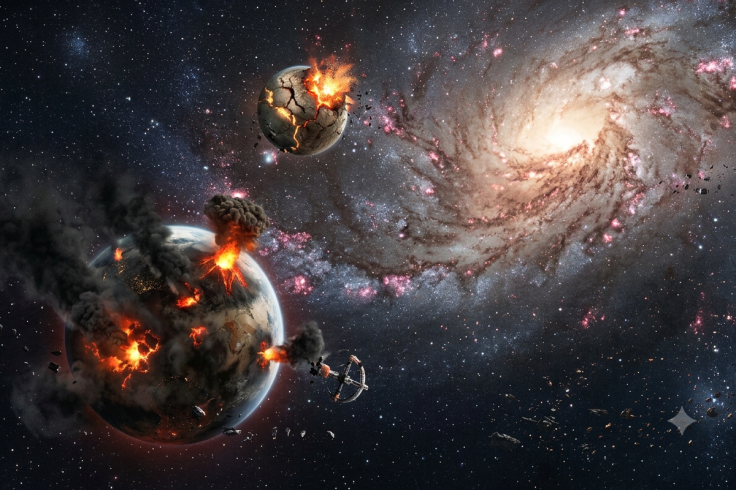
Scientists say the silence of the cosmos may be explained by the possibility that technological civilisations destroy themselves before they ever become easy to find. The idea draws on research into the Fermi paradox, a question that has followed astronomers for decades, namely why, in a universe so vast, Earth still appears to be hearing from nobody.
Alien Theory and the Silent Cosmos
Researchers revisited a familiar cosmic complaint, if life should be common, where is everybody? In a 2021 study in Galaxies, Xiang Cai, Jonathan H. Jiang, Kristen A. Fahy and Yuk L. Yung modelled the Milky Way and found that the probability of self-annihilation was the most influential parameter in shaping the quantity and age of intelligent life. Their simulation suggested that the peak of potential extraterrestrial intelligence sits around 4 kiloparsec (kpc) from the Galactic Centre, roughly 8 billion years into galactic history, while most intelligent life, if it exists, may be young and difficult to detect.
The Fermi paradox is not a new piece of sci-fi wallpaper. It is the old, awkward mismatch between a universe that looks teeming with possibility and a sky that remains stubbornly quiet. Cai and colleagues wrote that they were trying to build a statistical picture of intelligent life over roughly 20 billion years, and they explicitly folded in abiogenesis, evolutionary timescales and the chance of self-annihilation. That last factor is the brutal one, because even a promising civilisation may simply not stay around long enough to shout into the void.
The paper does not claim aliens are definitely out there, nor does it claim they are definitely snuffing themselves out. It argues instead that the balance of probabilities may be less comforting than the usual cheerful assumption that advanced beings inevitably become galaxy-spanning storytellers. In the authors' model, the inner Milky Way is where the action is most likely to be, while the Sun's neighbourhood sits outside the main concentration of potential intelligent life. That leaves us, inconveniently, off to one side.
What the Alien Theory Means
The alien theory also broadens the search problem beyond the old radio fantasy. As our own civilisation has moved from radio to fibre optics, cables and the internet, a truly advanced species could be using communication methods we would barely recognise, let alone decode.
A 2025 preprint by Robin H. D. Corbet, published as 'A Less Terrifying Universe? Mundanity as an Explanation for the Fermi Paradox,' argued that extraterrestrial technology may be far more ordinary than pop culture likes to imagine, with no need for 'super-science' or obvious galaxy-sized engineering.
Maybe civilisations are out there, but they are not blasting the heavens with easy-to-spot signatures. Maybe they are modest, local, and frustratingly unspectacular. Or maybe they are there and then gone, another dead end in the long evolutionary traffic jam. This leaves all three possibilities, and that uncertainty is exactly why the question refuses to die.
Cai's study found that even when the probability of abiogenesis varied, the self-annihilation parameter dominated the results. In plain English, life may start, intelligence may emerge, and still the whole thing could collapse under its own weight. That is the nightmare version of the silent cosmos, and it is not exactly wild to ask whether a species clever enough to split the atom might also be clever enough to vanish itself.
Why the Silence Matters
The most concrete takeaway is not that scientists have found a killer answer, but that the search has become more precise. Cai and his co-authors concluded that potential intelligent life is likely concentrated in the inner Galaxy and that most of it may be too young to detect, while Corbet's later preprint suggested advanced civilisations might simply be too mundane to stand out. Put together, the two ideas point in the same direction, the cosmos may be full of life that is either hidden, fleeting or both.
That is a sobering thought, and a rather mad one too. We tend to imagine contact as a dramatic first conversation, the cosmic equivalent of a phone call from the next room. Civilisations may rise, flicker, falter, and disappear before they ever manage a clear signal, which would make the universe feel less like a stage and more like a graveyard of unfinished attempts.
What happens next is, predictably, a matter for more searching, better models and a great deal more patience. SETI will keep listening, astronomers will keep refining their assumptions, and the silent cosmos will remain silent for now. The annoying part is that silence may not mean emptiness at all. It may just mean nobody lasts long enough to speak.
© Copyright IBTimes 2026. All rights reserved.