

No Raises for 5,100 Workers as CEO Funds AI With Salary Budget — His Own 2025 Pay Topped $16M
Companies are prioritising AI by cutting employee compensation across bonuses, raises, and benefits

Teradata CEO Steve McMillan told the company's 5,100 employees in January that their annual salary rises were being scrapped this year, with the money redirected towards artificial intelligence instead, according to an internal memo first obtained by Business Insider.
'We will fund this AI investment by reallocating the budget from 2026 annual salary adjustments,' McMillan wrote. The memo allegedly said the bulk of spending would go towards scaling the firm's AI capabilities and competing for talent in the AI market.
The decision affects staff at every level of the San Diego-based cloud software company. Two US-based employees who have spent more than a decade at Teradata told the outlet that annual rises typically fall between 2% and 4%, though they are never guaranteed. Workers will still be eligible for performance-based bonuses and equity awards — but the outright freeze on base pay caught many off guard.
Across the wider tech sector, frozen wages and persistent layoff fears have piled another layer of pressure on workers already navigating an unstable job market.
McMillan's Own Pay Topped £12.8M Last Year
The freeze sits uncomfortably alongside the CEO's own earnings. McMillan's total compensation for fiscal year 2025 reached roughly £12.8 million ($16.1 million), per Teradata's proxy filing with the US Securities and Exchange Commission. His base salary stood at £655,000 ($822,616), with a bonus of £828,000 ($1.04 million) and approximately £11.1 million ($14 million) in stock awards stacked on top.
More recently, McMillan sold 20,000 shares of the company's common stock in May, bringing in $634,158, with prices ranging from $31.40 to $32.10 per share.
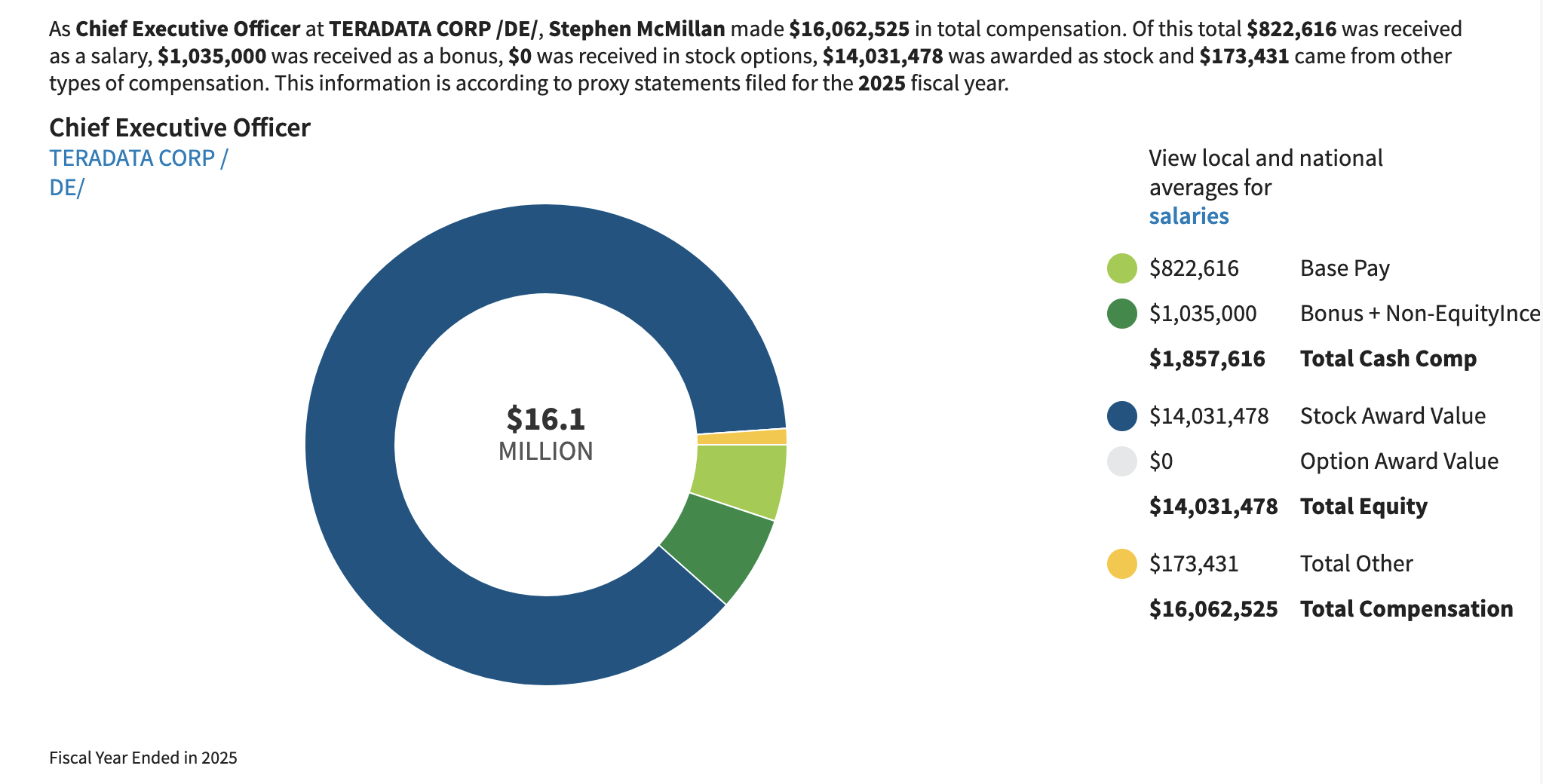
Teradata is hardly short of cash. The company's stock surged more than 40% in a single session on 11 February, hitting a fresh 52-week high after fourth-quarter revenue of £335 million ($421 million) and adjusted earnings per share of $0.74 (£0.59) blew past Wall Street's estimates. As of 4 June, shares traded at around £27.90 ($35), giving the firm a market capitalisation of roughly £2.6 billion ($3.3 billion).
Full-year revenue for 2025 came in at £1.32 billion ($1.66 billion), a decline of nearly 5%. Cloud annual recurring revenue hit £558 million ($701 million), up 15%, while total ARR reached £1.21 billion ($1.52 billion). For 2026, management is guiding for £247 million to £263 million ($310 million to $330 million) in free cash flow. The firm also returned £111 million ($140 million) to shareholders through buybacks last year — all while telling staff there was no room for raises.
McMillan told investors during the Q4 earnings call that Teradata is 'uniquely suited' to support enterprises running agentic AI at scale. On 2 June, the company underscored that commitment by appointing Josh Fecteau to the newly created dual role of Chief Data and AI Officer and Chief Information Officer.
Over Half of US Companies Are Cutting Pay to Chase AI
Teradata's decision sits within a much wider shift. A March 2026 survey by ResumeBuilder.com found that 54% of US companies planned to cut employee compensation by year's end to fund AI, as CFO Dive highlighted. A further 26% had laid off workers for the same reason. The survey polled 866 business leaders.
'Companies are making a clear calculation: AI investment is the priority, and employee compensation is where the budget will come from,' said Stacie Haller, ResumeBuilder's chief career adviser. 'This is not just layoffs. Bonuses, raises, equity, benefits, and base pay are all being cut simultaneously, across industries.'
The pattern extends well beyond one company. Atlassian slashed 10% of its workforce in March, citing AI as a central driver. Block announced plans to shrink headcount from 10,000 to just over 6,000, leaning on automation to fill the gaps.
Companies including Meta, Snap and Cisco have also pointed to AI as a reason for recent workforce reductions, Business Today noted, as the race to deploy the technology forces increasingly difficult trade-offs between investment and payroll.
Three-quarters of those surveyed by ResumeBuilder said they believe AI will deliver a competitive edge, and 74% expect it to drive revenue growth. But Haller warned the gamble has a shelf life — and a cost. 'When the job market shifts back in employees' favour, these companies will find it much harder to attract and retain the people they need.'
© Copyright IBTimes 2026. All rights reserved.