

Zuckerberg Admits Meta's AI Development 'Hasn't Accelerated' Despite Billions Invested and 8,000 Job Cuts
If Meta and rivals can't deliver on AI automation despite huge spending, how reliable are those promises to replace workers soon?
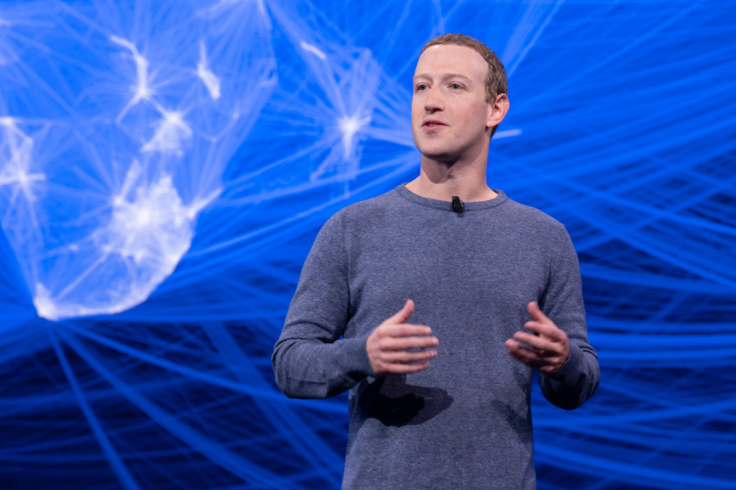
Mark Zuckerberg told Meta staff on 2 July 2026 that the company's AI agents 'hasn't really accelerated in the way that we expected,' four months after he restructured the business and cut roughly 8,000 jobs to chase that acceleration. For anyone told for the past year that a bot is about to do their job, the admission from the tech boss who bet hardest on that future carries a blunt message: the timeline was oversold.
According to a recording of the internal town hall heard by Reuters, Zuckerberg said the bets made during the reorganisation 'haven't come to fruition yet' and that the reshuffle was not as 'clean' as it could have been. He was talking about AI agents, automated systems meant to carry out tasks on a person's behalf. They are the whole premise behind the layoffs, and on his own account, they are running late.
What the Boss Actually Conceded
The candour is the story. Zuckerberg told employees that senior figures had been 'super optimistic' in January and February about how fast AI coding tools such as Anthropic's Claude Code were improving, and that this drove the decision to cut deep and fast. The worry inside the room, he said, was that Meta 'weren't going to move fast enough to adapt.'
So they moved. In May, the company cut about 10% of its global workforce and reassigned roughly 7,000 staff onto AI-focused teams. Zuckerberg had framed Meta as running on two cost centres, compute and people, with headcount bending toward compute. Fewer humans, more chips, faster agents. That was the plan.
The Bill for Getting the Timing Wrong
Here is the number that makes the delay sting. Meta expects to spend up to $145B (£108B) on AI infrastructure this year, a forecast it raised from a $115B to $135B range at its results on 29 April 2026, per Meta's own earnings statement. That is more than it spent on capital projects across 2024 and 2025 combined. Investors noticed: shares fell about 7% in extended trading. The fullest account of the town hall came from the agency that heard it.
Spending that much to make people redundant, then conceding the technology is not ready, is an awkward place for a chief executive to stand. Zuckerberg's answer was patience.
He told staff he expects 'more significant benefits' from Meta's AI investment within three to six months, pointing toward late 2026. He did not say which products would deliver.
Why the People Who Kept Their Jobs Are the Angriest
The reshuffle landed badly with the staff who survived it. More than 1,600 employees signed a petition opposing an internal programme that logged workers' clicks and keystrokes to train Meta's AI models, according to reporting by Wired.
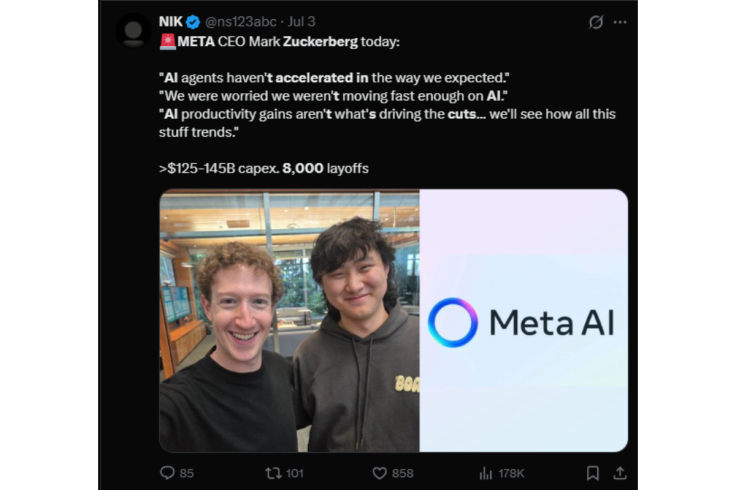
Negative posts flooded the anonymous workplace forum Blind. During one livestreamed all-hands, an employee interrupted to demand that a senior AI executive be told, in unprintable terms, exactly what staff thought of him. Outside the company, the admission travelled fast, in widely shared posts pairing the CEO's words against the layoff count.
Much of the anger sits inside Applied AI, a unit stood up in March with around 6,500 engineers and product managers who had little say in the move. Same pay, worse job, no vote. That combination tends to curdle.
Meta's own chief technology officer, Andrew Bosworth, reportedly called the rollout of that division 'atrocious' in an internal memo. Leadership has since promised better communication, career support, and perks to steady morale. Whether snacks and a manager headcount cap fix a trust problem is another question.
What It Means Beyond Menlo Park
Strip away the corporate detail and a plainer question sits underneath, the one that reaches a reader's own desk. If the company, spending $145B a year, with the pick of the industry's engineers, cannot make AI agents replace workers on schedule, how solid was the promise that they soon would?
Rivals, including OpenAI, Google, and Anthropic, have made the same bet. Zuckerberg is the first at that level to admit the technology has not kept pace with the spending.
None of this means the agents are a dead end. Meta's ad business already uses AI to lift prices and engagement, and a few months is not long to wait. But for now, the most expensive attempt to automate human work has produced a CEO asking shareholders and staff to hold on.
© Copyright IBTimes 2026. All rights reserved.