

US Plans To Resist Binding Killer Robot Rules, Even After UN Chief Calls These AI Weapons 'Merciless'
Washington favours non-binding guidelines as Guterres urges a treaty and Russia disrupts Geneva talks
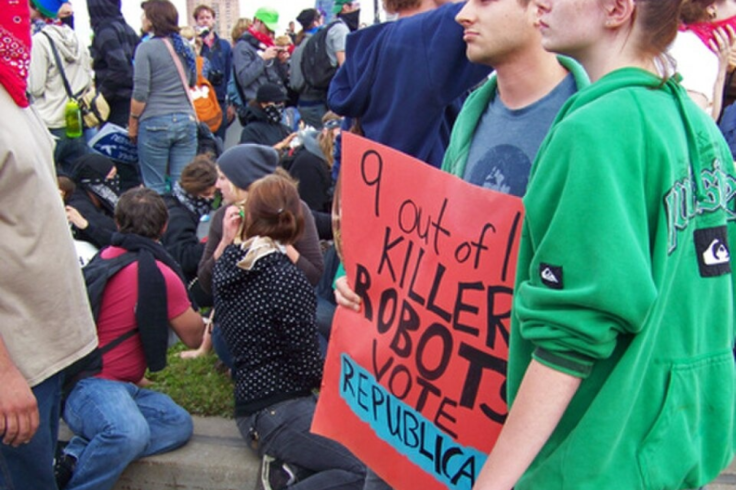
The United States has signalled its opposition to legally binding international rules on lethal autonomous weapons, favouring non-binding guidelines instead, even as UN Secretary-General António Guterres urged governments to curb what he called 'merciless' killer robots.
Talks in Geneva stalled on their opening day after Russia blocked the agenda, leaving the prospects for a treaty on AI-driven weapons uncertain.
Washington Backs Guidelines Over a Treaty
The US, Russia and Israel have signalled that they will oppose binding rules, NPR reported from Geneva. Washington has instead proposed drafting non-binding guidelines, a process that would take five years under the US plan.
That puts the US at odds with a large bloc of nations. At least 50 countries, including Ireland, Italy, Brazil, Mexico, France and Germany, are calling for a strict timetable for negotiating binding rules, according to NPR.
NPR also pointed to recent remarks by Secretary of State Marco Rubio, who warned against 'quoting laws to men with swords' in a speech to the Federalist Society. He was not speaking specifically about autonomous weapons.
Guterres Warns of a 'Moral Red Line'
Guterres addressed the opening session in Geneva on Monday, 16 November, speaking to the 128 High Contracting Parties to the Convention on Certain Conventional Weapons (CCW) in a video message. 'Take action to prevent the use and spread of these merciless weapons,' he said, calling for 'a legally binding instrument to regulate autonomous weapon systems.'
He warned that allowing fully autonomous weapons to kill would mean 'crossing a moral red line', NPR reported.
Experts say there is no evidence yet that fully autonomous lethal weapons are in use, DPA reported. However, AI-assisted weapons have already been deployed in Ukraine and Gaza, according to NPR.
These systems remain subject to human control, unlike weapons that could select and attack targets on their own. Ukrainian civilians have described feeling 'hunted' by drones while shopping or going to school, NPR reported.
Georgia Haines, a legal adviser at the International Committee of the Red Cross, warned that such systems struggle with context. 'The risk is that, based on the technology we are seeing, they are not able to understand in the same way,' she told NPR, adding that 'the risks are incredibly high that there will be a misidentification of a target.'
Human rights groups have also warned that the spread of these weapons could put them in the hands of terrorist groups or repressive governments.
Russia Stalls Opening Session
The Geneva meeting ran into trouble before substantive talks could begin. Russia blocked adoption of the agenda by demanding that observers speak only at the end of the session, DPA reported. No other state backed the demand, and the session was adjourned.
Adopted in 1980, the CCW prohibits or restricts certain conventional weapons considered excessively injurious or indiscriminate. It has hosted discussions on lethal autonomous weapons for more than a decade but has no specific protocol governing them.
A Russian representative also accused the European Union of making 'politically motivated statements'.
Despite the impasse, a decision on whether to authorise formal negotiations on a binding instrument could come by Friday, 20 November, according to DPA, though any outcome remains uncertain.
The CCW review conference meets once every five years, NPR noted, meaning the outcome of this week's talks could shape the debate for years.
© Copyright IBTimes 2026. All rights reserved.