

New Analysis of Trump's Speeches Finds More Profanity and Rambling as Questions About Age Persist
Analysis says Trump's profanity has doubled and rambling increased, renewing questions over the 80-year-old president
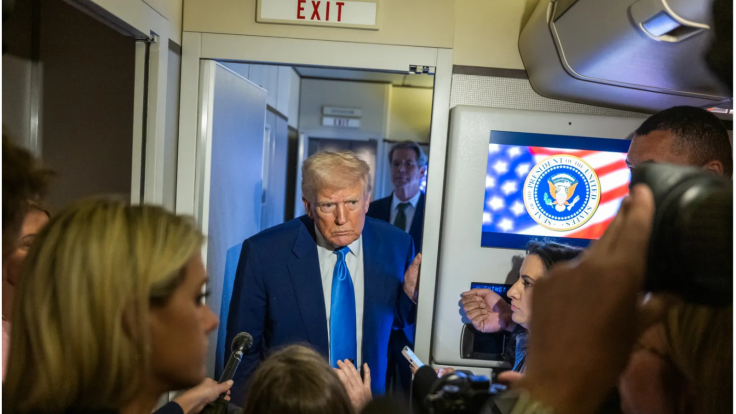
A new analysis of Donald Trump's public remarks has found a sharp increase in profanity and more rambling speech compared with his first presidential campaign, as scrutiny of the 80-year-old president's age and communication style continues. Published on Sunday, 1 November 2026, the review examined Mr Trump's recent language against speeches dating back to 2015.
For context, the New York Times examined thousands of speeches, interviews, social media posts and schedules. Its findings showed measurable changes in Mr Trump's vocabulary and speaking patterns since his first presidential campaign.
The 80-year-old president reportedly uses more profanity and absolute expressions, while some passages have become harder to follow. However, the findings do not establish whether these changes reflect a medical condition or deliberate rhetorical choices.
Profanity in Trump's Speeches Rises Sharply
The most striking numerical shift concerns swearing. According to the Times, Trump now uses approximately 15 swear words for every 10,000 words he speaks, compared with six a decade earlier.
That comparison matters because it measures frequency rather than simply counting offensive remarks across speeches of different lengths. It suggests the change cannot be explained merely by the president speaking more often.
The analysis also identified an increase in language presenting events as entirely successful or disastrous, with little room between those extremes.
Trump used such expressions almost 20 per cent more frequently than a decade ago and roughly five per cent more than in 2024.
Experts cited in the reporting said these patterns can be associated with ageing and changes in cognitive functioning. Association is not proof, however, and individual speaking habits cannot establish a medical diagnosis.
Nor does profanity automatically demonstrate diminished judgement. Politicians sometimes use provocative language to energise supporters, challenge critics or command attention. The analysis measures how Trump's words have changed, not precisely why.
AI Review Fuels Fresh Scrutiny of Rambling
The Times examined more than 6,500 passages using an artificial intelligence model to assess rambling and incoherence. The assessment followed criteria informed by human review, rather than relying on an automated impression alone.
That method gives the findings a broader base than any isolated clip circulating online. It also has limits. A model evaluating speech patterns cannot determine a speaker's health, intentions or state of mind.
Trump has long relied on digressions and improvised remarks at public appearances. The question raised by the review is whether those familiar habits have become more pronounced as he has grown older.
Former ABC journalist Terry Moran offered one explanation during an October appearance on the Daily Beast podcast. He argued that Trump was less effective at holding audiences with spontaneous material than he once was.
Moran said the president previously had a sharp instinct for finding what excited a crowd. 'And now he droned,' he said, suggesting swearing serves as a substitute.
It is a pointed assessment, but it remains Moran's opinion rather than a clinical evaluation. Distinguishing an observer's criticism from evidence of cognitive impairment is essential when examining a president's behaviour.
Reporter Clash Highlights Tensions Over Stamina
The scrutiny extends beyond the statistical review. On Thursday, 29 October, Trump confronted Reuters correspondent Jacob Bogage after being questioned about cancelled campaign appearances in Kansas and Iowa.
Bogage asked whether the president's travel schedule had become tiring. Trump responded by attacking the reporter's appearance and fitness, saying, 'You look like hell.'
The president subsequently shared Bogage's photograph on Truth Social, repeating the insult. The exchange illustrated the combative language highlighted in the wider analysis, although one confrontation cannot explain a decade-long statistical trend.
The events in Kansas and Iowa were subsequently rescheduled, according to the Daily Beast. Questions about the cancellations nevertheless prompted another public confrontation over Trump's stamina.
In another recent appearance, Trump discussed the physique of Ohio senator Jon Husted, a former college football player. He told supporters he had examined Husted's body and made a remark about his backside.
Neither episode proves anything about the president's cognitive health. Both show why his public comments have become a focus of renewed attention alongside the quantitative research.
© Copyright IBTimes 2026. All rights reserved.