

Trump's Health Under Scrutiny After Visible Neck Mark and Sudden Exit from Medal of Honour Ceremony
A president who says he never gets bored now faces a public that cannot look away from every bruise, stumble and scab.

Donald Trump's health was under renewed scrutiny on Monday, March 2, after the 79-year-old US president appeared with a dark red scab-like mark on his neck and stumbled over his words during a Medal of Honour ceremony at the White House, before abruptly leaving without taking questions.
Trump has faced persistent questions about his fitness for office in recent months, fuelled by images of severe bruising on his hands and apparent efforts to conceal the discolouration with make-up during a televised meeting with Ukrainian president Volodymyr Zelensky in December. The White House has repeatedly dismissed any suggestion of serious illness, but each new appearance now gets picked over in forensic detail by reporters and online commentators.
Visible Neck Scab and Slurred Line Spark Rumours
On Monday, the president arrived more than 40 minutes late to the East Room event, where he was due to present the Medal of Honour to military personnel. Photographs and broadcast footage showed a dark red patch stretching across the right side of Donald Trump's neck, immediately prompting fresh speculation.
White House doctor Sean Barbabella moved quickly to frame the mark as benign. In a statement, he said: 'President Trump is using a very common cream on the right side of his neck, which is a preventative skin treatment, prescribed by the White House Doctor. The President is using this treatment for one week, and the redness is expected to last for a few weeks.'
Scabs and redness now join a growing catalogue of visible ailments, alongside the discoloured hands that were again evident as he handed the medals to the honourees. None of these signs has been linked to any confirmed diagnosis beyond what the administration itself has volunteered, and there is no independent medical assessment in the public domain. That uncertainty means every new blemish is read as a clue.
The ceremony itself did little to calm nerves. As Trump attempted to honour the final recipient, he appeared to stumble and slur while reading from the teleprompter. 'Finally, we honour one more soldier, a fallen warria of world... of wars,' he said, according to the Mirror, tripping over the prepared text.
Taken in isolation, a mangled phrase at a lengthy event might not merit much attention. Set alongside the visible skin issues, the chronic venous insufficiency previously disclosed by the White House, and his age, the moment fed a narrative of a president under physical strain.

White House Dismisses Fears as Trump Goes Off Script
The news came after weeks of the administration batting away questions about Trump's earlier hand bruising. At the time, press secretary Karoline Leavitt insisted there was a mundane explanation.
Leavitt said the marks were the result of 'consistent' irritation from 'frequent handshaking and the use of aspirin.' She also confirmed that the president had been diagnosed with chronic venous insufficiency, a condition that affects blood flow in the veins, but insisted it had not forced any change in his daily life.
'Look, you see the president every day,' she told reporters then. 'He's moving, he's working. There have been no adjustments made to his lifestyle.'
So far, the White House has treated each flare-up of concern as a communication problem rather than a medical one. There has been no suggestion from officials that Trump is unable to carry out his duties, and no formal indication of cognitive decline. That said, no detailed, independent medical report has been released to settle the question definitively, so much of the current speculation should be taken with a grain of salt.
Monday's event also showed the other side of Trump's public persona, that of an improviser happy to wander away from the script. Midway through the military ceremony, he broke off to talk at length about his controversial ballroom project, which will alter the structure of the White House.
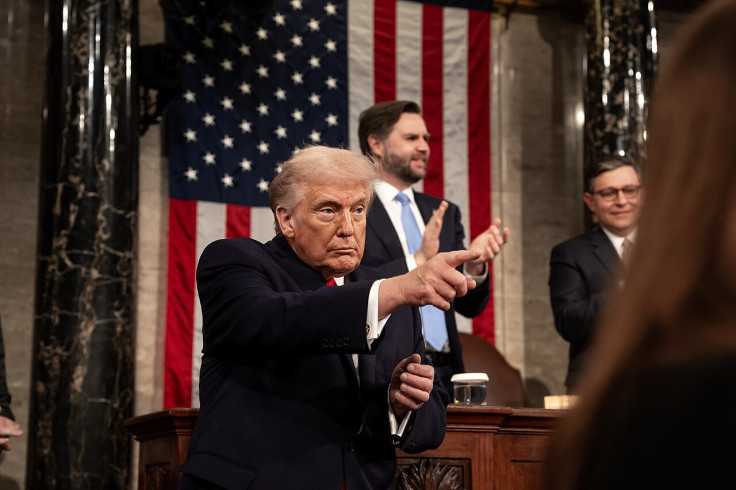
'See that nice drape? When that comes down right now you see a very very deep hole, but in about a year and half you're gonna see a very very beautiful building,' he said, gesturing as he spoke.
'And there's your entrance to it right there. In fact, it looks so nice I think I'll leave it and save money on the doors. I picked those drapes,' he continued. 'I always liked gold. I believe it will be the most beautiful ballroom anywhere in the world.'
To supporters, this kind of riff is familiar and harmless. To critics already watching his every movement for hints of decline, it looked like distraction at best, confusion at worst.
The president also addressed US-Israeli military action against Iran that resulted in the death of Supreme Leader Ali Khamenei. War Secretary Pete Hegseth had earlier told a press conference that the joint operation, dubbed 'Operation Epic Fury,' would wrap up within weeks.
Trump appeared to stretch that timetable, saying the United States was prepared to keep going. 'We have right from the beginning projected four to five weeks, but we have capability to go far longer than that,' he said.
'We'll do whatever. Somebody said, "the president will get bored." 'I don't get bored. There's nothing boring about this.'

The contrast between a president insisting he is energised by war planning and the same man stumbling through a tribute to a fallen soldier is exactly the kind of split-screen moment that keeps the health questions alive. When Trump then left the room without taking questions from journalists, the queries simply followed him into the corridors.
© Copyright IBTimes 2026. All rights reserved.