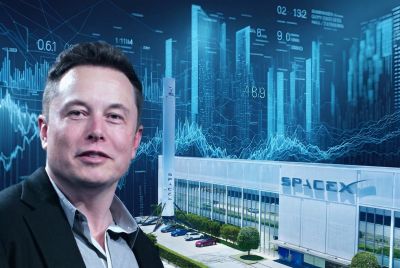
Elon Musk Sparks $2 Trillion IPO Panic After His Own Tweet Blows Hole in SpaceX and xAI Money Claims
Musk's clarification on revenue assumptions challenges the $2 trillion valuation narrative
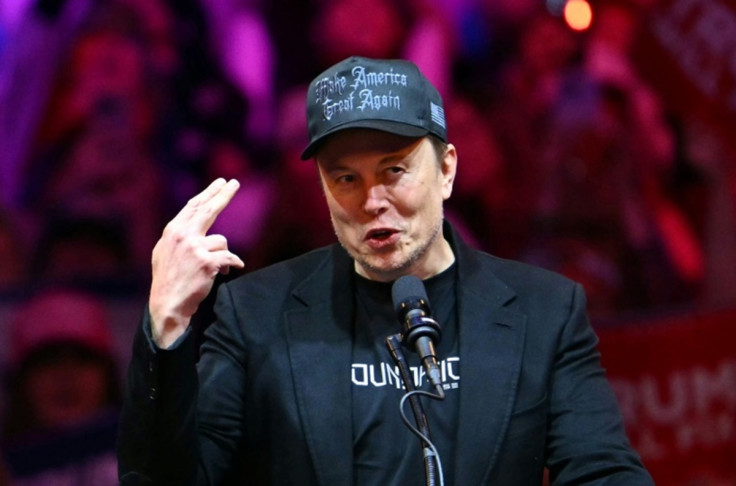
Elon Musk has ignited fresh market chaos after a single social media post cast doubt on major revenue assumptions tied to SpaceX and xAI, fuelling what analysts are calling a credibility shock around a proposed $2 trillion valuation (£1.58 trillion).
Musk's Reply Reversing Billion Dollar Revenue Expectations
The turmoil began after claims circulated that xAI infrastructure, particularly its Colossus data centre operations, could generate as much as $45 billion (£35.3 billion) over three years from leasing compute power to AI firms including Anthropic. This figure quickly spread as a cornerstone of bullish IPO projections, strengthening the narrative that Musk's combined ventures were sitting on stable, long-term revenue streams.
However, Musk's own response disrupted that assumption. In his post, he stated that SpaceX has not committed to a multi-year leasing arrangement, describing the deal instead as a short-term 180-day structure with a 90-day mutual cancellation option.
While he added that extensions were possible, the clarification immediately weakened perceptions of guaranteed income. For investors, what looked like predictable cash flow suddenly appeared conditional, reversible and far less secure than first reported.
As the recently expanded partnership with @AnthropicAI demonstrates, @SpaceX is offering AI compute as a service at significant scale.
— Elon Musk (@elonmusk) May 20, 2026
We are in discussions with other companies to do the same.
Over time, especially with orbital data centers, we expect to serve AI at extremely…
Anthropic Deal Questions
Further scrutiny has focused on the nature of the reported relationship with Anthropic, an AI competitor that allegedly agreed to rent computing capacity despite also operating in the same rapidly evolving sector. Documents circulating in industry reports suggest complex arrangements involving short-term leases and flexible exit clauses, raising questions over how much revenue can realistically be locked in.
Adding to investor unease, internal leaks also referenced broader procurement networks involving firms linked to Turkey, the United Arab Emirates and China in related supply chains for AI and energy infrastructure. While not directly confirming wrongdoing, the overlapping commercial ties have contributed to a perception of opaque revenue forecasting.
Critics argue that the situation exposes a wider issue in AI valuation culture, where projected earnings are often treated as near certainty despite being highly dependent on rapidly shifting contracts, compute demand and geopolitical constraints. In this case, Musk's clarification has been interpreted as a reminder that headline figures may not reflect durable financial reality.
SpaceX Potential Compute Business
— John Tinsman (@JohnTinsman) May 27, 2026
XAI spent $3-4 billion on Colossus I.
They are leasing it out for $45 bil of 3 years to Anthropic.
SpaceX is finishing a 1 gigawatt Colossus II for around $17 billion with plans for multiple more.
It seems like SpaceX could lease out Colossus… https://t.co/PhBJ57BHEh
SpaceX has not committed to leasing Colossus for years, although it’s possible that may be what happens.
— Elon Musk (@elonmusk) May 28, 2026
This is a 180 day lease with 90 day notice mutual cancellation thereafter. The short term was our request, not Anthropic’s.
We won’t leave them hanging and will provide a…
The controversy has also drawn attention to IPO 'quiet period' expectations, where senior executives are typically discouraged from making public statements that could influence investor sentiment. Legal experts note that enforcement in modern markets is inconsistent, particularly when high-profile figures communicate through social media rather than formal filings.
Former US Securities and Exchange Commission officials have previously warned that informal communication channels can blur the line between commentary and market-moving disclosure. In this case, Musk's post has been interpreted by some analysts as effectively resetting expectations around revenue stability at a sensitive moment in the IPO process.
Market watchers say this creates a difficult environment for pricing any offering near the $2 trillion mark, especially if key revenue assumptions remain fluid. The result is a widening gap between promotional valuations and verifiable long-term contracts.
The Pressure Behind The Trillion Dollar Narrative
Beyond the immediate IPO debate, the situation highlights broader tension across the AI and space sectors, where massive capital requirements collide with uncertain monetisation timelines. SpaceX continues to face operational scrutiny following rocket test setbacks, while xAI is competing in an increasingly crowded AI infrastructure race dominated by firms such as Anthropic and OpenAI.
At the same time, industry analysts warn that investor enthusiasm for AI has begun to resemble earlier tech cycles where expectations outpaced delivery. Large-scale compute leasing, satellite systems and defence-adjacent contracts are all capital intensive and often dependent on government or long-term commercial stability that is not yet guaranteed.
The result is a fragile narrative supporting the $2 trillion IPO outlook. Musk's tweet has not only challenged specific revenue claims but also reignited debate over whether the broader valuation ecosystem surrounding AI and space ventures is running ahead of financial reality.
© Copyright IBTimes 2026. All rights reserved.
- Recommended For You