'Still Hearing Voices': War-Damaged Tower Collapses on Ten Families in Gaza City, Killing 21
'We are still hearing voices': rescuers race against time as families remain trapped beneath Gaza rubble
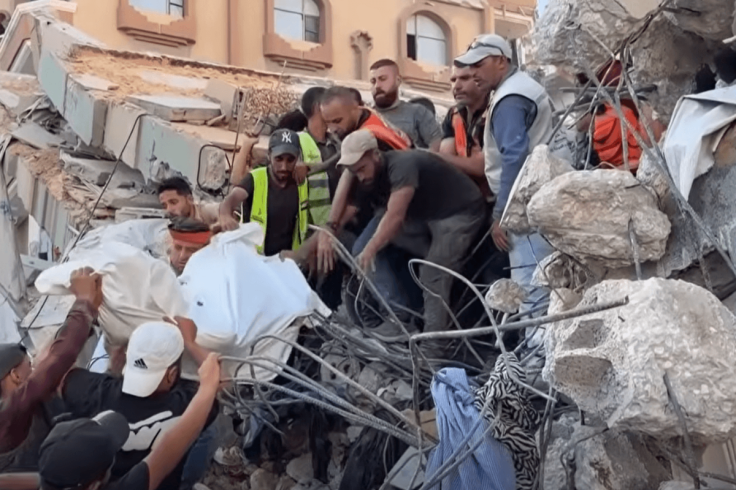
'We are still hearing voices from under the rubble, so there is still hope to find people.'
The words from Raed al-Dahshan, director of Gaza City's Civil Defence service, came as rescuers clawed through the remains of a bomb-damaged apartment building that collapsed overnight in Gaza City.
Twenty-one people were eventually confirmed dead, while 45 others were rescued from the rubble, according to Palestinian officials cited by Reuters. The building had housed more than 110 people, many of whom had nowhere else to go.
The six-storey building in the Tal al-Hawa area had previously been damaged by Israeli strikes and was considered unsafe. At least 10 families were nevertheless living inside it, according to Dahshan.
Then, shortly after 3am, the weakened structure suddenly gave way. A nearby resident told Reuters that the building collapsed into rubble in less than 10 seconds.
A damaged building in Gaza City housing about six displaced families collapsed on Wednesday, killing at least 21 people and injuring more than 25 https://t.co/TFbmFbz3kB
— The National (@ScotNational) September 16, 2026
Voices Beneath the Rubble
The rescue operation quickly became a race against time.
Dahshan said voices could still be heard beneath the wreckage, raising hopes that people trapped inside might survive. But the teams searching for them faced a devastating obstacle: they lacked sufficient heavy machinery to clear the debris quickly.
Alessandro Mrakic, head of the UN Development Programme's Gaza office, said the shortage was so severe that people were digging through the rubble with their bare hands.
UN agencies and an Egyptian relief team were involved in the rescue effort, while heavy machinery was later used to clear the concrete and debris.
Rescuers Dig With Bare Hands
The scale of the disaster was enormous. More than 110 people had reportedly been living in the building, while dozens were initially believed to be trapped beneath it.
The rescue teams eventually pulled 45 people alive from the wreckage. But 21 people died, including eight children, according to a Palestinian Civil Defence official cited by Reuters.
The danger did not end with this building.
Mrakic said around 400 other buildings were considered at risk of collapse. Separately, estimates have put the number of structurally compromised buildings across Gaza at around 2,000, reflecting the wider danger facing families living in unsafe structures.
Why Families Stayed
The families inside the building had been warned about its condition, but finding somewhere safer was far from straightforward.
Residents told reporters that displaced people were being pushed towards damaged buildings due to a shortage of tents, land and other accommodation. One survivor told Reuters that his family had moved into the damaged building because they could not find other shelter.
That helps explain why a building already weakened by war was still occupied when it collapsed.
The latest disaster has therefore exposed a brutal cycle: homes are destroyed, families are displaced, damaged buildings become makeshift shelters, and those same structures can later become deadly traps.
A Crisis Beyond One Collapse
The building's destruction also highlights the difficulties facing Gaza's rescue and reconstruction efforts.
Palestinian and UN officials have called for more heavy machinery, fuel, engine oil and spare parts, while attributing shortages of rescue equipment to restrictions on what can enter Gaza. Israel says its restrictions aim to prevent equipment from reaching militants.
For those pulled from the rubble, the immediate rescue may have ended. But many survivors were left without the shelter they had already been struggling to find.
And with hundreds, potentially thousands, of damaged buildings still considered dangerous, the collapse in Tal al-Hawa is another warning of the risks facing Gaza's displaced population.
© Copyright IBTimes 2026. All rights reserved.
- Recommended For You