

Can Doctors Diagnose Donald Trump From Video Clips? The Goldwater Rule and the $75,000 Libel Case Behind It
A 1964 magazine poll sent to 12,356 psychiatrists led to the rule, which binds members of one US body alone

Psychiatrists in the American Psychiatric Association (APA) may not give a professional opinion on Donald Trump's mental health from video clips. Their ethics code's Goldwater Rule requires an examination and permission before any such opinion. The American Medical Association advises all doctors in the media against diagnosing unexamined public figures.
The rule grew out of a 1964 survey on Senator Barry Goldwater, who sued for libel and won $75,000 (about £56,000) in punitive damages. On 20 September, psychiatrist Bandy Lee called parts of Trump's conduct pathological. Psychologist John Paul Garrison argues on YouTube that footage may show neurological problems. Neither has examined him.
How One Magazine Survey Ended in Court
Fact magazine publisher Ralph Ginzburg asked 12,356 psychiatrists whether Goldwater was psychologically fit to be president. Of the 2,417 who replied, 1,189 said the senator was unfit. Those figures come from an analysis in the Journal of the American Academy of Psychiatry and the Law. The rest called him fit or said they did not know enough to judge. As the chart below shows, the cover's claim rested on fewer than one in ten respondents.
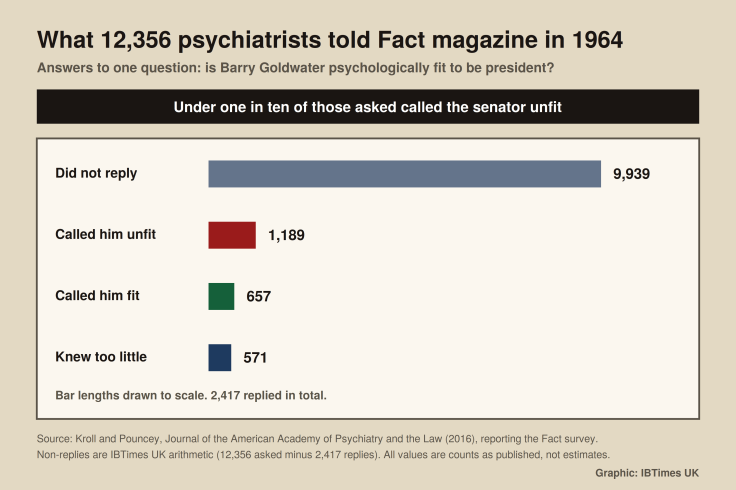
A New York federal jury sided with Goldwater against Ginzburg and Fact in 1966, putting two-thirds of the punitive award on the magazine. Warren Boroson, the managing editor who suggested the poll, had quit before publication. He paid a token 33 cents (about 25p). Jacob Appel, a Mount Sinai ethics educator, said in Boroson's 2023 obituary in The Boston Globe that Boroson's work had 'the unintended consequence of muzzling psychiatrists like me today.'
Who the Rule Covers
The APA made the rule Section 7.3 of its Principles of Medical Ethics in 1973, in the code's first edition. That section lets members talk about psychiatric issues in general terms. It calls a professional opinion about someone in the public eye unethical, though, unless the psychiatrist has examined them and has proper authorisation. In March 2017, the association's ethics committee stated the rule covers every professional view, not only a diagnosis.
Psychologists such as Garrison sit outside the rule. Yet the American Psychological Association's president wrote in 2016 that its ethics code warns psychologists against diagnosing public figures they have not examined. IBTimes UK could not establish whether Lee belongs to the psychiatric association. That year, emeritus psychiatry professor Jerome Kroll and scholar Claire Pouncey called the rule 'an excessive organisational response to what was clearly an inflammatory and embarrassing moment' for American psychiatry.
What Trump's Medical Report Shows
Trump, who turned 80 in June, had a physical examination at Walter Reed National Military Medical Center on 26 May. Navy Captain Sean Barbabella, the White House physician, wrote that the president scored 30 of a possible 30 on the Montreal Cognitive Assessment. That short test screens for memory and thinking problems.
The White House has rejected remote assessments of the president. In a May statement, spokesperson Davis Ingle said medical professionals engaging in 'armchair diagnosis or false speculation for political purposes' were breaking the Hippocratic Oath. Barbabella's memo rests on an in-person examination, though the president approves what the White House releases about his health.
© Copyright IBTimes 2026. All rights reserved.