Trump Administration Mocked in New Guerrilla Video Game 'Operation Epic Furious: Strait to Hell'
An anonymous art collective has installed playable cabinets on the National Mall, featuring a pixelated Trump on a quest for Diet Coke while 'rocking' Iran

The Trump administration's guerrilla video game installation on the Washington, D.C., National Mall has triggered a fresh wave of debate over the use of interactive media as political protest art.
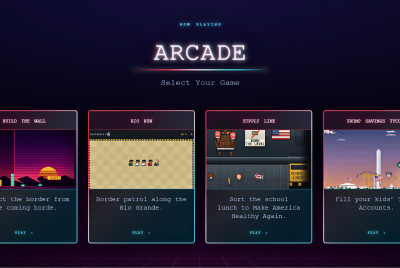
On 11 May 2026, an anonymous satirical art collective known as Secret Handshake erected three functional arcade cabinets at the DC War Memorial, inviting passersby to play 'Operation Epic Furious: Strait to Hell'.
The 16-bit title serves as a scathing parody of the ongoing conflict with Iran, portraying the President and his inner circle in a pixelated quest for oil and 'pixelated patriotism'.
Strategically placed near the Reflecting Pool, the installation has already gone viral, blending retro gaming aesthetics with high-stakes political commentary. This guerrilla project is the latest in a series of provocative works designed to ambush the capital's political establishment with surrealism and satire.
Set near the DC War Memorial on the National Mall, just south of the Reflecting Pool, the installation features three fully working arcade cabinets. What looks at first like a nostalgic throwback to classic gaming quickly turns into a looping political experience where satire, war rhetoric, and absurd humour collide.
The anonymous artists responsible for satirical art installations aimed at the Trump administration struck again this week with a pop-up video game titled “Operation Epic Furious: Strait to Hell.” https://t.co/VpJ8cl8d8p pic.twitter.com/l7f2KO27k3
— The Washington Post (@washingtonpost) May 13, 2026
A War Game With No Ending, and No Escape
The 'Operation Epic Furious: Strait to Hell' video game takes the structure of a 16-bit role-playing game and twists it into something deliberately unresolved. Players move through missions that parody political conflict between the United States and Iran, but there is no final-victory screen.
That absence is what has drawn the most attention. Instead of a traditional win-or-loss condition, the game loops endlessly, leaving players trapped in a cycle that never resolves.
One visitor described the experience by saying, 'I couldn't tell if there was something I was missing or if that was done on purpose'. That uncertainty now sits at the heart of the installation's viral appeal.
It is this design choice that has led many to call it the war game that won't let you win, not because it is difficult, but because it refuses closure altogether.
NEW: Secret Hanshake has put up a functioning arcade on the National Mall mocking Operation Epic Fury.
— Aaron Parnas (@AaronParnas) May 11, 2026
The arcade games are fully playable and you can pretend to be Donald Trump throughout the game.
"Operation Epic Furious" pic.twitter.com/oZHPtSZeRe
Inside the Chaos of Operation Epic Furious
The 'Operation Epic Furious Strait to Hell' video game mixes political satire with surreal gameplay in a way that feels closer to internet culture than traditional protest art.
A pixelated version of Donald Trump is portrayed initiating a fictionalised war scenario involving Iran. Along the way, players encounter bizarre side quests that break any expectation of seriousness, including finding a Big Mac, tracking down a Diet Coke, and navigating exaggerated political encounters.
Key political figures appear throughout the experience, including Vice-President JD Vance, Health and Human Services Secretary Robert F. Kennedy Jr., first lady Melania Trump, and FBI Director Kash Patel. Even global references such as Pope Leo are woven into side missions, adding to the deliberately chaotic tone.
One of the most discussed prompts asks players, 'Ready to ROCK Iran back to the Stone Ages?', a line tied to rhetoric attributed to Donald Trump regarding Iran. Players are then given stark choices such as 'Yes' or 'Hell Yes', reinforcing the game's satirical framing of escalation language.
Despite the war setting, the creators reportedly removed guns and shooting mechanics entirely. The focus is not combat, but commentary, especially on how political messaging is packaged and repeated in digital spaces.
Secret Handshake and the Rise of Guerrilla Political Art
The installation is credited to the Anonymous satirical art collective Secret Handshake, a group that has become increasingly known for guerrilla art installations that Washington DC National Mall visitors encounter without warning.
Their previous works include a gold-painted toilet placed near the Lincoln Memorial and statues referencing Donald Trump alongside Jeffrey Epstein, installations that sparked intense public reaction and political discussion.
Each project builds on the last, escalating both scale and controversy. This latest shift into interactive media marks a significant evolution, moving from static sculpture to playable political satire.
The group reportedly uses intermediaries to obtain permits from the National Park Service, allowing its installations to temporarily occupy high-profile federal spaces.
When Video Games Become Political Messaging Tools
The rise of political video game protest art reflects a broader cultural shift in which games are no longer just entertainment but vehicles for messaging, critique, and persuasion.
Experts studying media and digital culture, including University of Notre Dame professor Matthew Thomas Payne, have noted that governments have long used gaming aesthetics to shape narratives around military action.
The White House has previously shared edited video content on platforms like X, blending real-world military footage with visuals reminiscent of games like Call of Duty and Halo. This installation flips that logic. Instead of promoting or sanitising conflict, it distorts it, loops it, and removes resolution entirely. The result is a digital experience that feels intentionally uncomfortable, forcing players to sit inside repetition rather than resolution.
The Trump administration guerrilla video game has already reached over 14,000 players through its online browser version, proving that the impact of guerrilla art extends far beyond the physical boundaries of the National Mall.
As the line between digital entertainment and political reality continues to blur, projects like 'Operation Epic Furious' force the public to confront the packaging of modern warfare. For now, the three arcade cabinets remain at the War Memorial, a glowing reminder of the chaotic intersection of politics and play in 2026.
© Copyright IBTimes 2026. All rights reserved.
- Recommended For You