Donald Trump Admits He 'Took A Break' From The Iran War After Being Grilled Over Failed Six-Week Victory Timeline
President Trump defends extended Iran conflict timeline, citing strategic pause amid growing scrutiny.

Donald Trump has admitted to taking a 'break' from the Iran war to explain why the conflict has now stretched well past his administration's original four-to-six-week victory timeline.
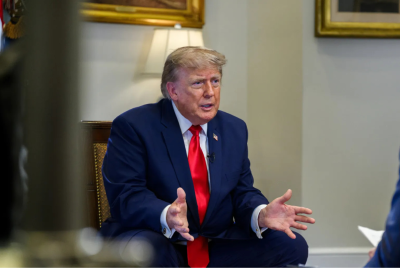
The president made the admission during a press exchange in the Oval Office on 23 April 2026, when a reporter pressed him on why Operation Epic Fury, launched on 28 February, remains unresolved nearly eight weeks on.
Trump, who had repeatedly and publicly projected a short, sharp victory over Iran, claimed the pause was intentional and strategic, not a failure of planning. The exchange quickly became acrimonious, with Trump telling the reporter 'You're such a disgrace' before insisting he remained firmly in control of the conflict's pace.
Trump's 'Break' Claim and the Oval Office Confrontation
When a reporter told Trump on 23 April that 'it's been eight weeks that the US now has been involved with Iran,' and reminded him of his administration's earlier four-to-six-week forecast, the president did not dispute the timeline had been missed.
'Well, I hoped that, but I took a little break,' Trump told reporters. 'I gave them a break.' The remark drew immediate scrutiny, as it implied the pause to broker a ceasefire counted against the military clock, rather than representing a gap in the original forecast.
Trump had also falsely claimed during the same session that the US had been involved with Iran for only 'five and a half weeks,' when 23 April marked day 55 of the conflict, placing it one day short of the full eight-week mark.
The reporter corrected him directly on the record. Trump then shifted to defend his handling of the war on its own terms, saying: 'I took the country out militarily in the first four weeks. Now what we're doing is sitting back and seeing what deal, and if they don't make a deal, then I'll finish it up militarily.'
When a separate reporter asked how long he was willing to wait for a response from Iran, Trump's tone shifted further. 'Don't rush me,' he said. 'We were in Vietnam for like 18 years; we were in Iraq for many, many years.' The comparison to protracted American wars, framed as a defence of patience, stood in sharp contrast to the swift resolution Trump and his team had promised at the outset.
How the White House's Own Timeline Unravelled
The original timeline was set by Trump himself. On 1 March 2026, the day after the US and Israel launched strikes on Iran, Trump told The New York Times: 'Well, we intended four to five weeks.' The following day, he reiterated at a White House ceremony that the projection was 'four to five weeks, but we have capability to go far longer than that.'

Defence Secretary Pete Hegseth offered a slightly wider range at a Pentagon press briefing on 4 March, telling reporters: 'You can say four weeks, but it could be six, it could be eight, it could be three. Ultimately, we set the pace and the tempo.' The upper bound Hegseth cited, six weeks, is what anchored much of the subsequent reporting and public scrutiny, and what the 23 April Oval Office exchange was broadly premised upon.
Between those early statements and late April, Trump's public assessments shifted markedly and often. On 11 March, he described the war as 'an excursion that will keep us out of a war.' By 17 March, he told reporters that Iran 'was essentially largely over in two or three days.' He declared victory at a Kentucky rally on 11 March, saying: 'We won. We won the -- in the first hour, it was over.' Then, in the same breath, conceded: 'We got to finish the job, right?' The contradictions mounted week by week.
The Naval Blockade and a Strait Still Closed
The conflict has grown significantly in scope since the ceasefire brokered by Pakistan, which began on 8 April. After what Trump described as the failure of talks in Islamabad, he announced a naval blockade of Iran beginning 13 April. Iran, in response, has continued to dispute control of the Strait of Hormuz, through which an estimated 20 per cent of global oil supply passes. On 18 April, Tehran announced it had again closed the strait, citing the US refusal to lift the blockade.
On 23 April, Trump posted on Truth Social that the US Navy had the strait 'Sealed up Tight,' and separately ordered the Navy to 'shoot and kill' any Iranian boat found placing mines. In the Oval Office session, he said he personally blocked an earlier Iranian offer to reopen the strait because it would have allowed Tehran to earn an estimated $500 million (approximately £397 million) a day in oil revenue. 'I said, wait a minute if we open the strait that means they're going to make $500 million a day,' Trump said. 'I don't want them to make $500 million a day until they settle this thing.'
On 20 April, US forces fired on and seized an Iranian-flagged cargo ship, the M/V Touska, in the Gulf of Oman after it attempted to pass the naval blockade. Iran's Red Crescent Society said the vessel was carrying medical supplies for dialysis patients and called the seizure a violation of international law. US Central Command had not issued a formal response to that characterisation at the time of publication.
Trump has also claimed, without independent verification, that he intervened to prevent the execution of eight Iranian women protesters, saying Iranian authorities agreed to release four immediately and jail the remaining four for one month. Iranian judiciary-linked outlet Mizan said Trump's claim was 'untrue,' stating none of the women were sentenced to death. The White House has not released documentation to substantiate the account.
With Congress now examining whether Trump has exceeded the 60-day limit under the War Powers Act, and peace talks in Pakistan yielding no resolution, the president's insistence that he is 'possibly the least pressured person ever to be in this position' is being tested by a war that shows no sign of ending on any timeline his administration has ever publicly offered.
© Copyright IBTimes 2026. All rights reserved.
- Recommended For You