

Hantavirus Map Hotspots: Growing Infection Rate Now Feared in the Following Countries After Cruise Ship Spread
International efforts intensify to contain hantavirus outbreak from MV Hondius cruise, with multiple deaths and infections reported.
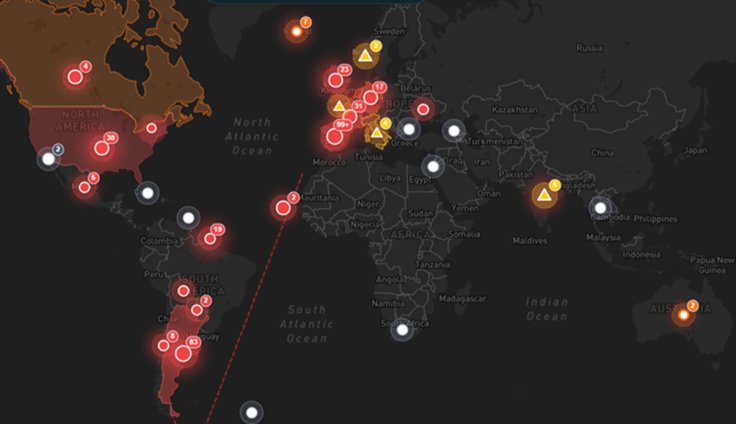
Health authorities across Europe, Africa, North America, and parts of the South Pacific are scrambling to contain a widening hantavirus outbreak linked to the expedition cruise vessel MV Hondius.
The outbreak, which began after several passengers reportedly developed flu-like symptoms during the voyage, has now triggered international quarantines, emergency contact tracing operations, and growing fears of secondary transmission chains across multiple continents.
The situation has intensified following the deaths of a Dutch couple and a German passenger connected to the voyage, while additional confirmed and suspected infections continue to emerge in countries where passengers were repatriated.
Public health agencies are warning that the next two weeks will be critical in determining whether containment measures can stop the spread before wider community outbreaks develop.
Governments' Protocols Against Hantavirus Spread
Governments worldwide are now enforcing strict monitoring measures as hundreds of contacts linked to the ship undergo testing, isolation, and medical observation.
Several countries have established emergency quarantine centres, while hospitals continue evaluating symptomatic passengers and crew members who may have been exposed during the voyage.
Hantavirus Hotspots Identified
As of 13 May, these are the identified hotspots of where the hantavirus has expanded since passengers on the MV Hondius have been dispersed to their own countries or to designated health centres across the world.
- United Kingdom: Two positive cases hospitalised in the Netherlands and South Africa; 20 passengers isolating at a hospital on the Wirral; one suspected case on Tristan da Cunha; one person quarantined on the Pitcairn Islands.
- Netherlands: Dutch husband and wife dead; a 41-year-old Dutch national hospitalised; a 56-year-old British passenger also hospitalised.
- United States: One confirmed case; one suspected symptomatic case; 15 people isolating at Nebraska Medical Centre.
- Spain: Fourteen repatriated passengers transferred to Madrid's Gómez Ulla Military Hospital for a 42-day quarantine; one tested positive.
- Canada: Four repatriated passengers in isolation.
- South Africa: British passenger in intensive care; Dutch woman died in Johannesburg.
- Greece: One repatriated passenger is isolating.
- Ireland: Two repatriated passengers are isolating.
- Germany: One German national died aboard the MV Hondius.
- Turkey: Three repatriated passengers are isolating.
- Switzerland: Three repatriated passengers are isolating. One tested positive.
- Belgium: Two passengers hospitalised for testing.
- France: One confirmed positive case on life support; four in isolation; 22 monitored contacts.
Attention Also on Vessel's Filipino Crew Members
A total of 38 Filipino crew members from the outbreak-hit MV Hondius are currently under mandatory 42-day quarantine protocols. Officials confirmed 24 crew members were evacuated from the Canary Islands to Eindhoven Airport between 10 May and 12 May.
The remaining 14 stayed aboard the ship as it sailed toward Rotterdam. Their return to the Philippines will only proceed after quarantine requirements are completed.
How Officials Hope to Stop the Spread
Health experts say rapid isolation and aggressive contact tracing remain the most important tools for preventing the outbreak from escalating into broader community transmission. Governments involved in the response are attempting to identify every passenger, crew member, airport contact, medical worker, and family member who may have interacted with infected individuals since the ship began disembarking passengers.
Medical authorities are also urging anyone linked to the voyage to immediately report symptoms, including fever, muscle pain, headaches, breathing difficulty, nausea, or severe fatigue. Hospitals across several countries have been advised to maintain heightened surveillance for unusual respiratory illnesses potentially connected to the outbreak, especially among recent international travellers.
Public health agencies are additionally stressing strict hygiene practices and controlled quarantine environments to minimise risk. Although hantaviruses are traditionally associated with rodent exposure, investigators are now examining whether prolonged close-contact conditions aboard the vessel may have contributed to possible human-to-human transmission involving the Andes virus strain. Scientists warn that confirming sustained secondary spread would significantly escalate international concern surrounding the outbreak.
A live global tracking overview of the outbreak, quarantines, and suspected transmission chains can be viewed at an online Hantavirus Map, which updates as new information emerges.
© Copyright IBTimes 2026. All rights reserved.