

Hawaii Telescope Captured Earliest Spectrum of 3I/ATLAS 12.5 Hours After Discovery
Cosmic trespasser: Interstellar comet 3I/ATLAS is rewriting how we view alien star systems

Imagine a piece of debris, ejected violently from a star system light-years away, now hurtling through our own cosmic neighbourhood. It is not just a rock; it is a message in a bottle from an alien planetary birth — a tangible piece of evidence that could fundamentally change our understanding of where we come from. This is the dramatic reality of 3I/ATLAS, only the third interstellar object ever detected, and the data being gathered from it is already shaking up our comprehension of what lies beyond.
These cosmic trespassers — these 'ejected building blocks of other solar systems' — are perhaps the single most precious cargo astronomers can hope to examine. They offer 'otherwise inaccessible information about nascent extrasolar systems', giving us a fleeting glimpse into the raw materials that formed worlds around stars far, far away. Until now, our understanding of extrasolar planet formation has been largely limited to computer models and distant telescopic observations.
The arrival of an object like 3I/ATLAS provides a physical, untouched sample from a completely different stellar cradle, allowing scientists to directly 'compare it to the small bodies in our own' solar system, such as comets and asteroids. This is a scientific opportunity that comes once in a generation, and the race to analyse it was intense.

The Extraordinary Speed and Composition of 3I/ATLAS
The scientific community's response to the object's discovery was nothing short of a frantic, global race against time. This object was moving fast, and researchers knew they had a vanishing window to capture its most intimate secrets before it disappeared back into the darkness of space.
In the immediate aftermath of the announcement, a dedicated team swooped in to capture crucial data. Using the powerful SuperNova Integral Field Spectrograph on the University of Hawaii 2.2-m telescope, researchers managed to get an early look at this cosmic visitor. The commitment and speed demonstrated by the astronomers was breathtaking: the earliest spectrum they captured, specifically at < 3800 A, was obtained an astonishing '~ 12.5 hours after the discovery announcement'. They needed to see it quickly before it sped too far away.
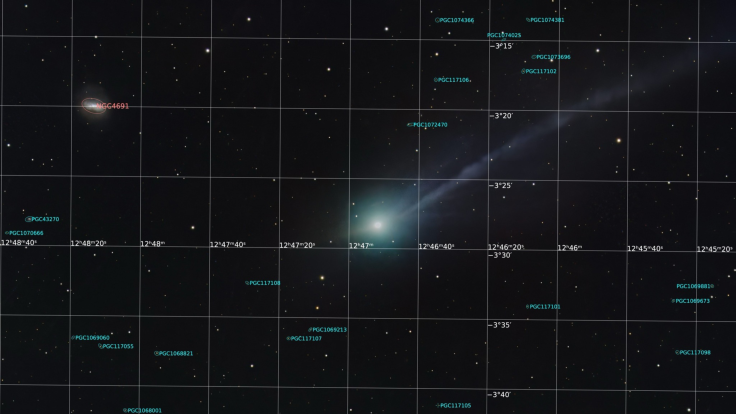
This urgency paid off massively. The subsequent spectrophotometric observations confirmed 'previously reported cometary activity', but the analysis revealed something truly spectacular — the emission of both Ni (Nickel) and CN (Cyanogen). It is this very cometary behaviour that makes 3I/ATLAS so incredibly special. Unlike 'Oumuamua and 'Borisov, the first two interstellar objects, 3I/ATLAS is actively shedding material as it heats up, turning from a dormant rock into a glowing, temporary comet as it makes its 'pre-perihelion (rh = 4.4 - 2.5 au) approach'.
Essentially, the object is opening up for us, giving scientists an unparalleled look at the raw elements sealed within. The presence of nickel, in particular, raises fascinating questions about the temperature and pressure conditions in the distant system where the comet was born.
Decoding the Colour-Code: What the Data Reveals About 3I/ATLAS
For astronomers, the 'colour' of an object — which is to say, how it reflects and absorbs light at different wavelengths — is a critical chemical and mineralogical fingerprint. The latest observations showed 'wavelength-varying spectral slopes (S ~ (0%-29%)/1000 A, depending on wavelength range)' throughout its close approach to the sun. This variation in how light was reflected across the spectrum is a key clue to the complexity of its surface.
Despite this variability, a deeper analysis showed a remarkable stability in its overall surface colour evolution. The synthetic photometry performed on the spectra showed 'mostly stable colour evolution' throughout the observation period. The precise colour readings remained within tight bands: 'g - r colours ranging from ~ 0.69 - 0.75 mag', 'r-i colours ranging from ~ 0.26 - 0.30 mag' and 'c - o colours ranging from ~ 0.50 - 0.55 mag'.
These seemingly small, highly technical variations are, in fact, incredibly significant. They tell a coherent story about the surface chemistry and mineralogy of a body that formed around a completely different star, possibly one that was dramatically different to our own sun. A stable colour profile suggests a uniform or slowly evolving surface composition, which is valuable information when trying to deduce the conditions of its cosmic birth.
While the initial data on 3I/ATLAS has answered some questions — confirming its cometary nature and revealing exotic elements — it has opened up a dozen more. What does the consistent colour evolution imply about its formation history? Why is it so rich in nickel?
The international team is now eagerly anticipating the next phase of research, noting that the 'ongoing post-perihelion observations of 3I/ATLAS will provide further insight into its potentially extreme composition'. The final, complete analysis of this interstellar visitor will not just reveal the history of a single comet; it promises to rewrite the cosmological rulebook on how planetary systems — including our own — are truly built.
The final, complete analysis of this interstellar visitor will not just reveal the history of a single comet; it promises to rewrite the cosmological rulebook on how planetary systems — including our own — are truly built. The message is here, but the decoding is ongoing.
© Copyright IBTimes 2026. All rights reserved.