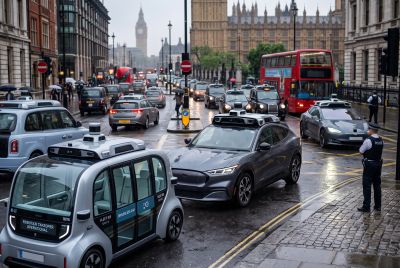
Rare £3.7M Ferrari Monza Among 90 Supercars Worth £8M Seized in London: Police Skip Tow Truck
Rules changed on 22 July cut the time a confiscated vehicle may be held from 14 days to seven

A Ferrari Monza SP2 valued at £3.7M ($5M) was among 90 vehicles taken by the Metropolitan Police in central London between 7 and 9 August 2026. The force puts the total value at more than £8M. Rather than call a recovery truck, an officer drove the open-top Ferrari to the pound through Mayfair with a police convoy behind.
The timing matters more than the spectacle. Regulations that came into force on 22 July 2026 cut the period during which police must hold a confiscated vehicle before disposing of it from 14 days to seven days. Every car taken that weekend, therefore, sat on a clock, half the length it would have run a month earlier.
What It Costs to Get an Impounded Car Back
The charges are set by the government and do not change with the badge on the bonnet. Recovering a vehicle under 3.5 tonnes costs £192, and storage adds £26 for every day or part of a day it stays in the pound. Regulations in April 2023 set those figures, raising the previous £105 and £12 by 28%.
For most drivers, that bill is the whole penalty. For the owner of a £3.7M Ferrari, the fee is trivial, and the deadline is the real risk, as the chart below sets out.
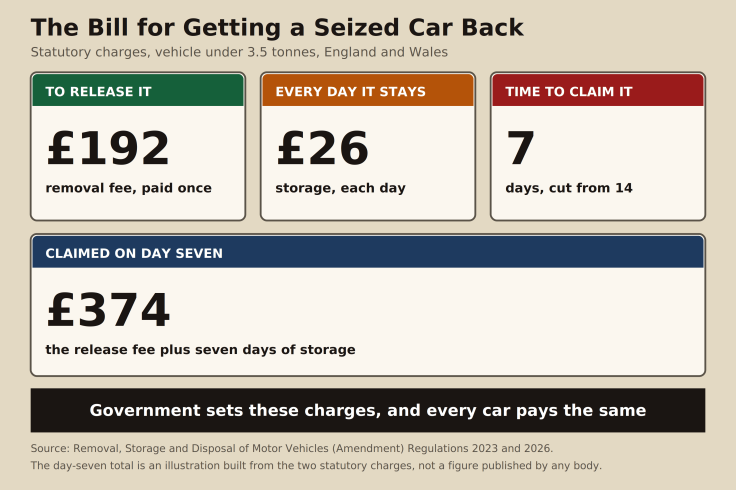
Paying is not the end of it. A driver who fails to reclaim the vehicle in time loses it altogether, because police may then sell or scrap it, and the removal and storage charges already run up remain owed.
The seven-day rule covers England and Wales and is not retrospective, so it reaches only vehicles taken on or after 22 July 2026. The same government review proposed lifting the recovery charges by a further 16.2%, which would push the release fee above £220.
Why the Seizure Totals Keep Rising
August 2026 was the fifth year of the Met's summer operation and the largest on both measures the force records. Officers took more than 60 vehicles worth about £6M over the first weekend of August 2025. This year the count reached 90, and the value passed £8M.
Some of that growth is a change in what officers are allowed to do. Fifteen of the 90 were taken under a power that no longer requires a warning first, as the graphic below shows.
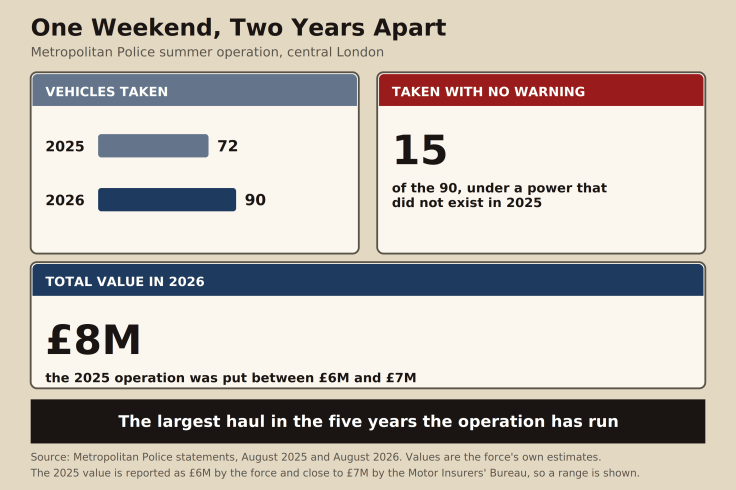
The Crime and Policing Act became law on 29 April 2026. It scrapped the requirement that an officer warn a driver first, where a car is used in a way likely to cause alarm, distress or annoyance. Until then, the warning stood for 12 months and a second incident was needed before anything could be taken away.
Geoff Tatman, the Special Chief Inspector in charge, said local people were 'fed up with people driving cars dangerously.' Separately, a Mercedes driver was held on suspicion of money laundering and of handling stolen goods. Officers found £2,500 in cash on him, along with 19 bank cards issued in names that were not his.
The Motor Insurers' Bureau supported the operation. The bureau pays claims brought against drivers who have no cover, and every motor insurer in the country funds it. The cost of uninsured driving therefore reaches people who never meet an uninsured driver.
Driving without insurance remained the most common reason a vehicle was taken. The Ferrari was one of 499 Monza SP2s built, had arrived from Saudi Arabia, and was pulled over at a gathering of supercars beside Wellington Arch. Its driver held a provisional licence and had been driving for barely half an hour.
© Copyright IBTimes 2026. All rights reserved.
- Recommended For You