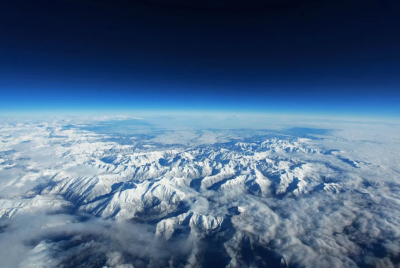
NASA Supercomputer Models Predict Earth Will Lose All Oxygen Much Sooner Than We Thought
New modelling backed by the NASA Astrobiology Institute reveals a 'sell-by date' for our atmosphere, warning that breathable air will collapse long before the sun expires

Earth's Oxygen-rich atmosphere has a 'sell-by date' that is arriving much sooner than previously estimated, according to startling new NASA-backed research.
Using advanced supercomputer simulations, planetary scientists Kazumi Ozaki and Christopher T. Reinhard have found that our planet's breathable air will effectively vanish in roughly one billion years.
The study, published in Nature Geoscience, warns that the oxygen collapse will be rapid and total, returning the planet to a state reminiscent of the 'Great Oxidation Event' that occurred 2.5 billion years ago.
The findings, supported by data from the NASA Astrobiology Institute, suggest that the window for complex life is significantly shorter than the two billion years previously cited. This NASA oxygen collapse forecast implies that animals and plants will face extinction long before the sun enters its terminal 'Red Giant' phase.
The Bulletin of the Atomic Scientists' Doomsday Clock, created in 1947, now sits perilously close to midnight, reflecting worries over a possible confrontation between the US and China, in part linked to Donald Trump's proposed blockade of the Strait of Hormuz, along with climate change, nuclear weapons and runaway AI. Yet this study quietly reminds us that even if humanity navigates every political and technological minefield it has laid for itself, Earth's story has a hard stop written into the physics of its star.

NASA Models A Shorter Future For Earth's Biosphere
The new analysis, led by Kazumi Ozaki and Christopher T. Reinhard, challenges a long-standing assumption about how long our oxygenated biosphere can last. Previous work, largely based on the Sun's gradual brightening, suggested that Earth would remain hospitable to life as we know it for roughly another two billion years. Using NASA-derived climate, geochemical and atmospheric data in a supercomputer model, Ozaki and Reinhard argue that those forecasts were overly generous.
Their calculations indicate that Earth's atmosphere has a 'sell by' date of about one billion years from now. In headline terms, the NASA computer run translates that into a tongue-twisting calendar point: the year 1,000,002,021. Beyond that, they say, oxygen levels crash to a fraction of today's values and never recover, at least not in a way that could sustain animals, plants or anything requiring breathable air.
A billion years is astronomically large on human timescales. But it is still a conspicuous downgrade from the roughly two billion years that had been widely cited, and it recasts our planet's oxygen-rich phase as a relatively brief window rather than a permanent feature.
The Rise And Future Fall Of Oxygen On Earth: NASA Data
To recall how precarious our atmosphere really is, you have to go back a very long way. Around 2.5 billion years ago, Earth's air contained almost no oxygen. Then a new kind of life evolved, organisms that released oxygen as a waste product. This 'Great Oxidation Event' was both creative and destructive. It wiped out most organisms adapted to the old, oxygen-poor world, but it also laid the groundwork for a highly oxygenated biosphere, as Ozaki and Reinhard emphasise, and one that is remotely detectable.
The pair stress that this oxygen surplus is not guaranteed to last indefinitely. At present, the planet's photosynthetic biosphere channels large amounts of oxygen into the ocean-atmosphere system, leaving the air about 20 per cent oxygen by volume. The scientists note that this level appears to be a recent development in Earth's history, particularly tied to the emergence of land plants. These plants accelerated key geochemical cycles, especially those involving phosphorus, effectively 'turbocharging' the system that supplies oxygen to the atmosphere.
The uncomfortable twist is that even with oxygen-producing plants and microorganisms in place, the balance can be tipped. NASA's modelling points to the Sun as the long-term culprit. Over the next billion years, the Sun is expected to expand slightly and burn hotter. That extra energy alters Earth's climate and chemistry in subtle but compounding ways.

One projected outcome is the gradual loss of water. As the Sun brightens, more water vapour is drawn higher into the atmosphere, where it is broken apart and escapes into space. With less water at the surface and in the soil, photosynthetic life struggles, and the planet's ability to pump out oxygen declines. At a certain point in the simulations, the researchers report, the system flips. Oxygen levels collapse to levels closer to those of early Earth, making the planet effectively uninhabitable for complex aerobic life.
The study draws heavily on NASA's computational power and planetary science frameworks, but it also ties back to NASA's search for life elsewhere. Ozaki and Reinhard point out that the agency's planned Large Ultraviolet Optical Infrared Surveyor, or LUVOIR, could be sensitive enough to detect similar atmospheric shifts on distant exoplanets. An oxygen-rich world seen through LUVOIR's mirrors might not be a permanent Eden, but a snapshot of a temporary, and perhaps fragile, biological phase.
No one can verify predictions on a billion-year horizon, and all such modelling should be treated with a measure of caution. The authors' timing, while grounded in the best available data and NASA-supported tools, remains a projection rather than a certainty, and the precise 'year' of atmospheric collapse should be taken with a grain of salt. What the work does underline, however, is that even in the most optimistic version of our near future, with climate change tamed and nuclear tensions defused, Earth's breathable air is on a cosmic countdown.
© Copyright IBTimes 2026. All rights reserved.
- Recommended For You