

US, UK Navies Launch Inert Mk 48 From XV Excalibur in 'A Historic First for Allied Undersea Warfare'
A U.S. Mk 48 torpedo launch from Britain's XV Excalibur tested allied undersea integration while setting up further AUKUS trials under Project CUTLASS
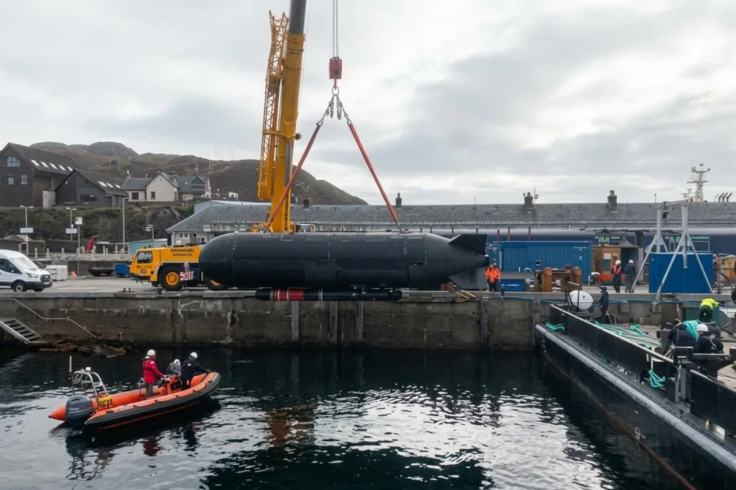
The US Navy and Royal Navy launched an inert, recoverable Mk 48 Mod 4 heavyweight torpedo from Britain's XV Excalibur uncrewed submarine during a trial in Scotland on Sept. 13, 2026.
The proof-of-concept launch took place at the British Underwater Test & Evaluation Centre under Project Broadsword and Trial Iron. The Royal Navy said it was the first time one of its uncrewed submarines had successfully fired a torpedo.
The three-week experiment involved British and US naval teams, the UK's Submarine Delivery Group Autonomy Unit, part of the Defence Nuclear Enterprise, and industry partners including MSubs, which built Excalibur, and QinetiQ, which operates the BUTEC range.
Project Broadsword was approved by the US Department of the Navy Rapid Capabilities Office in February 2026. The US Navy said the project moved from approval to execution in less than seven months, while the Royal Navy said British and American teams delivered the capability in about six months.
The trial was designed to test the mechanical, electrical and software integration needed to launch a US weapon from an allied autonomous underwater platform.
XV Excalibur Tests Allied Undersea Integration
XV Excalibur is an extra-large uncrewed underwater vessel developed as an experimental Royal Navy testbed for new technologies and payloads. For the September trial, the inert torpedo was carried externally beneath the vessel.
The Royal Navy said neither Excalibur nor the Mk 48 had originally been designed for that deployment method. The test therefore focused on the systems needed to connect and control the American weapon from the British platform rather than demonstrating a fielded combat configuration.
Project Broadsword forms part of AUKUS Pillar II, the advanced-capabilities strand of the Australia-UK-US security partnership. Pillar II covers areas including undersea warfare, artificial intelligence and autonomy, quantum technology, advanced cyber capabilities, electronic warfare and hypersonics.
The US effort involved the Department of the Navy Rapid Capabilities Office, OPNAV N97, the Royal Navy, the Defense Innovation Unit, Naval Undersea Warfare Center Division Keyport and industry partners.
Excalibur had already been used in remote-control trials. During Exercise Talisman Sabre in July 2025, the Royal Navy controlled the vessel in UK waters from a remote operating centre in Australia, more than 10,000 miles from its home in Plymouth.
Adm. Daryl Caudle, chief of naval operations, called the September launch 'a historic first for allied undersea warfare.' He said the test 'validates our shared vision for true interchangeability.'
Those comments set out the US Navy's wider objective for the programme. The demonstration itself established that the specific Mk 48 and Excalibur configuration could be integrated and used for a proof-of-concept launch under test conditions; it did not, by itself, establish interchangeability across other allied weapons or platforms.
Project Cutlass Will Build on Excalibur Trial
Vice Adm. Robert Gaucher, director of submarine programs, described Broadsword as an example of AUKUS Pillar II interoperability and an early step in developing capability in autonomous undersea systems.
The US Navy said the follow-on effort, Project CUTLASS, will use Anduril's Dive-XL platform. The next phase is expected to examine advanced payload integration data, command-and-control architectures and tactical employment scenarios as the partners continue developing uncrewed undersea capabilities.
The Royal Navy separately said the Excalibur firing was the first in a planned series of trials that will increase in scope and complexity.
That distinction is important. Broadsword demonstrated the integration and launch of one exercise torpedo from one experimental uncrewed platform. Further testing will be needed before broader claims can be made about how the approach performs across other weapons, vessels or operational conditions.
© Copyright IBTimes 2026. All rights reserved.