Erika Kirk TPUSA Succession Recording Faces New Scrutiny After Candace Owens Claims It Was AI Manipulated
Debate intensifies over the authenticity of a recording naming Erika Kirk as Charlie Kirk's successor

A growing storm has engulfed Turning Point USA after claims emerged questioning the authenticity of a widely circulated recording allegedly featuring Charlie Kirk naming Erika Kirk as his successor.
The controversy escalated further after commentator Candace Owens suggested the audio may have been artificially generated, intensifying already heated debates surrounding leadership, legacy, and digital manipulation within the organisation.
Erika Kirk Succession Tape
The recording at the centre of the dispute allegedly captures Charlie Kirk stating that he appoints his wife, Erika Kirk, to lead Turning Point USA in the event of his death. The clip has been shared widely among supporters and critics, often cited as a symbolic moment in the organisation's succession planning.
However, Owens has now raised doubts about its legitimacy, pointing to what she describes as unnatural speech flow and unusually formal phrasing. She argued that the repetition and cadence of the voice sounded inconsistent with Kirk's typical speaking style, suggesting the possibility of synthetic audio manipulation.
She said during her podcast, 'It just doesn't flow when you hear it. And it's also remarkably formal.'
Her comments have reignited speculation online, with supporters of the organisation dismissing the claims as baseless, while critics argue that the lack of a clear verification process leaves room for legitimate concern.
AI Voice Allegations
The controversy expanded further following claims that Turning Point USA has previously experimented with AI-generated voice technology in internal presentations. According to commentary discussed on Owens' programme, insiders have suggested that synthetic voice tools may already be used in donor events and organisational materials.
These claims have led to speculation that the disputed succession recording could potentially involve similar technology, although no verified evidence has been produced to confirm this.
Owens directly called for clarity on the matter, stating during her broadcast, 'We would like a response on this. Are the donors lying? A simple yes or no would do as a starting place.'
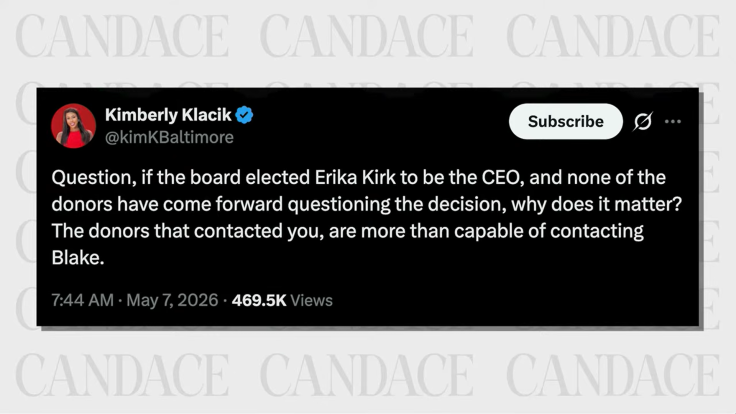
Further complicating the situation is the ongoing silence from key figures within Turning Point USA regarding the disputed audio. Owens and others have questioned why no definitive public statement has been issued to confirm or deny the recording's authenticity.
Some donors allegedly claim they were present at events where similar statements were made, though these accounts remain unverified. The absence of a clear, unified response has allowed speculation to spread rapidly across social media platforms.
Critics argue that the organisation's reluctance to directly address the issue only deepens public mistrust, while supporters say the focus on the recording distracts from broader political and organisational goals.
Critics Question Legitimacy of Her Rapid Elevation
Amid the dispute, Erika Kirk's increasing public visibility has added another layer to the debate. She has recently taken on more prominent speaking roles, including delivering a commencement address at Hillsdale College and receiving an honorary doctorate, moves that have drawn both praise and criticism online.
Supporters describe her as stepping into leadership during a difficult period, while critics question the timing and legitimacy of her rapid elevation within the organisation's public-facing structure.
Owens and others have used these developments to further question whether the succession narrative is being shaped by internal messaging strategies rather than organic leadership transition.
No verified technical analysis has confirmed whether the contested recording is authentic or AI-generated. The debate continues to divide audiences, with the issue now sitting at the intersection of politics, media trust, and emerging artificial intelligence technology.
© Copyright IBTimes 2025. All rights reserved.
- Recommended For You