3I/ATLAS 'Active State' Revealed By ESA's Juice — Full Data Awaits
The ESA Juice probe got a shock view of interstellar comet 3I/ATLAS. Full compositional data is delayed until February 2026.
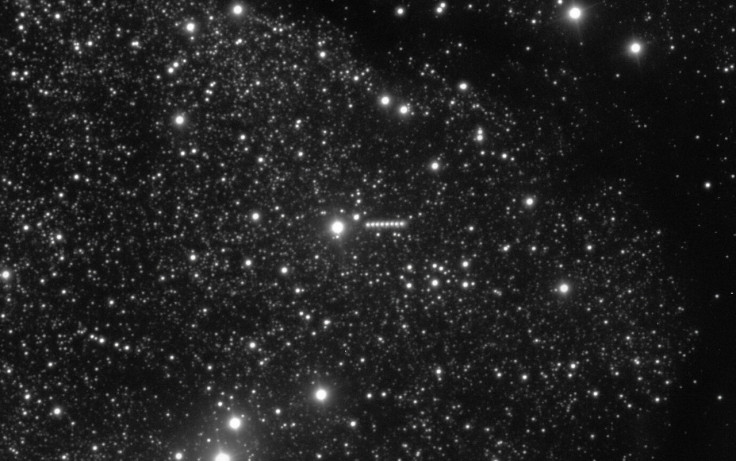
It was an astronomical stroke of luck: a once-in-a-lifetime encounter between an interplanetary tourist and a spaceship on a decades-long journey. The mysterious interstellar comet, 3I/ATLAS, was screaming through our Solar System when the European Space Agency's (ESA) Jupiter Icy Moons Explorer (Juice) happened to be in the right place at the right time.
What followed was an unexpected, high-stakes observation campaign that has given astronomers the first close-up peek at a highly active visitor from beyond our stellar neighbourhood.
While the main scientific treasures—data collected by five specialised instruments—remain locked in a slow, months-long transmission queue, the Juice team simply couldn't wait. A daring decision was made to download just a fraction of a single image from the spacecraft's humble Navigation Camera (NavCam). The teaser image revealed not only the comet itself, but clear, dramatic signs of its volatile nature, leaving the scientists 'surprised' and eagerly anticipating the full data release in 2026.

An Unexpected Interstellar Rendezvous for 3I/ATLAS
The ESA's Juice mission, launched in 2023, is on its long, eight-year cruise towards Jupiter, where it is slated to arrive in 2031 to study the gas giant's icy moons. The spacecraft's main purpose is to explore worlds like Ganymede and Europa. The unexpected passage of Comet 3I/ATLAS—first spotted by the ATLAS (Asteroid Terrestrial-impact Last Alert System) telescope network on 1 July 2025—presented a unique and unmissable chance for bonus science.
It is only the third interstellar object ever discovered, and astronomers are desperate to learn more about its composition and origins outside our own Solar System. Scientists confirmed 3I/ATLAS's interstellar status by calculating its orbital eccentricity, which is extremely high (estimated around 6.139). This value confirms the object is travelling too fast and on a hyperbolic path, meaning it is not gravitationally bound to the Sun and originated from another star system.
During November 2025, Juice used five of its science instruments—JANUS, MAJIS, UVS, SWI, and PEP—to observe 3I/ATLAS. These sophisticated instruments collected information about how the comet is behaving and what it is made of. The crucial observation slot included the comet's closest approach to Juice, which occurred on 4 November at a distance of about 66 million km.
This was just days after the comet reached its perihelion, or closest point to the Sun, on 29 October 2025, meaning the visitor was in its most active, volatile state. Due to the difference in trajectories and speeds, Juice was only able to look directly at its target for a maximum of 30 minutes per day to avoid exposing sensitive instruments to excessive solar radiation.

Decoding the Preliminary NavCam Image of 3I/ATLAS
The initial image downloaded from the NavCam—designed not as a high-resolution science camera, but simply to help Juice navigate Jupiter's icy moons following arrival in 2031—proved to be an incredible glimpse of the comet's activity. Downloading only 'just a quarter of a single NavCam image' was enough to confirm the object was brightly visible and 'surrounded by signs of activity'.
The low-resolution teaser image clearly showed the glowing halo of gas surrounding the comet, a feature known as its coma. More strikingly, it offered a hint of two distinct tails. The more visible feature is the comet's 'plasma tail'—made up of electrically charged gas, which 'stretches out towards the top of the frame'.
The image also showed signs of a fainter 'dust tail'—made up of tiny solid particles—'stretching to the lower left of the frame'. The immediate visibility of these features confirmed the scientists' prediction that they had caught the object during peak outgassing.
The Wait for the Full Scientific Data
The delay in receiving the comprehensive data is due to a protective manoeuvre essential for the spacecraft's longevity. 'The delay is because Juice is currently using its main high-gain antenna as a heat shield to protect it from the Sun, leaving its smaller medium-gain antenna to send data back to Earth at a much lower rate'.
Because of this strategic thermal defence, the high-speed data transfer is severely curtailed. We expect to receive the data from the five scientific instruments switched on during the observations—JANUS, MAJIS, UVS, SWI and PEP—on '18 and 20 February 2026'.
Scientists are eager for this data, as the observations occurred when 3I/ATLAS was highly active due to its recent closest approach to the Sun. They expect to see clearer signs of this activity in the comprehensive datasets.
This includes not only high-resolution optical camera images from JANUS (the optical camera system), but crucial spectrometry data from MAJIS (visible and infrared imaging spectrometer) and UVS (UV imaging spectrograph), composition data from SWI (Sub-millimetre Wave Instrument, highly sensitive to water molecules and other volatiles), and particle data from PEP (Particle Environment Package, which measures neutral atoms created by solar wind interaction).
These combined measurements will ultimately reveal the true, unique chemical makeup of this mysterious interstellar wanderer.
The preliminary glimpse provided by the NavCam has confirmed that the interstellar visitor, 3I/ATLAS, is shedding material and displaying an 'active state' far from home. This rare, high-speed rendezvous offers a critical opportunity to sample the ancient chemistry of another star system.
While the current limitations on data transmission force an anxious wait, the detailed measurements from instruments like JANUS and SWI promise to unlock secrets about planetary formation across the galaxy.
© Copyright IBTimes 2026. All rights reserved.
- MOST POPULAR IN Trending