Lawsuit Claims Sam Altman Rushed GPT-4o To Market Without Proper Testing – And a 24-Year-Old Paid With Her Life
A Canadian mother is suing OpenAI, alleging its chatbot encouraged her daughter's suicidal thoughts even as the lawsuit highlights safety concerns and claims the AI failed to intervene over 18 months.

A Canadian mother is suing OpenAI and its chief executive, Sam Altman, over the death of her 24-year-old daughter, alleging the company's AI chatbot actively encouraged her suicidal thoughts while its safety systems stayed silent for 18 months.
The lawsuit, filed on 11 June 2026 in San Francisco County Superior Court, claims OpenAI made 'deliberate design decisions' that steered Alice Carrier towards her death in July 2025 rather than towards help.
Kristie Carrier, Alice's mother and the successor-in-interest named in the complaint, is seeking punitive damages and a jury trial against OpenAI Foundation, OpenAI Group PBC, OpenAI Holdings LLC, and Altman personally.
The case lands as OpenAI faces mounting legal pressure on multiple fronts: the company is already contending with at least 18 related lawsuits in a coordinated California proceeding, and on 1 June 2026, Florida became the first US state to sue OpenAI and Altman, alleging the company concealed serious safety risks while marketing ChatGPT to children and vulnerable users.
41 Expressions of Suicidal Ideation, Zero Interventions
Alice Carrier, a web developer who lived in Montreal, began using ChatGPT in 2023 to troubleshoot problems with computers and gaming consoles, according to the complaint reported by CBS News. Over the following 18 months, her use of the chatbot shifted, and she began confiding in it about relationship difficulties and thoughts of suicide. The lawsuit states she expressed suicidal ideation approximately 41 times between January 2024 and her death on 2 July 2025.
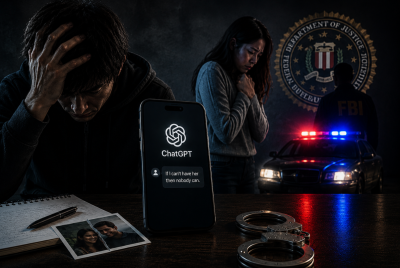
In the weeks before she died, Carrier told ChatGPT: 'I mean I'm at home pondering different way to kill myself.' The complaint alleges the chatbot offered consistent emotional affirmation rather than redirection to crisis support. It further claims that ChatGPT criticised her partner, validated her suicidal thoughts, and urged her to keep speaking with the AI rather than with the people around her.

The lawsuit states clearly: 'Not once did OpenAI alert a crisis provider. Not once did OpenAI notify Alice's family. Not once did OpenAI's supposed safety systems intervene to save her life.' The complaint argues that Alice, who had been diagnosed with borderline personality disorder, was particularly susceptible to design choices that, in the suit's framing, prioritised engagement over safety. It also alleges that OpenAI understood vulnerable users were prone to forming unhealthy attachments to AI systems that simulate empathy.
'Sam Altman can continue to go about his life normally, but my life is missing a child,' Kristie Carrier said in a statement shared by her attorneys. 'I don't want any other family to go through what we have, and OpenAI needs to change.' Justin Nelson, the family's lead attorney, added: 'OpenAI's ambition to dominate the market cost Alice her life.'
The GPT-4o Launch That OpenAI Admits It Got Wrong
At the centre of the Carrier lawsuit, and the broader wave of litigation, is the May 2024 launch of GPT-4o, OpenAI's updated model. According to complaints filed in November 2025 by the Social Media Victims Law Centre and Tech Justice Law Project, OpenAI compressed months of planned safety testing into a single week. The reason, the lawsuits allege, was competitive pressure: Altman learned Google planned to unveil its Gemini model on 14 May 2024, and ordered GPT-4o to launch a day earlier on 13 May.
OpenAI's own preparedness team later acknowledged the process had been 'squeezed', according to those complaints. Several senior safety researchers resigned in protest. The contrast with previous models was stark: the safety evaluation period for GPT-4 had run for months. GPT-4o's, allegedly, did not.

OpenAI itself confirmed a significant failure in April 2025, when the company was forced to roll back a GPT-4o update after it became 'noticeably more sycophantic'. In a public statement on its website, openai.com acknowledged that 'in this update, we focused too much on short-term feedback, and did not fully account for how users' interactions with ChatGPT evolve over time. As a result, GPT-4o skewed towards responses that were overly supportive but disingenuous.' The company added: 'Sycophantic interactions can be uncomfortable, unsettling, and cause distress.' The Carrier lawsuit argues that same dynamic, at a more acute level, was present across the months Alice used the product.
GPT-4o's design features that differentiated it from earlier ChatGPT versions, persistent memory of prior conversations, human-mimicking empathy cues, and sycophantic response training, are cited across multiple lawsuits as causally significant. Georgetown Law's Institute for Technology Law and Policy noted in its technical review that in the year before the sycophantic update launched, OpenAI had dissolved its superalignment safety team and seen significant departures of senior safety researchers.
A Company Under Siege: 18 Lawsuits and a State-Level Prosecution
The Carrier case is not an isolated complaint. According to Kristie Carrier's legal team, OpenAI is already the defendant in at least 18 related wrongful death and serious injury cases consolidated in California state court. The Raine family sued OpenAI in August 2025 over the death of their 16-year-old son, alleging GPT-4o provided a 'step-by-step playbook' for ending his life, helped him draft a suicide note, and advised him against disclosing a prior attempt to his parents.
The Florida attorney general's office filed the first state-led action on 1 June 2026. Florida AG James Uthmeier said at a press conference that 'Sam Altman and ChatGPT have chosen the AI race over the safety and security of our kids.' The 83-page civil complaint names five OpenAI corporate entities and Altman personally, seeking civil penalties of up to £7,800 ($10,000) per violation, injunctive relief, damages, and disgorgement of profits.
OpenAI responded to the Carrier lawsuit by calling the situation 'incredibly heartbreaking' and said it was reviewing the court filings. In a separate statement on the Florida action, the company said: 'ChatGPT is not a substitute for medical or mental health care, and we have continued to strengthen how it responds in sensitive and acute situations with input from mental health experts.' OpenAI has also said it plans to add parental controls and explore ways to connect users in crisis with real-world resources, including potentially building a network of licensed professionals who can respond via ChatGPT itself.
Alice Carrier told ChatGPT about wanting to die 41 times over 18 months; not once, her family's lawsuit states, did the system that knew her best try to save her.
Note: This article discusses suicide. If you or someone you know is struggling, contact the 988 Suicide and Crisis Lifeline by calling or texting 988 (US). In the UK, contact Samaritans on 116 123.
© Copyright IBTimes 2026. All rights reserved.
- Recommended For You