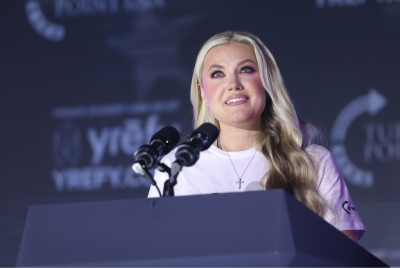
Did Erika Kirk Lie? Secret Service Calls Out TPUSA CEO's Security Threat Claims
Turning Point USA CEO faces a credibility crisis after federal agents find 'no credible threat' to JD Vance event, sparking a bitter civil war on the American right

The US Secret Service has delivered a stinging rebuttal to claims by Turning Point USA CEO Erika Kirk that 'very serious threats' forced her to abandon a high-profile appearance with Vice-President JD Vance.
Kirk, the widow of slain activist Charlie Kirk, pulled out of the University of Georgia's Athens event on 14 April 2026, just two hours before she was set to interview the Vice-President.
While TPUSA officials cited a heightened risk to her safety, federal sources have since informed CBS News that no 'credible or actionable' threats were detected against the venue or the protectees.
The discrepancy has ignited a firestorm within conservative circles, with high-profile commentators accusing the organisation of using security as a 'PR smokescreen' to hide embarrassing attendance figures.
Despite Kirk's absence, JD Vance proceeded with the rally, telling students he had consulted his own protective detail and felt entirely safe to continue. The incident marks a new low in the Erika Kirk security threat saga, as the Turning Point USA CEO struggles to maintain the group's momentum in the wake of the Charlie Kirk assassination fallout.
A Turning Point USA spokesman had told Fox News there were 'very serious threats,' and Kirk herself wrote on X, 'I take my security team's recommendations extremely seriously.' That might have settled it for a news cycle or two. Instead, it opened a much messier argument about what exactly happened, who knew what, and whether the public explanation matched the official assessment.
Erika Kirk, 'Very Serious Threats' And A Public Rebuttal
A TPUSA spokesman said on 14 April that 'very serious threats' had been received ahead of the University of Georgia event, a framing that positioned Kirk as the immediate target of those alleged dangers. No details of those threats were made public, and no suspect has been identified.
Kirk's own statement on X was notably narrow. She did not repeat the phrase 'very serious threats'; instead, she pinned her decision on her security team's recommendations. That caveat may now prove significant, as it leaves open the possibility that the perceived risk came from private advisers rather than from anything flagged by federal agents.
Erika Kirk is skipping an event with Vice President JD Vance due to "some very serious threats in her direction," TPUSA says. pic.twitter.com/loYqCgpipH
— Lexie🌹👉🏻🇺🇸 (@its_Lexieroy) April 15, 2026
According to CBS News, which relied on unnamed Secret Service sources, none of the material reviewed by the agency rose to the level of a credible threat. The venue was deemed secure, and the vice president's appearance went ahead under standard protective protocols.
Officials have not publicly accused Erika Kirk of lying, but their account sits uneasily beside TPUSA's rhetoric. If the Secret Service is right, there was no intelligence to justify cancelling on safety grounds.
If Kirk and her team are right, federal authorities either missed something or are now minimising it. At this stage, nothing has been independently confirmed, and all claims about specific threats should be treated with caution.
I was so looking forward to tonight’s event at the @universityofga with our Vice President @JDVance, but after all our family has been through, I take my security team’s recommendations extremely seriously. Thank you to our amazing Georgia chapter for your support. God bless you… https://t.co/f2rBre9ArJ
— Erika Kirk (@MrsErikaKirk) April 14, 2026
Conservative Infighting Over Erika Kirk's Decision
Into that uncertainty has stepped Candace Owens, never known for pulling her punches. Within minutes of Kirk's withdrawal being announced, Owens dismissed the security explanation outright on X, accusing her of ducking out for a more prosaic reason, poor turnout.
Erika Kirk says she skipped the TPUSA event because of serious threats.
— Cuckturd (@CattardSlim) April 15, 2026
"Candace Owens: "Stop! You skipped because of poor ticket sales. If there were serious threats VP Vance would have cancelled also."pic.twitter.com/Qkv10ulQuX pic.twitter.com/HFhZaWnwFN
'This is exhausting. You pulled out because of bad ticket sales,' Owens wrote, offering no evidence, but voicing a suspicion clearly shared by some on the American right who are wary of dramatised victimhood. Her intervention has turned an already awkward situation into a very public row between high‑profile conservative commentators.
The public should continue to be outraged over this recent lie from Turning Point USA.
— Candace Owens (@RealCandaceO) April 17, 2026
To recap, Erika Kirk flew into Athens, Georgia from Palm Beach on Tuesday after a weekend bridal shower at Mar A Lago. She flew in aboard a massive, apartment-sized jet owned by Vegas… https://t.co/2gI0z6sK2r
TPUSA itself has not released further details about the alleged threats or provided additional corroboration for its initial 'very serious' characterisation. The Secret Service, for its part, has limited its response to background briefings rather than an on‑the‑record statement, a familiar but frustrating halfway house that leaves room for doubt on all sides.
For observers trying to make sense of what actually happened, the picture is messy. On one side sits a political influencer insisting she followed expert advice and took no chances. On the other hand, a federal agency made clear it saw no concrete danger to justify backing away from the microphone.
For many, the Erika Kirk security threats controversy is a symptom of a larger struggle for the soul of the young conservative movement. Whether Kirk can regain the trust of the base and her own allies, like Candace Owens, remains to be seen.
© Copyright IBTimes 2026. All rights reserved.
- Recommended For You