

Trump Admin Renames Iran's $300 Billion Reparations Demand an 'Investment Fund' to Avoid a Political Firestorm at Home
Draft agreement between US and Iran includes a massive investment fund, avoiding terms like 'reparations.'

The man who spent a decade calling Obama a traitor for sending Iran $400 million is now floating a fund four hundred times that size, just with a friendlier name on the tin.
A draft memorandum of understanding between the United States and Iran, reported by the New York Times on 28 May 2026, includes a proposed £224 billion ($300 billion) reconstruction mechanism for Iran. The fund's inclusion follows months of negotiations to end the 2026 US-Iran war, during which Tehran had explicitly demanded reparations for bombardment damage that some Iranian officials estimate at between £224 billion ($300 billion) and £745 billion ($1 trillion).
Diplomats familiar with the draft told the Times that the American side intentionally avoided the words 'compensation' or 'reparations,' opting instead for the term 'international investment fund,' a rebranding confirmed by multiple officials across outlets including Axios and CNN. As of 30 May 2026, President Trump has not signed the agreement.
Semantic Sleight of Hand Behind Fund's Framing
An Iranian official described the proposed mechanism to the New York Times as a 'reconstruction programme' that would be promised to Iran upon the signing of a final agreement. Two diplomats briefed on the latest draft used different language, calling it an international 'investment fund' that the United States would facilitate. The divergence in terminology is deliberate.
The domestic constraint is not hypothetical. Trump himself, according to the Times' reporting, told aides he would not sign any deal that could be seen as the United States directly giving money to Iran. That position is rooted in his own two-decade political record. As a candidate in 2016 and repeatedly thereafter, Trump attacked the Obama administration's settlement of a decades-old arbitration case with Iran, which involved a cash payment of £307 million ($400 million) as part of a total £1.3 billion ($1.7 billion) transfer.

Republicans called it ransom. Trump called Obama a liar. He has repeated variations of the claim in almost every major foreign policy speech since. A fund labelled 'reparations' at £224 billion ($300 billion) would hand his critics, and his own base, the exact cudgel he spent a decade swinging.
On 29 May 2026, Trump posted to Truth Social: 'No money will be exchanged, until further notice.' The same post laid out his terms: no nuclear weapon, the Strait of Hormuz open with no tolls in both directions, and the removal of all sea mines. He did not address the investment fund by name.
Two Developers Behind $300 Billion Tehran Idea
The investment fund concept did not originate on the Iranian side. According to the New York Times, the proposal is an iteration of an idea first raised by Steve Witkoff, Trump's Special Envoy to the Middle East, and Jared Kushner, the president's son-in-law. Both men are real estate investors.
Some mediators told the Times that Witkoff and Kushner had suggested promoting real estate projects in Tehran and establishing a broader investment mechanism as an incentive for a deal, a framing that has since been folded into the formal draft text.
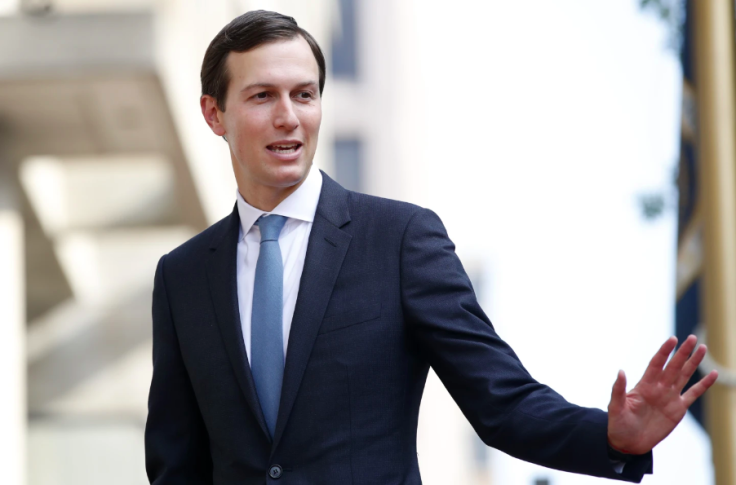
Witkoff, a New York property developer who founded the Witkoff Group, was appointed Special Envoy to the Middle East in November 2024 and expanded his role to Special Envoy for Peace Missions from July 2025.
Kushner, who owns his own real estate firm, began assisting Witkoff in late 2025. Iranian negotiators took the investment fund proposal and built on it, suggesting that large American oil and energy companies could enter Iran's market through joint ventures after sanctions are lifted, according to the Times and corroborated by Ynet News. The prospect of US energy corporations gaining access to Iran's reserves, the fourth-largest in the world, gives the fund a commercial logic that 'reparations' never could.
What the Draft MOU Contains and Remains Unsigned
Beyond the fund, the 60-day memorandum of understanding covers a sequence of immediate commitments on both sides. According to Axios's primary reporting, the MOU would reopen the Strait of Hormuz to unrestricted commercial shipping with no tolls, require Iran to remove all mines from the strait within 30 days, lift the American naval blockade proportionally as commercial shipping resumes and issue sanctions waivers allowing Iran to sell oil freely. The deal would also include an Iranian commitment not to pursue a nuclear weapon, with negotiations on enrichment and the disposal of Iran's highly enriched uranium stockpile deferred to the 60-day talks that follow.
Iran's access to approximately £17.9 billion ($24 billion) in frozen foreign bank assets is a parallel negotiating thread. Iranian officials have insisted on receiving at least £14.9 billion ($20 billion) of that amount during the negotiation stage itself, before a final deal is signed, in order to stabilise the economy. The US has committed only to discuss sanctions relief and frozen funds as part of the 60-day window, not before it.
Iran's Fars News Agency, affiliated with the Islamic Revolutionary Guard Corps, reported that the Strait of Hormuz would remain under Iran's management under the latest exchanged text, directly contradicting Trump's public characterisation of the deal. Military vessels, Iranian officials said, are explicitly excluded from any commitment to reopen passage. Despite two skirmishes between US and Iranian forces in the strait in the 48 hours before the MOU was confirmed, US officials told Axios they believed Iran's economic pressure was pushing its system toward settlement.
A president who built his brand on never giving Iran a cent is now the architect of the largest financial commitment to Tehran in American history, provided nobody calls it what Iran originally asked for.
© Copyright IBTimes 2026. All rights reserved.