Former F1 Driver Reveals The Awkward Restroom Encounter That Michael Schumacher Turned Into A Joke
Bird recounts awkward Schumacher bathroom gaffe that sparked laughs and welcomes at Mercedes.

Former Formula 1 driver Sam Bird has revealed how a nervous first weekend as Mercedes' young test driver in 2012 took an unexpected turn in the team toilets, when a startled Michael Schumacher turned an awkward encounter into a running joke in front of senior staff.
Bird had arrived at Mercedes during Schumacher's final season in F1, joining a line-up headed by the seven-time world champion and his team-mate Nico Rosberg. Mercedes were still in the middle of their long build-up to dominance, and Bird, then 25, had been brought in as reserve and rookie-day driver, shadowing the race team and learning the ropes from inside one of the sport's most scrutinised garages.
The British driver recalled the episode, and its oddly disarming role in his introduction to the team, when speaking about his time alongside Schumacher. According to Bird, the chain of events began with something as basic as a pre-meeting dash to the loo.
He explained that before one of his first big internal meetings at Mercedes, he decided to quickly use the toilet. As he tells it, the door indicator outside showed green, so he walked straight in.
Inside, he found not an empty cubicle but Schumacher, mid-use.
Bird's description of that instant is deliberately coy, but he did not underplay his own shock. He said he was confronted with 'parts of Michael' he had not expected to see, and the situation was obviously mortifying for a junior driver still trying to prove he even belonged in the room.
Bird backed out, the moment passed, and he took his seat for the meeting, presumably hoping it would never be spoken of again. Schumacher had other ideas.
Michael Schumacher, Mercedes And A Toilet Gag That Stuck
The meeting was chaired by Ross Brawn, then Mercedes' team principal and the man who had guided Schumacher to multiple titles at Ferrari. Brawn began the session in routine fashion, but quickly turned to the matter of the team's new arrival.
'Look, everybody, we've got young Sam Bird here,' Brawn said, as recalled by Bird. He went on to explain that Bird would be shadowing the team over the weekend, carrying out rookie test duties and serving as reserve driver. Then came the punchline that made the room look straight at Bird.
'Please make him feel welcome. And, if you need to find him, he'll be hanging around outside the toilets.'
Bird says the line landed perfectly. In one sentence, Brawn, with a nudge from Schumacher, had transformed Bird's private embarrassment into a shared joke, instantly lowering the temperature in a room full of world champions, senior engineers and executives.
The implication from Bird is that Schumacher had 'teed that up' with Brawn between the incident and the meeting, deciding to use the mishap as an icebreaker rather than something to be brushed aside. It was, in its slightly schoolboy way, a piece of social engineering from a driver whose public image never really dwelt on warmth.
After the meeting, according to Bird, Schumacher came over, gave him a hug and offered a simple 'Welcome to the team.' For a 25-year-old stepping into a world defined by split-second judgement and unforgiving expectations, that private gesture probably mattered as much as the public joke.
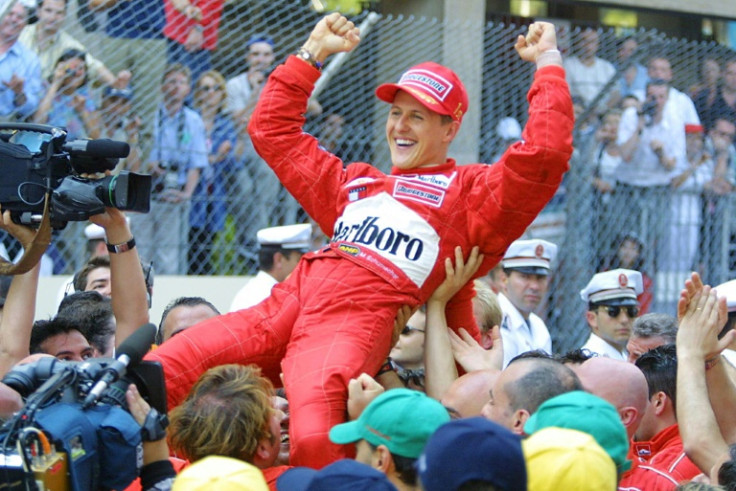
What The Michael Schumacher Story Reveals About A Giant
The toilet anecdote sits in stark contrast to the numbers that usually define Schumacher. He retired from Formula 1 for the second and final time at the end of 2012 with 92 grand prix victories, a record that at that point put him 40 clear of Alain Prost, who was then his closest rival on the all-time list.
Schumacher's seven world titles still stand as a joint record, now shared with Lewis Hamilton. Hamilton has since nudged beyond Schumacher's wins tally, reaching 105 victories, and has taken the bulk of those with the very same Mercedes team that Schumacher helped to shape in the early 2010s.
Even with Hamilton's haul, several of Schumacher's records remain untouched. He is still the only driver to have won five consecutive world championships, a run that came with Ferrari from 2000 to 2004. He is also the only driver ever to stand on the podium at every race in a season, achieving that in 2002, a year of near-total dominance that set the standard for what a driver and team operating in lockstep can do.
Those statistics tend to freeze Schumacher in time as an almost mechanical presence, all relentless precision and competitive calculation. Bird's story, by contrast, offers an unguarded glimpse of the man in the quieter corners of the paddock: someone willing to turn his own brief embarrassment into a joke that made a junior colleague feel less alone.

Nothing in Bird's account alters the hard facts of Schumacher's career. The numbers are fixed and the records either stand or fall in the cold light of future seasons. Yet stories like this do adjust the angles at which those facts are viewed. They suggest that behind the tinted visor and the team-managed quotes was a driver who understood the human tension in an F1 garage and, occasionally, chose to defuse it with something as simple as a laugh in a team meeting.
None of this, of course, changes the reality that many details of Schumacher's post-racing life remain private and unconfirmed, following the skiing accident that occurred after his retirement. The Bird anecdote comes from a period when Schumacher was still in the public eye, still travelling, still part of the travelling circus of Formula 1. Everything else must be treated with caution.
© Copyright IBTimes 2026. All rights reserved.
- MOST POPULAR IN Sports