Michael Schumacher's Family Targeted in €15m Blackmail Plot in 2025 Over Private Medical Files
Even now, the fiercest battles around Michael Schumacher are being fought over what the world is not allowed to see.
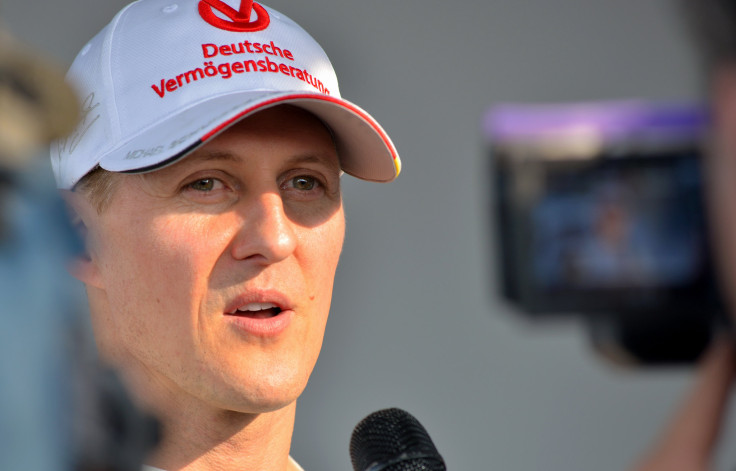
Michael Schumacher remains out of public view more than a decade after his 2013 skiing accident, and his family's insistence on privacy has been thrown back into the spotlight after an attempted blackmail case in Germany reportedly targeted medical files linked to the former Formula 1 champion.
For context, Schumacher's condition has been guarded with near-total discipline since December 2013, with the family limiting visitors, controlling information and declining the kind of routine health briefings that often follow celebrity illness. The approach has been consistent, and it has also made the household a magnet for rumour, opportunists and the occasional criminal scheme.
Readers trying to keep up with a story that rarely offers solid ground have a short list of points that can be stated without implying certainty. Schumacher lives under intensive care arrangements shaped around his recovery. Corinna Schumacher is widely described as leading the family's privacy strategy. A small circle is said to have access, and public details remain scarce enough that even minor claims travel fast and linger.

A Life Run Behind Closed Doors
The picture painted by the latest reports is of a family home adapted to medical needs and designed to keep the outside world at arm's length, both physically and legally. Access is described as tightly filtered, with only close relatives and a handful of long-trusted figures allowed through, and with the family ready to challenge unauthorised reporting through lawyers when lines are crossed.
Jean Todt, the former Ferrari team boss and former FIA president, has long been treated as one of the few people able to offer anything resembling an update, though even his comments have tended to be careful and impressionistic. In one widely reported remark about a visit, Todt said he had watched the Brazilian Grand Prix in Switzerland with Schumacher, adding, 'I'm actually always cautious when I say something. But it's true'.
That is roughly the register the family appears to prefer. Nothing granular, nothing that can be picked apart into a diagnosis, but just enough to confirm that Schumacher is there, and that the people closest to him remain intent on managing his environment rather than satisfying public curiosity.
The same privacy culture has shaped the way the Schumacher name continues in public. Mick Schumacher has pursued a professional motorsport career under a level of scrutiny that would test any young driver, and Gina-Maria Schumacher has built a separate sporting profile in equestrian competition. The family has also marked personal milestones privately, including the arrival of a new generation, moments of happiness that sit beside the long, quiet grind of care.
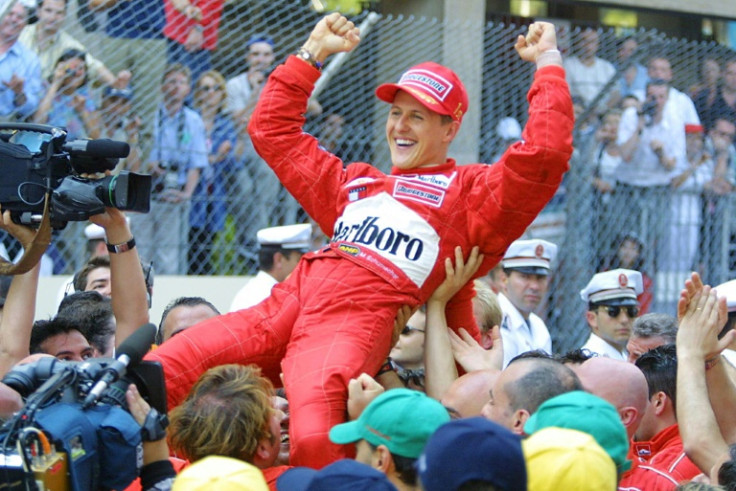
The Missing Medical Files
If the family's silence is designed to deny gossip oxygen, blackmail attempts attack the same problem from the other direction, weaponising the very absence of information that the Schumachers have worked to preserve. Reports describe a plot in which private material and digitised medical records were used as leverage, with demands running into the millions.
In February 2025, Sky Sports reported that three men were found guilty of attempted blackmail against the Schumacher family after demanding €15m to avoid the release of private photos, videos and digitised medical records, with the case heard at a district court in Wuppertal. The same report said the public prosecutor's office described the seizure of around 900 pictures and nearly 600 videos, along with digitised medical records, while noting that a hard drive remained missing.
That missing hard drive is the detail that refuses to settle. The idea that sensitive material might still be out there, unaccounted for, helps explain why the family's rules have not softened with time. A decade can dull many things, but it does not make private medical information any less private, or any less valuable to the wrong person.
The Schumachers have never offered the public the closure it sometimes demands, and the blackmail case underlines the cost of that stance, as well as its rationale. In a world where intimate data can be copied, traded and threatened into daylight, the most revealing update on Michael Schumacher may be the one his family still refuses to give.
© Copyright IBTimes 2026. All rights reserved.
- MOST POPULAR IN Sports