'I Borrowed £45,000. Now I Owe £80,000': Why UK Graduates Call Student Debt a Lifetime Graduate Tax
Graduates raise alarm over frozen thresholds and soaring interest as MPs investigate student loan system


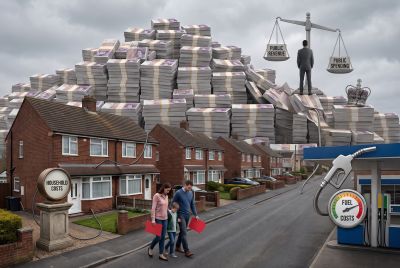
Growing anger over student loan repayments is sparking a heated and deeply personal debate across UK social media, as thousands of graduates say the reality of university finance has become far more severe than they were led to expect.
Many describe the system as a 'lifetime graduate tax' that continues to place them under financial and psychological strain.
On 2 June, MPs launched an inquiry into student finance and graduate taxation amid growing concerns over decades-long repayments, rising interest charges and changing loan terms.
Across social media, graduates have described the system as 'disgusting', 'regressive' and an 'undemocratic tax'. They argue that the reality of student debt bears little resemblance to what they were told while applying for university finance.
One Reddit user responding to BBC coverage wrote: 'Moral Failure.'
The scale of concern has become difficult for policymakers to ignore. More than 50,000 graduates responded to the Treasury Committee's call for evidence, with many raising concerns about rising debt balances, frozen repayment thresholds and changes to loan terms.
Graduates Say They Were Never Fully Prepared
One of the strongest criticisms gaining traction online is the argument that student loans were marketed to teenagers without fully explaining the long-term financial implications.
While the system was originally designed to widen access to higher education regardless of family income, many borrowers now argue that the complexity of repayment terms, interest charges and policy changes was never adequately explained.
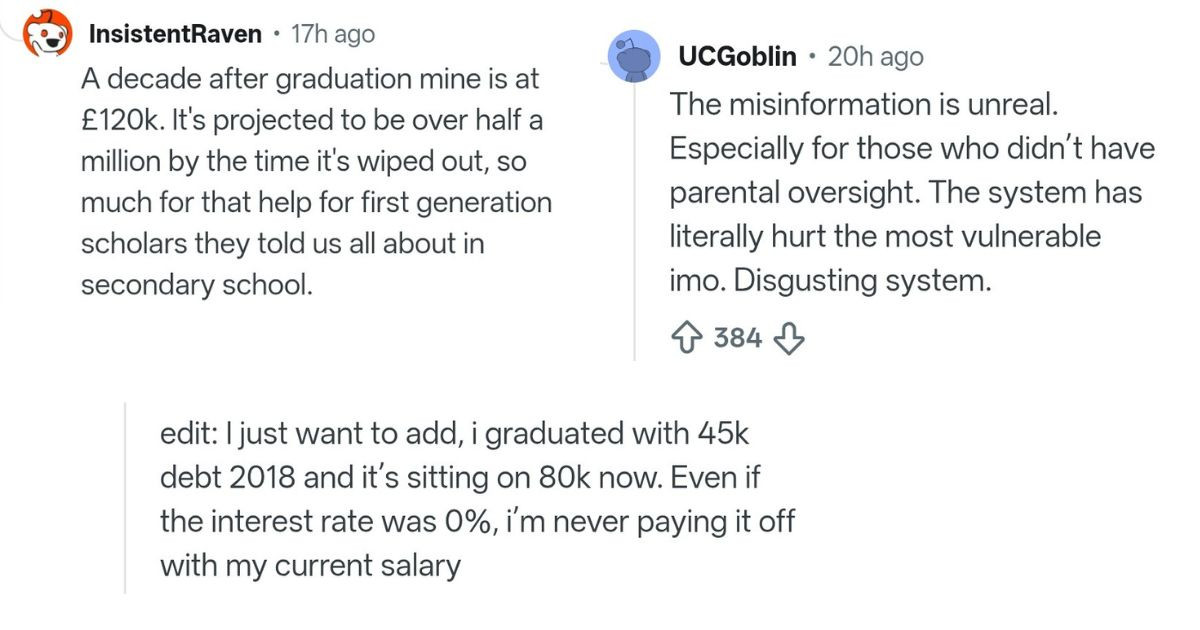
In response to BBC coverage, a graduate wrote: 'The misinformation is unreal, especially for those who didn't have parental oversight. The system has literally hurt the most vulnerable.'
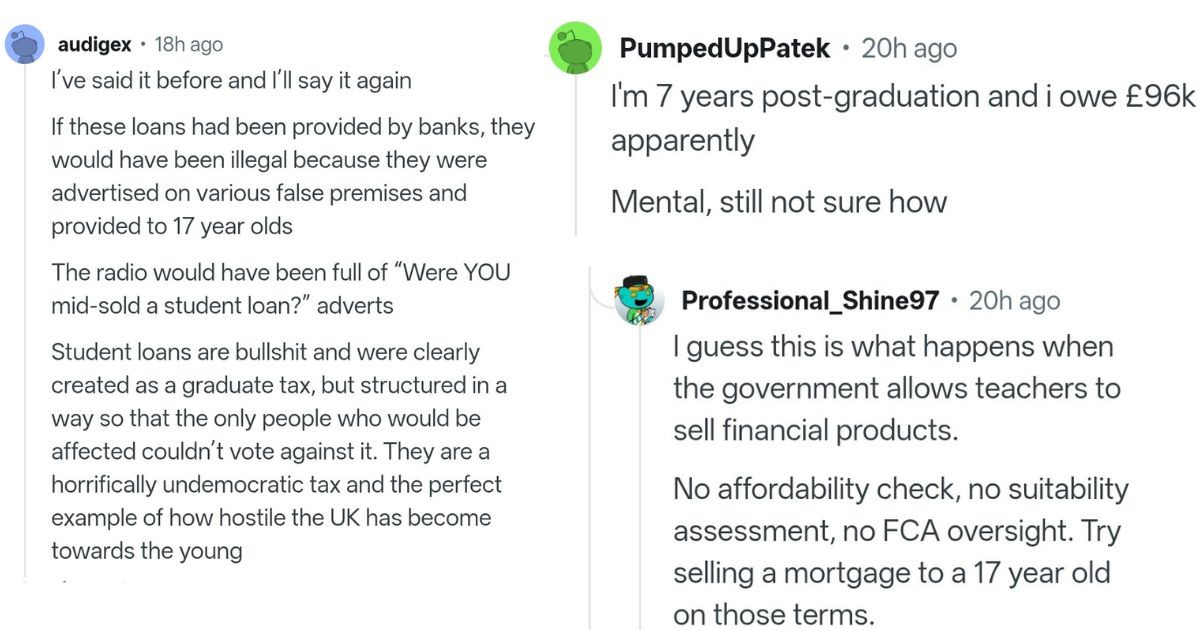
Another added: 'No affordability check, no suitability assessment, no FCA oversight. Try selling a mortgage to a 17-year-old on those terms.'
The Maths Doesn't Add Up
Discussion surrounding student debt has exploded online as graduates share loan balances that continue to rise despite years of regular repayments.
On Reddit, many borrowers have posted personal stories describing how their debt increased by tens of thousands of pounds because of interest accumulation.
One graduate wrote: 'A decade after graduation, mine is at £120,000.'
Another said: 'I am seven years post-graduation and I apparently owe £96,000.'
A third graduate added: 'I graduated with £45,000 of debt in 2018 and it's sitting at £80,000 now.'
The frustration is not limited to social media. During the Treasury Committee hearing, National Union of Students representative Alex Stanley described this experience as 'harrowing' for many young graduates trying to build stable social and financial lives.
'I graduated just three years ago and borrowed £50,000, and I am already in a situation where I have £63,000 of debt,' he told MPs.
Committee member Yuan Yang noted that many borrowers find annual loan statements 'extremely soul destroying' because their debt continues to increase despite years of repayments.
Many graduates consider this loan system a long-term tax on earnings.
The government's decision to freeze repayment thresholds has further increased repayment pressure as graduates struggle to keep pace with inflation and rising living costs.
Many graduates also discussed the emotional toll associated with long-term debt in online discussions, particularly among younger workers already struggling with housing affordability and financial insecurity.
Claims Of 'Mis-Selling' and Moral Failure
Amid growing frustration, graduates also questioned the acceptability and viability of the student loan system in the private sector. A graduate wrote online: 'If these loans had been provided by banks, they would have been illegal because they were advertised on various false premises and provided to 17-year-olds.'
Critics argue that retrospective policy changes, frozen repayment thresholds and interest structures have fundamentally altered the original deal offered to students.
During the Treasury Committee hearing, Sir Philip Augar, who led the government's independent review of post-18 education funding, said there was a 'moral issue' involved.
'You should not retrospectively change the terms in quite a complicated, almost sneaky way, bit by bit,' he told MPs.
According to witnesses, student loans lack many of the consumer protections available under the Consumer Credit Act and financial services regulations. These protections would otherwise restrict providers from unilaterally and retrospectively changing the terms.
Fran is one of those affected graduates. She had £58,000 worth of debt which, after six years of repayments, stands at £66,000. While sharing her story to ITV news, she said: 'When I was sold the loan at 17, it was explained to us that these loans would never affect our mortgages. Yet, I am sat here with this massive outgoing and it's wrong. It's definitely affecting us.'
Fran's experience reflects concerns raised by many graduates who say they did not fully understand the long-term implications of the loan system when they signed up.
Why the Story Resonates Online
The debate is generating strong engagement because student loan repayments increasingly affect wider financial decisions. Many graduates believe the student loan system has become a long-term financial burden affecting major life decisions such as buying a home, saving money, starting a family or changing careers.
The high tuition fees and debt burdens have weakened public confidence in the value of higher education.
Dan, a teacher who had £63,000 worth of debt, now has £87,500 worth of debt after eight years of repayments. He said he would not be a roadblock if his children wanted to attend university, but if asked for his opinion, he would not want them to experience the same pressure he faces.
'Do I want to burden my kids with the level of debt I have got? I would probably say no.'
Fran and Dan are not isolated cases. Evidence presented to MPs suggests their experiences reflect a much wider pattern affecting graduates across Britain.
MPs Hear Warnings of an 'Intergenerational Crisis'
Witnesses lamented that apart from making high monthly repayments, the debt has also affected their ability to start a family, own a home and save for retirement.
Oliver Gardner presented data from a survey of more than 1,300 people, revealing that 90% of respondents said student loan repayments are 'delaying or preventing their ability to buy a house', while 85% stated that repayments are 'delaying or preventing them from starting a family'.
Gardner argued that this would result in an 'intergenerational crisis' in which young people will struggle to buy homes, build savings or achieve the financial security enjoyed by previous generations.
Campaigners warned that the impact could stretch into retirement, with some borrowers expected to continue making repayments into their early 60s under newer loan plans.
Several witnesses told MPs they felt graduates were being treated as 'cash cows' through frozen repayment thresholds and changing loan terms.
What Happens Next?
The Committee is expected to publish a report before Parliament's summer recess, increasing pressure on ministers to address concerns raised by graduates.
Across social media platforms, student debt is increasingly being discussed as a symbol of broader economic insecurity facing younger generations in Britain.
Critics argue the issue has evolved far beyond a technical policy debate and has become a wider conversation about affordability, opportunity and trust in the UK's higher education system.
As Alex Stanley told MPs: 'It is not fair that we have been punished for having the ambition to go to university, but I hope that we will have the opportunity to unfreeze our futures.'
For many graduates following the inquiry, that hope now depends on whether policymakers are willing to reform a system they believe is no longer working as intended.
© Copyright IBTimes 2026. All rights reserved.
- Recommended For You