

Hundreds of Britons Face £100,000 Tax Bills After Cashing in Their Pensions: The Reasons Why
Savers who take out all their money at once are charged at the highest rates on most of it, so the bill is quite large

Hundreds of savers have been landed with tax bills of more than £100,000 after emptying their pensions early, new figures show. The rush to pull money out followed a government decision to bring unused pension savings within inheritance tax from April 2027. Many who acted to dodge that future charge triggered a large income tax bill straight away.
The pattern comes from an analysis of Financial Conduct Authority data by the pension firm Standard Life. It found a clear jump in very large withdrawals in the months after Chancellor Rachel Reeves announced the change.
What the Figures Show
Between October 2024 and March 2025, almost 400 people took out pension pots worth £250,000 or more in one go. Each of those savers faced a minimum income tax bill of £98,700, according to Standard Life. The number pulling out sums that size was around a third higher than in the same six months a year earlier, and the scale of the shift is set out below.

The trend was not limited to the very largest pots. A further 1,772 people fully cashed in pensions worth between £100,000 and £249,999 over the same period, about 20% more than the year before. Both groups moved in the months after the change was announced.
Taken together, the figures suggest thousands of savers reacted quickly to the prospect of a future death charge on their pensions. Standard Life's view is that many moved without fully weighing the immediate cost. The inheritance tax change does not take effect until April 2027. So a saver who empties a pot now to avoid it can pay a large bill years early, often a bigger one than the charge they feared.
Why the Bills Are So Large
The size of the bills comes down to how pension withdrawals are taxed. A saver can normally take a quarter of a pension tax-free, up to a cap of £268,275. Every pound taken above that quarter counts as income for the year and is taxed at the saver's marginal rate. The chart below shows how a £250,000 pot is carved up.
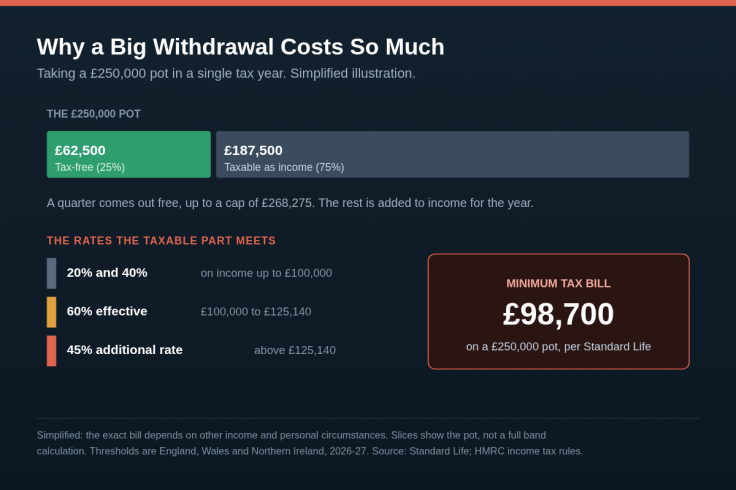
A single large withdrawal stacks up fast against the income tax bands. Pull out a six-figure sum in one go and it lands on top of any other income, pushing the total well into the higher bands. That is what turns a one-off decision into a five-figure tax charge.
Two thresholds do most of the damage. Once total income passes £100,000, the tax-free personal allowance is clawed back by £1 for every £2 earned above it. That creates an effective 60% rate on income between £100,000 and £125,140. Above £125,140, income is taxed at the additional rate of 45%. A large pension withdrawal can cross both lines at once. That is how a single decision produces a bill approaching £100,000.
What Savers Can Do
The immediate lesson is that the inheritance tax change is still nearly two years away, so there is time to plan rather than react. Emptying a pot in a single tax year is what drives the bill into the top brackets. Spreading withdrawals across several years, or taking only what is needed, keeps more of the money out of the 45% and 60% bands.
Anyone unsure is best served by taking regulated advice before touching a pension, because a withdrawal cannot be undone once made. A financial adviser, or the government's free Pension Wise service, can set out how a planned withdrawal would be taxed. They can also say whether the feared future charge would even apply to a saver's estate.
© Copyright IBTimes 2026. All rights reserved.