IDF Soldier Exposes Gaza 'Dog Line' Where Palestinians Were Shot on Sight and Corpses Left for Dogs
Former IDF soldier exposes illegal actions and moral dilemmas faced during Gaza conflict
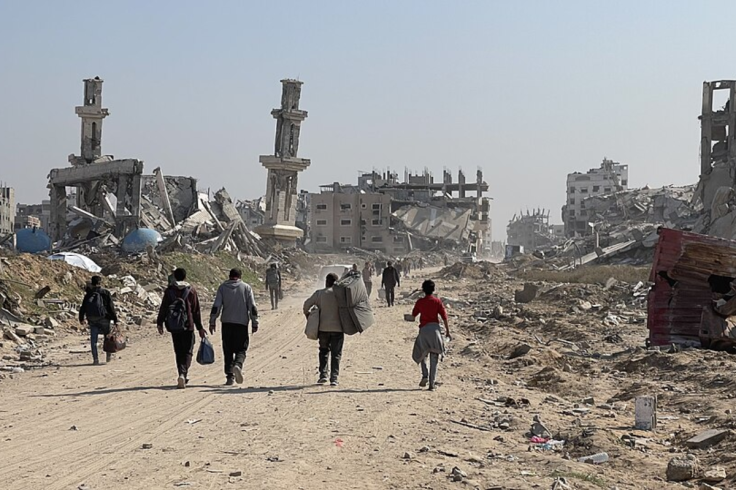
An Israeli soldier who fought in Gaza has given a rare and damning first-person account of a war he now describes as illegal, immoral and driven by a system — not rogue individuals. Speaking to The Economist's 1843 magazine under the pseudonym Jonathan, the former infantry soldier described a conflict in which Palestinian men were shot without confirmation of combatant status, unarmed civilians were used as human shields, and entire neighbourhoods were razed without clear military justification.
Among the most disturbing details in his account is what soldiers called the 'dog line' — an invisible boundary drawn around IDF positions in Gaza. Any Palestinian who crossed it was shot on sight. The corpses were left where they fell, and dogs gathered along the line to feed on them. Jonathan recounted how soldiers on guard duty would open fire without knowing who they were killing. 'Someone on guard duty sees someone, shoots him, kills him — we wouldn't know what his story was or what he did,' he said.
Killed Without Checking
Jonathan told The Economist that the absence of formal rules of engagement in Gaza set the conflict apart from his previous service in the West Bank. No guidance was given on how to identify civilians. All men of military age were treated as legitimate targets — and the definition of military age, he said, was left dangerously open. 'It could be from 16 to 60 or even younger,' he said.
The consequences, by his own admission, were grave. 'Most of the people that my unit killed were not armed,' he said. 'We had cases where we killed a lot of people, and we didn't check if they had uniforms or weapons.' Figures seen moving through rubble hundreds of metres away were fired upon. The word 'civilian' was not part of the operational vocabulary.
In response, an IDF spokesman told The Economist that the military 'issues detailed and binding rules of engagement to all of its troops' and that directives require strikes should be directed 'only against lawful military objectives.' The spokesman added that 'in cases of doubt, IDF directives require that the individual be presumed to be a civilian.'
A “dog line” in Gaza.
— Hamza Yusuf (@Hamza_a96) May 30, 2026
Any Palestinian who crossed it would be shot. Dogs then ate the corpses.
Never forgive. Never forget. pic.twitter.com/ZfhR23dJzz
Human Shields With Their Own Name
Beyond the 'dog line', Jonathan's account shed light on a practice that became so widespread it acquired its own codename. Palestinian civilians — predominantly men of military age — were detained and forced to enter buildings ahead of IDF soldiers, check for booby traps, and guide troops through areas cleared by Hamas fighters. The practice was called the 'mosquito protocol.' The IDF told The Economist that using individuals as human shields 'is strictly prohibited in IDF orders which are consistent with international law.'
Jonathan said his unit's 'mosquito' appeared to be a young man who had been passed between units. At night, he was tied up in a corner near the guard post. 'We had arguments inside my platoon, but it wasn't a moral discussion about using human shields. It was about how to treat him: what and how much we should give him to eat, if we should beat him or not,' he said.
When his unit was withdrawn, the man was simply released into an area where men of military age risked being shot. The IDF has since announced an investigation into the use of human shields in Gaza, though no charges have been brought against any soldiers to date.
'It Is Illegal, It Is Not Moral and It Is Wrong'
Jonathan's disillusionment deepened as the war dragged on. Hostages remained in captivity. Hamas had not been destroyed. Reservists began skipping rotations. The justification for continued fighting grew harder to articulate — particularly when it came to the systematic demolition of entire neighbourhoods.
'I couldn't explain the destruction as a military reason,' he told The Economist. 'It wasn't about security or defeating Hamas. It was something else — entire neighbourhoods completely gone,' demolitions that became, he said, the primary activity for most IDF infantry in Gaza.
On the radio, Palestinians were referred to by a Hebrew term translated as 'dirties.' Soldiers spoke openly about going to Gaza to hunt. Some expressed frustration when orders prevented them from firing on displaced families sheltering in schools or clinics. 'In the eyes of many Israelis and soldiers, every Palestinian in Gaza is a terrorist,' Jonathan said. 'If it's a kid, he is probably a future terrorist. If it's a woman, she's probably the future mother of a future terrorist.'
His conclusion was unsparing. 'I know the solution we had — to kill every military-age male, and sometimes not just males — is not a solution. It's illegal, it's not moral and it's wrong.'
🚨🔥 IDF soldier confirms 'dog lines': shoot any Gazan who crosses, feed them to dogs
— Ash (@bitcoins1stlady) May 30, 2026
The Economist interviews Israeli troops who served in Gaza. Their testimony is chilling.
🔶 All men of military age were deemed legitimate targets. And military age is really open to… pic.twitter.com/rQTpJyut1G
A Soldier's Reckoning
Jonathan came forward through Breaking the Silence, an Israeli NGO established in 2004 that collects testimony from former soldiers about the occupation in the West Bank and Gaza. The organisation has logged accounts from more than 6,000 people. Its executive director, Nadav Weiman, told The Economist that the group exists to counter the narrative that abuses were committed only by bad apples. 'It's the entire system,' Weiman said. 'It is systematic crimes that we are doing.'
Jonathan now travels in Europe and says he is unable to take pride in his nationality. 'Today I'm not proud to be an Israeli, to be a former soldier. It's something I am ashamed of,' he said.
The mental health toll on Gaza veterans has been severe. According to an Israeli government report cited by The Economist, 279 soldiers attempted suicide between January 2024 and July 2025. The Economist also cited IDF figures showing a 40 per cent increase in PTSD cases between September 2023 and January 2026.
First-hand soldier testimony of this nature is rare and legally significant. International humanitarian law prohibits the use of human shields, collective punishment, and the targeting of civilians — all practices described in Jonathan's account. As pressure mounts on governments worldwide to respond to the scale of the conflict in Gaza, accounts like his are likely to feature prominently in ongoing international legal proceedings against Israel.
© Copyright IBTimes 2026. All rights reserved.
- Recommended For You