

Judge Blocks Donald Trump's Birthright Citizenship Order, Ruling He 'Cannot Carve Out New Exceptions'
Judge Christopher R. Cooper ruled that the president cannot create additional exceptions to the constitutional citizenship guarantee through an executive order
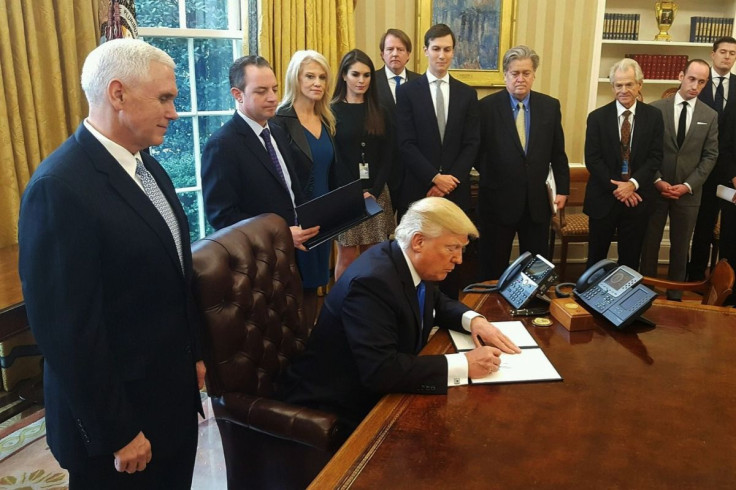
A federal judge in Washington, DC, blocked President Donald Trump's latest birthright citizenship order on 25 November 2026, ruling that the president cannot create additional exceptions to the constitutional right.
US District Judge Christopher R. Cooper issued a nationwide classwide preliminary injunction, preventing federal agencies from enforcing the restrictions on children covered by the certified class action.
Why Donald Trump's Birthright Citizenship Order Was Blocked
The decision marks another judicial setback for Trump's efforts to narrow birthright citizenship. It reinforces the constitutional protections afforded to children born in the United States and subject to its jurisdiction, regardless of their parents' immigration status.
Narrow historical exceptions include children of foreign diplomats who enjoy full diplomatic immunity and children born to enemy forces occupying US territory.
The ruling concerns Executive Order 14418, titled 'Continuing to Protect the Meaning and Value of American Citizenship'. Trump signed the order on 6 August 2026, after an earlier Supreme Court decision that rejected his first attempt to restrict birthright citizenship.
The second order targeted additional categories of children born in the United States. These included children of certain foreign government employees and international organisation workers, children born through commercial surrogacy arrangements, and children whose parents were classified as 'alien enemies' under the administration's definition, which included individuals associated with designated foreign terrorist organisations.
Cooper rejected the administration's attempt to establish those additional exclusions. 'As the Supreme Court has made clear, however, the President cannot carve out new exceptions to birthright citizenship for children born in the United States and subject to its laws,' the judge wrote in his memorandum opinion.
He also explained that the 14th Amendment's Citizenship Clause guarantees citizenship to nearly all children born in the country. The judge referred to the Supreme Court's earlier decision, which had already rejected the administration's first executive order.
The latest injunction applies to a certified class of children who are, or may be, unlawfully denied citizenship under Trump's August directive. Importantly, Cooper's decision is a preliminary injunction, not a final resolution of the underlying lawsuit.
Families Challenging Donald Trump's Citizenship Restrictions
The case, Nathan v. Trump, was filed on 28 September 2026 in the US District Court for the District of Columbia. Several parents and children challenged the administration's restrictions, arguing that Executive Order 14418 violated constitutional and statutory protections of birthright citizenship.
Their circumstances illustrate the policy's potential consequences. The plaintiffs included Clara, a French citizen who gave birth to her son, Nathan, in Washington, DC, in August 2026. She and her husband hold G-4 visas and work for international organisations with international-organisation immunity.
Another plaintiff, Edward, is an Australian citizen whose daughter, Eleanor, was born in the United States through commercial surrogacy in October 2026. Alexander, a Swiss citizen living in Monaco, also challenged the restrictions after his child was born through a US surrogacy arrangement that month.
Patricia, a Western European citizen living in the United States, is expecting a child around April 2027. She and her husband hold G-4 visas and work for international organisations. The case also includes Gregory, a Canadian citizen, who, along with his husband, is expecting twins through a US surrogacy arrangement in January 2027.
The plaintiffs argued that the restrictions could prevent their children from obtaining US passports and Social Security numbers. They also raised concerns about immigration enforcement, as government guidance warned that children denied citizenship under the order could face removal from the United States.
White House Pushes Back Against Judge's Decision
The White House defended Trump's executive order following Cooper's ruling, questioning the judge's intervention.
A spokesperson told Newsweek that the decision was 'just another ruling from an activist judge appointed by Obama, attempting to thwart President Trump's commonsense agenda'. The spokesperson maintained that the birthright citizenship directive was consistent with the Supreme Court's legal reasoning.
This is not the first court to block the August order. US District Judge Deborah L. Boardman previously issued an injunction in Maryland, adding another legal obstacle for the administration.
Trump's administration now faces the challenge of overturning both injunctions before it can enforce the restrictions. An appeal of Cooper's decision could proceed to the US Court of Appeals for the DC Circuit.
The case also raises a question central to the dispute. Can a president redefine constitutional protections for citizenship through an executive order, even though the Supreme Court has already rejected an earlier attempt?
© Copyright IBTimes 2026. All rights reserved.