

How Keisha Lance Bottoms Went From Atlanta City Hall to Georgia's Governor's Mansion
Georgia's governor-elect returns to elected office after a turbulent mayoral term, a White House appointment and a campaign against a billionaire Republican
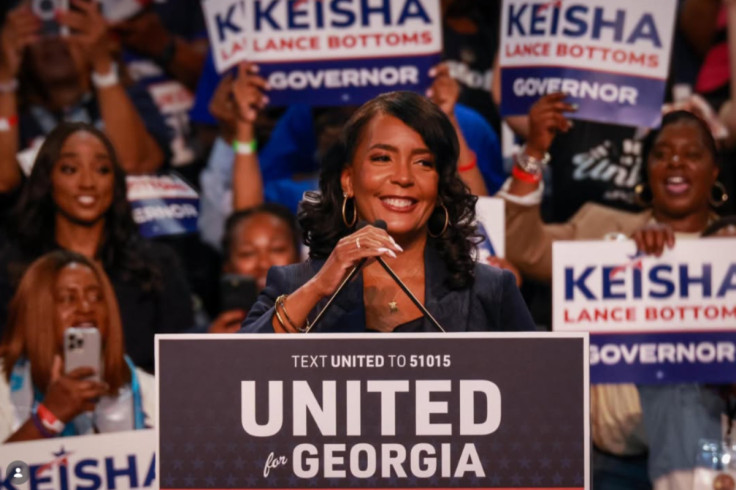
Keisha Lance Bottoms announced in 2021 that she would not seek another term as Atlanta mayor, leaving questions about her political future. Five years after that announcement, she has won Georgia's governorship, becoming the first Black woman elected governor of a US state.
The Democrat defeated Republican healthcare businessman Rick Jackson in the 3 November election and will succeed Brian Kemp, who could not seek another consecutive term. IBTimes UK reported that her victory returns the governor's office to Democrats after more than two decades of Republican control.
An Atlanta Upbringing and a Legal Career
Bottoms, 56, grew up in Atlanta and is the daughter of the late R&B singer Major Lance and Sylvia Robinson. She and her husband, Derek, have four children, according to her personal biography.
She studied broadcast journalism at Florida A&M University before earning a law degree at Georgia State University. Florida A&M's account describes her subsequent work practising law and serving as a magistrate judge.
Her electoral career began with a successful Atlanta City Council campaign in 2009, followed by re-election in 2013. Outgoing mayor Kasim Reed endorsed her bid to succeed him, and she defeated Mary Norwood in the December 2017 runoff before taking office on 2 January 2018.
Today I was sworn in as the 60th Mayor of Atlanta. This is a moment I won’t soon forget. Thank you to my family, friends and all of Atlanta for your support, your encouragement and your faith in me. I am honored to be your new Mayor - now let’s get to work. #OneAtlanta pic.twitter.com/Du4FXDL2dN
— Keisha Lance Bottoms (@KeishaBottoms) January 3, 2018
Leading Atlanta Through Overlapping Crises
Bottoms' single mayoral term encompassed a major cyberattack, the coronavirus pandemic and racial justice protests. Her public appeal for calm during unrest following George Floyd's death in 2020 brought national attention, while rising violent crime became a focus of criticism.
Her record also included measures intended to strengthen public services. In 2018, Atlanta City Council approved $10 million (£7.45 million) for police salary adjustments under a proposal from her administration, part of a wider programme to improve officer pay and recruitment.
That combination of crisis leadership and criticism followed her into the governor's race. Jackson attacked her handling of Atlanta and portrayed her decision against another mayoral term as abandoning the city, according to Associated Press reporting.
Why She Left City Hall and Returned
Bottoms announced her decision against re-election in May 2021, explaining that prayer and reflection had convinced her to step aside. In a statement transcribed by The Atlanta Journal-Constitution, she described it as a decision made from 'a position of strength and not weakness'.
https://t.co/4yHFpvnVre pic.twitter.com/b7IJEIyojq
— Keisha Lance Bottoms (@KeishaBottoms) May 7, 2021
She completed her term and left office in January 2022, rather than resigning when she made that announcement. When she returned to the campaign trail, she argued that declining another mayoral term did not mean she had finished with public service.
In a May 2025 interview with Capital B Atlanta, she linked her renewed interest in elected office to Donald Trump's return to the presidency. She said her earlier decision reflected a different period in her life, adding: 'I'm standing up and I'm fighting back.'
A White House Role Before the Statewide Campaign
Between those campaigns, Bottoms joined Joe Biden's administration. On 14 June 2022, the White House announced her appointment as senior adviser for public engagement, overseeing an office connecting the presidency with community leaders and other stakeholders.
The position broadened her experience beyond municipal government and placed her within the administration's national outreach operation. Her background in the courts, council chamber, mayor's office and White House subsequently formed the experience she offered Georgia voters.
Defeating a Wealthy Republican Opponent
Bottoms officially launched her governor campaign on 20 May 2025, presenting herself as an experienced executive. Her opponent offered a contrasting pitch centred on his business background, tax cuts and public safety, with endorsements from Trump and Kemp.
Jackson invested more than $200 million (£149 million) of his own fortune, according to Associated Press election coverage. Bottoms nevertheless won, becoming the first former Atlanta mayor elected Georgia governor and the first Democrat elected to the office since 1998.
The result followed Stacey Abrams' unsuccessful Democratic campaigns against Kemp in 2018 and 2022. It also gave Georgia its first woman and first Black governor-elect, adding statewide executive power to Democrats' recent successes in federal elections.
What She Has Promised Georgians
Bottoms' published platform calls for expanding Medicaid, supporting rural healthcare and addressing prescription drug costs. Her housing proposals include faster permitting, assistance for renters and first-time buyers, and an affordable housing trust fund.
On education, she proposes changes to school funding, eliminating state income tax for teachers and creating pathways to free technical and community college. Her public safety agenda combines additional investigative support for law enforcement with violence prevention, treatment and re-entry programmes.
These remain proposals requiring funding and, in many cases, legislative approval. Winning the governorship does not automatically enact the platform.
What Happens Next
Bottoms remains governor-elect until her inauguration, with Kemp continuing in office during the transition. Her next challenge is to turn campaign commitments into a governing programme.
At her victory celebration, she promised to represent voters beyond her own supporters. 'No matter who you voted for tonight, I will be a governor for all of Georgia,' she said, according to the Associated Press.
© Copyright IBTimes 2026. All rights reserved.