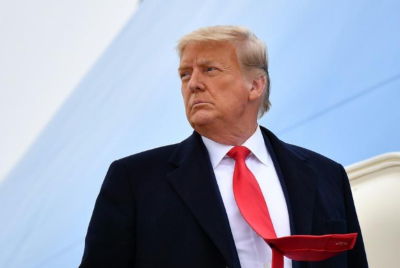
Medical Experts and Former Allies Sound Alarm Over 'Deteriorating' Donald Trump's 'Classic Signs of Dementia'
As Donald Trump proclaims himself a 'perfect physical specimen,' those who once defended him now openly wonder whether the man they knew is slipping away.

Donald Trump is facing fresh scrutiny over his health in Washington and beyond, as medical experts, political strategists and former allies claim the 79-year-old is showing 'classic signs of dementia' and possible stroke-related issues in recent months.
Questions about Trump's health have been simmering for years, but they have intensified since late 2025, when a string of unexplained bruises, rashes, visible bandages and apparent lapses in speech and movement drew wider public attention. The president, who insists he is in 'very good' condition, has repeatedly rejected concerns and cast himself as the 'healthiest president' in US history, but the chorus of doubters now includes people who once defended him.
In an in-depth profile published by The Wall Street Journal on 1 January, Trump addressed one of the most visible issues head-on. He said the bruises on his hands, frequently picked apart on social media, were the result of taking a higher dose of aspirin in recent years. Aspirin, he argued, was helping to thin his blood.
'They say aspirin is good for thinning out the blood, and I don't want thick blood pouring through my heart,' he told the paper. 'I want nice, thin blood pouring through my heart. Does that make sense?' He added that doctors would prefer him on a smaller dose, but he had been taking the larger one 'for years,' accepting that it 'causes bruising.' To head off speculation, he reportedly relies on makeup and bandages to cover marks and discolouration.

Visible Changes Fuel Trump Health Debate
A recent appearance showed Trump's skin and hands looking noticeably altered. On 3 March, cameras captured him with a heavy layer of foundation on his face and neck, a day after he was seen with what appeared to be a rash.
His primary physician, Dr. Sean Barbabella, moved quickly to explain that Trump was using 'a very common cream on the right side of his neck' as a preventative treatment for a skin condition. 'The president is using this treatment for one week, and the redness is expected to last for a few weeks,' Barbabella said.
By late March, Trump again appeared to be masking something. During the 24 March swearing-in of Homeland Security Secretary Markwayne Mullin, he appeared to have make-up on his right hand. Soon after, he was photographed with plasters on the same hand at Trump National Golf Club in Sterling, Virginia. Officials did not offer a detailed explanation.
Beneath the cosmetic questions sits a more serious medical puzzle. Trump underwent advanced imaging of his cardiovascular and abdominal systems in October 2025. He initially described the test as an MRI before later telling the Wall Street Journal it was 'less than that. It was a scan.' No full report has been made public.
On a January episode of The Court History podcast, Professor Bruce Davidson of Washington State University's Elson S Floyd College of Medicine went further than most. Citing changes in Trump's gait, speech and posture, he suggested the former president may have suffered a stroke that was never disclosed.
'I think his stroke was on the left side of the brain, which controls the right side of the body,' Davidson said, adding that he believed it happened 'six months ago or more, earlier in 2025,' He pointed to footage of Trump shuffling his feet instead of striding, cradling his right hand in his left and 'garbling words' in a way not seen in earlier years, though he noted some recent improvement. Davidson also highlighted 'marked episodes of excessive daytime sleepiness,' including Trump dozing during a White House event in July 2025 and again at the US Open.
Nothing in Davidson's account has been confirmed by the White House or Trump's medical team, and any diagnosis based on public video remains speculative and should be treated with caution.

Other clinicians have raised separate, if overlapping, worries. Health expert Dr. Gareth Nye flagged Trump's reported chronic venous insufficiency and medication for blood pressure and cholesterol as potential markers of cardiovascular stress. 'High blood pressure can cause lower limb swelling,' he said, after online commentators fixated on images of Trump with apparently swollen legs and ankles.
The speculation spiked again on 1 April, when Trump paused several times during a speech on the conflict in Iran, prompting talk of 'mini strokes' on social media. Over Easter weekend, rumours spread that he had been rushed to Walter Reed National Military Medical Center. Communications director Steven Cheung rebutted that directly, saying on X that Trump was 'working nonstop in the White House and Oval Office.' No hospitalisation has been officially acknowledged.

Allies Turn Critics Over Trump's Mind and Mood
Alongside the physical questions are increasingly blunt assessments of Trump's cognitive health. John Gartner, a former assistant professor of psychiatry at Johns Hopkins University Medical School, told one outlet in August 2025 that Trump's public performances represent 'gross deterioration from someone's baseline and function.'
'If you go back and look at film from the 1980s, [Trump] actually was extremely articulate,' Gartner said. 'He was still a jerk, but he was able to express himself in polished paragraphs, and now he really has trouble completing a thought, and that is a huge deterioration.'
New York magazine writer Ben Terris, speaking on the Today, Explained podcast, framed it less clinically but in similarly bleak terms. Trump's attempts to manage perceptions of his health, Terris argued, mirror his broader instinct to control every narrative, yet 'he's sort of losing some of that control.'
Veteran Democratic strategist James Carville, amplifying comments from another doctor who had noted possible dementia signs, urged viewers to trust their eyes. 'You don't have to be a neurologist or Dr. Jonathan Reiner or anything like that,' he said. 'We've all had experience with people aging... And you could just look at the guy as just an average person and say, "This man is deteriorating at a really rapid rate."'

The criticism is no longer confined to ideological opponents. On CNN's The Jim Acosta Show in March, Ty Cobb, who served as White House special counsel under Trump, called his late-night Truth Social posts evidence that he is 'clearly insane.' The unfiltered screeds, often published at 2 a.m. or 4 a.m., 'highlight the level of his insanity and depravity,' Cobb claimed.
Alex Jones, the conspiracy broadcaster and once-fierce Trump ally, has adopted a tone of grim resignation. Citing Trump's 'swollen ankles' and rambling speeches as signs of heart failure and cognitive decline, he told his audience they should be 'sad about Trump,' before concluding, 'He's gone. And that's it.'
Through all of this, Trump leans defiantly on the persona he prefers. At a St. Patrick's Day event on 17 March, he boasted of being the 'best physical specimen' and 'healthiest president this nation has ever seen,' recounting how former White House physician Ronny Jackson once ranked him 'by far' above Barack Obama and others. He has long attributed his endurance to 'very good genetics.'
No comprehensive, independent medical report has been released to verify or disprove the swirl of claims. Until that happens, every new bruise, pause or stumble by Trump will be pored over by supporters and critics alike, and much of the debate will sit in the uneasy space between what can be seen and what can be proven.
© Copyright IBTimes 2026. All rights reserved.
- Recommended For You