

$600BN Cash Payout vs $300BN Tariff Revenue: Donald Trump's $2,000 Cheque Plan Facing Massive Deficit
A promise of easy money at the border has become a test of credibility, timing and basic arithmetic for Donald Trump and the Americans waiting on his word.
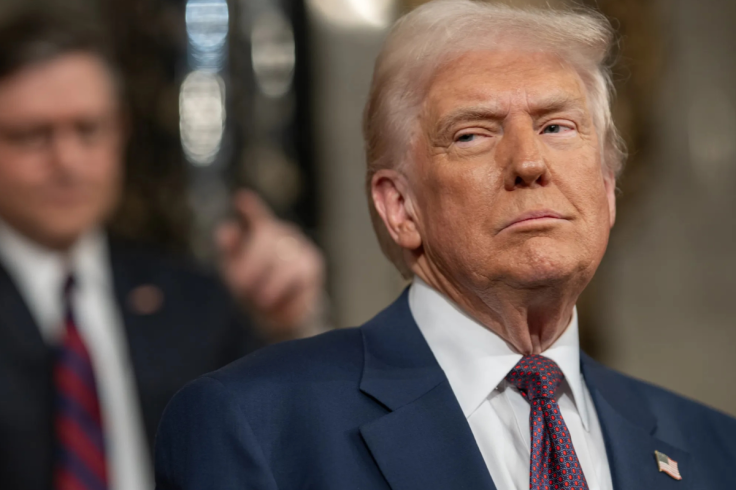
Donald Trump's promise of a $2,000 'tariff dividend' cheque to millions of Americans remains stalled in Washington, as of late July, with no legislation approved and experts warning the White House is running out of time to turn the headline-grabbing pledge into reality.
The president has repeatedly floated the idea of sending $2,000 payments to low and middle‑income households, funded not by traditional stimulus borrowing but by revenue raised from tariffs on imported goods.
The pitch is simple enough: tariffs have driven up prices on foreign products, so those who effectively overpaid at the till should be compensated by the federal government. On paper it sounds like a clean populist trade‑off. In practice, almost every plank of that promise is still theoretical.
Financial adviser Matthew Prchal, who has been tracking the proposal and its logistics, told viewers that if the Trump team wants the 'tariff dividend' to land with voters, the clock is already ticking down.
'The window in which this $2,000 payment would need to be sent out is between now and early November,' he said, calling the current period 'in my honest opinion, the sweet spot.'
He put particular emphasis on the summer months. 'Generally June, July, August, and maybe maybe the first half of September. That in my opinion, is the sweet spot,' Prchal argued, suggesting that any later and the impact on strained household budgets would start to blunt.
Donald Trump's Tariff Dividend Meets a Maths Problem
After weeks of mounting confusion online, with social media awash with claims that payments were imminent, portals were opening, or applications were required. None of that, according to US tax authorities, is true.
Trump's proposal hinges on a relatively narrow revenue stream. Tariffs are taxes on imported goods, collected at the border. The plan would divert that money into direct cheques, rather than into the general Treasury pot. Supporters cast it as ordinary Americans clawing back a piece of global trade. Critics point out a basic arithmetic problem.
If millions of Americans are to be paid $2,000 each, the total cost quickly climbs into the tens or even hundreds of billions of dollars. Analysts have already warned that tariff revenue alone is unlikely to cover a programme on that scale without dipping into the broader federal budget. There is no sign in the current reporting that the administration has produced a detailed funding breakdown or a bill text to reassure sceptics.
Prchal himself cautioned that even if the numbers can be made to work, delay could badly undercut the political and economic value of the move.
'If they wait too long, it's going to be too late,' he said, describing a public that is 'frustrated' and 'irritated'. 'The vast majority of people out there are struggling financially in a huge, huge, huge way.'
That note of urgency is less about election choreography and more about household cashflow. For many families still juggling high rents, lingering debts and the long shadow of inflation, an extra $2,000 now is very different from an extra $2,000 next year.
Donald Trump Cheques Fuel a Surge in Scams
In the absence of any signed law, the promise has opened a different kind of floodgate. Fraudsters have seized on the confusion around Trump's $2,000 cheques to push phishing schemes, fake application portals and text‑message cons.
Authorities and financial watchdogs are now urging Americans to treat any request for fees, banking details or 'pre‑approval' forms with extreme caution. The Internal Revenue Service has been explicit on two crucial points.
First, the IRS has not created any 'tariff refund portal.' There is no legitimate government website where citizens can apply specifically for a Trump‑branded tariff dividend. Second, there is currently no requirement for anyone to submit applications, pay processing charges or share private account information with third‑party platforms to secure money that does not yet exist.

Tax officials and the US Treasury have said they would publish clear guidance on how any such scheme would operate, but only after a law has been passed by Congress and an official payment plan is publicly announced. At the moment, there is no such law and no approved plan.
That leaves Trump's $2,000 promise in an awkward limbo. It is neither a con cooked up by internet hoaxers nor a concrete benefit people can reasonably plan around. It sits instead in the grey zone of American politics, where eye‑catching pledges are made loudly, the fine print is hazy, and ordinary voters are left to decode what, if anything, will land in their bank accounts.
Nothing in the available reporting confirms that Congress is close to passing a tariff dividend bill, or that the IRS and Treasury have finalised mechanisms to deliver the money. Until that changes, every timetable, including Prchal's carefully sketched 'sweet spot,' has to be taken with a grain of salt.
© Copyright IBTimes 2026. All rights reserved.