Trump Begins Shifting Iran War Blame To Pete Hegseth—Says He Was First To Say 'Let's Do It'
Trump Shifts Blame to Defense Secretary Hegseth Amid Iran War Controversy

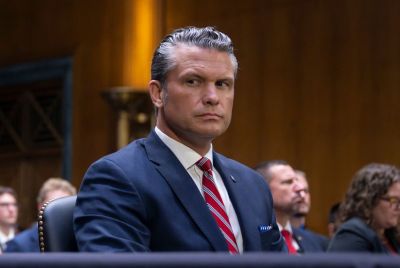
Donald Trump stood beside Pete Hegseth at a roundtable in Memphis on 23 March 2026 and, in front of cameras and reporters, publicly credited his Defence Secretary as the first person in the room to push for going to war with Iran.
The remarks, delivered at a Memphis Safe Task Force roundtable at the Tennessee Air National Guard Armory, came as Operation Epic Fury entered its fourth week and grew increasingly difficult to defend politically. The timing was loaded.
Hours earlier, Trump had claimed twice in separate public appearances that Iran's retaliatory strikes on Gulf allies had come as a complete surprise to his administration. Reuters had already reported, on 16 March, that Trump had in fact been briefed before the war that precisely that scenario was a likely outcome.
The confluence of those two facts, Trump distancing himself from the decision while simultaneously claiming to have been blindsided by its consequences, drew immediate scrutiny from reporters and Democratic lawmakers.
What Trump Said in Memphis, Verbatim
Trump's remarks were captured on camera and posted publicly by journalist Aaron Rupar. In the footage, Trump described the internal deliberations that preceded the 28 February launch of Operation Epic Fury in detail. 'I called Pete, I called General Caine, I called a lot of our great people,' Trump said.
'We've got a problem in the Middle East. We have a country — that for 47 years has been a purveyor of terror. And they're very close to having a nuclear weapon. We can keep going and get that 50,000 up to 55 and 60, there's no end. Or we could take a stop and make a little journey into the Middle East, and eliminate a big problem.'
Trump blames Hegseth for the war: "Pete, I think you were the first one to speak up. You said, 'Let's do it.'" pic.twitter.com/QBGeFuhM1M
— Aaron Rupar (@atrupar) March 23, 2026
He then turned the narrative toward his Defence Secretary directly. 'Pete, I think you were the first one to speak up,' Trump said. 'And you said, 'Let's do it.' Because you can't let them have a nuclear weapon.' The Hill confirmed the quote in its reporting on the event. Hegseth was seated beside Trump as the remarks were made and did not visibly respond.
Trump also acknowledged on separate occasions this week that Vice President JD Vance had been less enthusiastic about military action than other senior advisers.
By naming Hegseth as the first advocate for action, Trump effectively placed the momentum for one of the most consequential, and most publicly unpopular foreign policy decisions of his second term on a Cabinet member rather than on himself.

The president has consistently struggled to offer a consistent public justification for the war. Stated rationales have ranged from the claim that Israel would have acted regardless, to the assertion that Iran was weeks away from completing a nuclear weapon and would use it, a claim that two senior intelligence officials directly contradicted in separate congressional briefings, according to Reuters.
The Intelligence Warnings Trump Says He Never Got
Trump's claim to have been surprised by Iran's retaliatory reach sits in direct tension with what the US intelligence community told him before the war began. On 16 March, Reuters reported that pre-war intelligence assessments had identified Iranian retaliation against Gulf allies as a probable outcome, not a certainty, but 'on the list of potential outcomes,' as one source put it.
Trump said twice on 16 March that the Gulf strikes were a surprise. 'They weren't supposed to go after all these other countries in the Middle East,' he told reporters at a White House event. 'Nobody expected that. We were shocked.' He repeated the claim later that day during a signing event in the Oval Office, saying: 'Nobody, nobody, no, no, no. The greatest experts, nobody thought they were going to hit.'
PBS News and the Associated Press separately confirmed that officials from at least two Gulf countries said their governments had not been given advance notice of the US-Israeli attack and had actively warned Washington beforehand that the war would have devastating regional consequences, warnings that went unheeded.
Bader Mousa Al-Saif, a Kuwait-based analyst with Chatham House, told PBS that the US appeared to have underestimated its Gulf partners' exposure to Iranian retaliation, and that the absence of a protection plan 'speaks to US short-sightedness.' White House spokeswoman Anna Kelly responded that Iranian ballistic missile attacks had 'decreased by 90%' and that Trump remained 'in close contact with all of our regional partners.' The Pentagon did not respond to questions.
Hegseth's Conduct During the War — And Why He Became a Liability
Hegseth's public role during Operation Epic Fury has been conspicuous in ways that have proved damaging to the administration's narrative management.
At a Pentagon briefing on 4 March, the day the war's US death toll stood at six after an Iranian drone strike killed reservists from an Iowa unit at Shuaiba Port, Kuwait, Hegseth berated reporters for covering the casualties.
'I get it — the press only wants to make the president look bad,' he told the briefing room. 'But try for once to report the reality.' Joint Chiefs Chairman General Dan Caine, speaking at the same event, spent his opening remarks memorialising the fallen by name.
When a president publicly names the person who said 'let's do it,' at a safe-cities roundtable, with that person seated beside him, the question worth asking is not who pushed for the war, but who is already preparing to walk away from it.
© Copyright IBTimes 2026. All rights reserved.
- MOST POPULAR IN World