

Donald Trump Just Issued A Major Demand To The Federal Reserve Following New Economic Reports
President Donald Trump calls for interest rate cuts, citing strong economic data as justification.

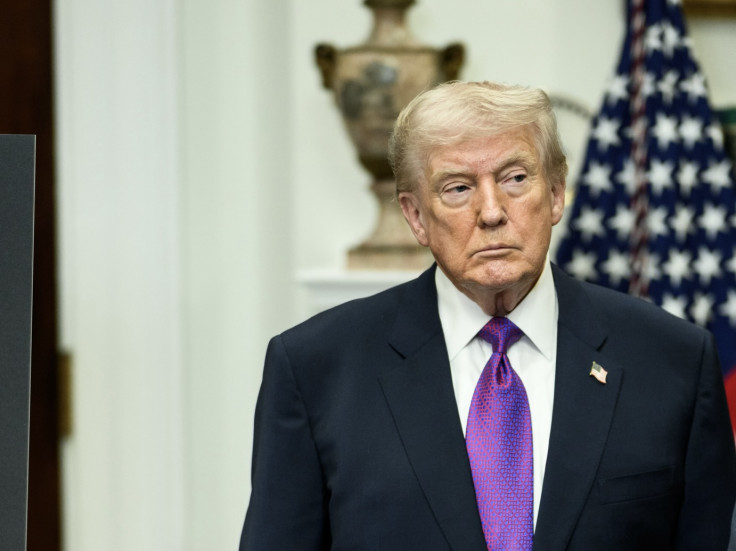
On most days, the Federal Reserve likes to imagine itself in a world apart from Washington — a place of charts, models and calm deliberation, sealed off from the political weather. Then Donald Trump opens his Truth Social app and reminds everyone that, in the real world, the Fed sits right in the blast radius of American politics.
The former president has seized on a pair of upbeat economic reports to do what he has always done with economic data: claim them as personal vindication and wield them as a cudgel. A stronger-than-expected January jobs report and a surprisingly cool reading on inflation have become, in Trump's telling, not just good news but grounds for a full-on assault on Jerome Powell's reluctance to cut interest rates.
'The numbers were surprising — except to me, they weren't surprising,' Trump declared, taking credit for the performance and insisting his administration has 'brought costs way down'. On Truth Social, he went further, arguing that the US 'should be paying MUCH LESS on its Borrowings (BONDS!)' because it is 'again the strongest Country in the World' and therefore ought to enjoy 'the LOWEST INTEREST RATE, by far.'
It is economic argument as nationalist bravado — and it puts the Fed directly in his sights.
Trump's Demand To The Federal Reserve — And The White House's Calculus
Inside the White House, the case has been boiled down to a brisk, almost schoolroom logic: if inflation is now 'low and stable' and hiring is strong, then rate cuts are 'long-overdue' and the economy is 'set to turbocharge even further'. There is an unmistakable irritation in that message, the sense that the central bank is a stubborn mechanic refusing to turn the key on an engine that is ready to roar.
What makes this more than the usual jawboning is how aggressively Trump is trying to define the meaning of the data before the Fed itself has finished parsing the spreadsheets. In Trump-world, a positive economic report is never simply encouraging; it is evidence that the referee is failing to award points to the rightful winner.
The Fed, for its part, has chosen caution over adrenaline. At its January meeting, policymakers voted 10–2 to hold their benchmark rate at 3.5% to 3.75%. Powell told reporters it was 'appropriate' to leave rates in place for now, describing a labour market that appears to be 'stabilizing' and inflation that remains 'somewhat elevated' above the bank's 2% target.
This is the part that drives Trump allies to distraction. They see a central bank that is paying too much attention to its models and not enough to what's happening on the ground — and, crucially, to what the White House wants.
Their resentment has been brewing for more than a year. The Fed's rate cuts in 2025 — three in total, delivered while the jobs market faltered and inflation hovered around 2.6% in November 2024 — were presented by Powell as a balancing act: easing enough to prevent deeper job losses without lighting a fresh fire under prices. The administration framed it very differently, accusing him of 'needlessly choking out the economy'.
Matters turned uglier still when, two weeks after that third cut, the Justice Department opened a criminal investigation into the Fed and Powell over headquarters renovation spending. Economists across the spectrum, along with Powell himself, saw the timing as barely disguised intimidation.
A Fed Under Pressure As Trump's Demand To The Federal Reserve Intensifies
The start of 2026 has only raised the temperature. The US added 130,000 jobs in January and annual inflation dipped to 2.5%, according to the consumer price index. For most governments, that combination would be reason for quiet satisfaction. For Trump, it is ammunition.
Yet the people whose money is actually on the line are not acting like a mob expecting imminent rate relief. Futures data tracked by CME Group's FedWatch tool show traders pricing in a 90.2% chance that rates stay unchanged in March, a 69.7% chance of no cut in April, and a roughly two-thirds likelihood of a first cut in June.
That calendar quirk brings its own awkwardness. Powell's term as Fed chair expires in May. If the first cut doesn't arrive until June, it would fall to his successor — and Trump has already moved to ensure that successor looks more like his kind of central banker.
Last month he nominated former Fed governor Kevin Warsh to replace Powell. Warsh is widely seen as more sympathetic to a 'forward-looking' approach that leans into the idea of structurally faster growth, fuelled in part by artificial intelligence. Trump's National Economic Council director, Kevin Hassett, has been busily laying the intellectual groundwork, waving away what he calls the 'old fashioned Phillips Curve story' that ties strong growth to higher inflation. In this telling, a supply-side surge from new technology means you can have rapid expansion without the penalty of tight money.
It is an alluring narrative if you sit in the Oval Office and want cheaper borrowing yesterday. But personnel changes at the Fed, like interest-rate moves, do not happen at the president's preferred speed. Senator Thom Tillis, a retiring Republican on the Senate Banking Committee, has threatened to block Trump's Fed nominees until the Justice Department resolves its investigation into Powell and the Fed's renovation spending.
In other words, the White House is demanding haste, the central bank is asking for proof, and Congress is busy wedging a foot in the door. Somewhere in that narrow, contested space sits the fragile thing both sides claim to care about: confidence.
What makes this standoff more than an inside‑baseball struggle over basis points is that every twitch in that confidence has real‑world consequences. For households facing mortgage renewals, for businesses deciding whether to hire or shelve investment plans, it matters whether they believe someone, somewhere, is in charge — or whether monetary policy has simply become another front in an endless political brawl.
Right now, the Fed insists it is still driving by the data. Trump insists he is the data. The markets, nervy and watchful, are left to decide who they believe.
© Copyright IBTimes 2026. All rights reserved.