'Will Take Down Francis': The Epstein-Bannon Plot to Subvert the Vatican from Within
Epstein and Bannon sought to exploit internal Catholic divisions

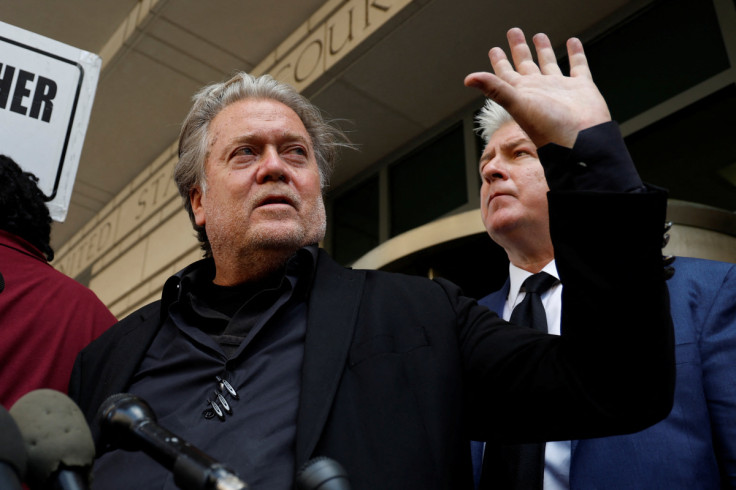
The recently released Epstein files have shed light on a surprising geopolitical target: the Vatican. Internal communications suggest Steve Bannon orchestrated a deliberate strategy to undermine Pope Francis's authority from within. These revelations offer a stark view of how high-level political manoeuvring sought to disrupt one of the world's most influential religious institutions.
Freshly disclosed records from the US Department of Justice expose a collaboration between Steve Bannon and the late financier Jeffrey Epstein to weaken Pope Francis's influence. The correspondence illustrates a shared belief among Epstein's elite associates that the Vatican functioned as a vital lever for global political control.
Aiming for the Altar
Correspondence from June 2019 indicates that Bannon viewed Epstein as a key financier for a film project that ultimately failed to launch. This documentary was intended to adapt Frédéric Martel's 2019 investigation, 'In the Closet of the Vatican,' which explored the inner workings of the Holy See.
Hard to read today’s Gospel from Mark on beheading of John the Baptist and not think of yesterday’s revelations: Steve Bannon promising Epstein in 2018 that he “will take down Francis”. Power and ambition hate goodness and seek to destroy it. pic.twitter.com/AggkgO3e6m
— Austen Ivereigh (@austeni) February 6, 2026
Bannon claims the film 'will take down Francis' before adding, 'The Clintons, Xi, Francis, EU — come on brother.' The book the film was based on exposes a world of secrecy and perceived insincerity regarding homosexuality in the Church. It triggered a massive wave of conservative backlash when it first hit shelves, largely for claiming that 80% of the Vatican's clerical staff are gay.
Bannon's Cinematic Ambitions
During a series of discussions with Religion News Service, Martel recalled that Bannon said he 'loved' the work. Their initial meeting took place in a penthouse at the Hôtel Bristol in Paris, where Bannon proposed adapting the research into a film. Martel noted that Bannon 'was very enthusiastic' and explicitly shared his desire to produce a film based on the book.
Martel explained that he neither agreed to Bannon's proposal nor took any money from him, noting that the book's rights were held by his publisher in France. Furthermore, the author stated he had never been in communication with Epstein.
A Cardinal's Departure
Bannon's fascination with Martel's research eventually pushed US Cardinal Raymond Burke to distance himself from the Dignitatis Humanae Institute. Burke felt the conservative Catholic group had become too closely linked to Bannon's personal influence. In a correspondence sent on 25 June 2019, the Cardinal made his stance clear, stating, 'I am not at all of the mind that the book should be made into a film.'
Steve Bannon — who conspired with Jeffrey Epstein to “take down” Pope Francis — warned that the election of the man who would become Pope Leo XIV would be his worst nightmare.
— Christopher Hale (@ChristopherHale) February 7, 2026
Bannon lost. The world won. pic.twitter.com/0ASGMRUVhL
The messages between the two men coincided with a peak in organised conservative efforts to challenge the Pope's authority. At the time, Francis was actively softening the Church's approach to LGBTQ Catholics and remarried couples, while frequently using his writings to champion environmental causes and the rights of refugees. For Epstein's network, these shifts transformed the Vatican into a significant ideological battleground.
The Traditionalist Response
Francis steered the institution away from the strict, dogmatic focus of previous Popes, prioritising a more welcoming atmosphere. This evolution was solidified during the 2014-15 Synod on the Family in Rome, which concluded with a formal message championing 'a church of mercy.' However, this change prompted a group of traditionalist cardinals—Burke among them—to formally challenge the Pope's guidance through a series of theological questions known as the dubia.
The internal rebellion peaked when Archbishop Carlo Maria Viganò, previously the Pope's envoy to the United States, released a biting open letter. In it, he alleged that Francis had ignored the misconduct of former Cardinal Theodore McCarrick. Commenting on the situation, biographer Austen Ivereigh noted that the Epstein documents add a fresh layer to a known narrative: 'There's a clear concerted campaign among a number of traditionalist figures and institutions to bring down Francis in the name of some sort of "purification," which culminates in the Viganò letter.'
Shared Disdain for Vatican Diplomacy
Email exchanges between Bannon and Epstein from 2018 reveal a mutual frustration with the Vatican's active stance against populism, racism, and xenophobia. The two men also expressed significant disapproval of the Holy See's diplomatic overtures toward China, viewing the Church's international priorities as a direct challenge to their own political interests.
The released files show that Epstein rarely spoke of the Holy See or Francis with any measure of respect. When the Pope stayed near Epstein's New York mansion during a 2015 visit, the financier took the opportunity to mock the religious leader in a message to his brother, Mark. 'I thought id invite him for a massage,' he wrote, before continuing the email with a series of offensive and vulgar observations.
Epstein appeared to be a keen observer of the Holy See's economic structure, specifically the Vatican bank. He was well-versed in the details of 'Who Killed God's Banker?,' a deep dive by Edward Jay Epstein into the Church's financial history. This work focuses heavily on the infamous collapse of Banco Ambrosiano and the subsequent death of Roberto Calvi, whose body was found suspended from a noose under London's Blackfriars Bridge.
A Testing Ground for New Currencies
During an August 2014 discussion regarding blockchain technology, Vincenzo Iozzo, an Italian cybersecurity expert, suggested to Epstein that 'the Vatican and Monaco' represented ideal sovereign territories for such experiments. Iozzo highlighted the plan's ambitious nature in his message, noting Epstein's affinity for significant disruptions.
'You said you like great hacks — selling companies and/or big western countries a currency that doesn't actually exist is probably the ultimate hack in the world,' Iozzo wrote.
At that time, Francis was deeply involved in a mission to overhaul the Holy See's notoriously secretive and complicated financial systems. To spearhead this transformation, he created the Secretariat for the Economy and appointed Cardinal George Pell to lead the new department. In a further move toward accountability, the Pope ordered the closure of thousands of questionable bank accounts held by individuals who were not Vatican City residents.
Diplomatic Immunity and Digital Shadows
Among the records is a report from the FBI containing a claim that the Italian cybersecurity figure known as 'Epstein's Hacker' might have held citizenship documents from the Holy See. This assertion, provided by a confidential source, points to a potentially deep and unusual tie between Epstein's technical inner circle and the world's smallest sovereign state.
© Copyright IBTimes 2026. All rights reserved.
- MOST POPULAR IN World