Watertown High School Students Walk Out In Protest After Board Bans Wordless Song 'A Mother of a Revolution' for 'Endorsing Violence'
Controversy arises as students protest the removal of a wordless composition linked to LGBTQ+ history.
A Wisconsin school board has banned a wordless wind ensemble piece from a student spring concert, citing fears of political violence despite the composition having no lyrics, no script, and no spoken content of any kind.
The Watertown Unified School District Board of Education voted 7-1 on 12 May 2026 to remove 'A Mother of a Revolution!' from the high school Wind Symphony's spring concert programme, scheduled for 18 May.
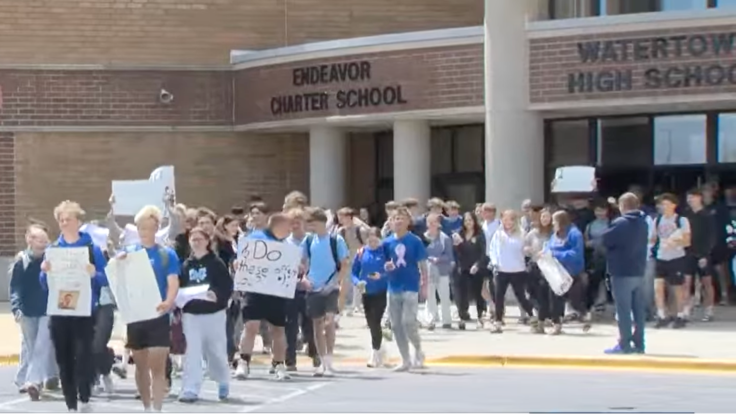
The piece, composed in 2019 by Omar Thomas and dedicated to transgender activist Marsha P. Johnson, contains no words, no lyrics, and no spoken narrative of any kind. Approximately 350 students responded the following day by walking out of class in protest, filling the school's Peace Garden and chanting 'Let them play.'
What the Board Voted to Remove, and Why It Has No Words
'A Mother of a Revolution!' is a fully instrumental work written for contemporary wind ensembles. Omar Thomas, now an assistant professor of composition and jazz studies at the University of Texas Austin, composed the piece in 2019 on commission from the Desert Winds Freedom Band to mark the 50th anniversary of the Stonewall Uprising.
He described his intention on his official composer website: 'This piece is a celebration of the bravery of trans women, and in particular, Marsha "Pay It No Mind" Johnson.' There is no text. There is no narrative. The only content is music.
Marsha P. Johnson was a Black transgender activist widely associated with the Stonewall Uprising of 28 June 1969, in which patrons of the Stonewall Inn in New York City resisted a police raid. The protests that followed lasted six days and are considered a pivotal moment in the LGBTQ+ civil rights movement. The Stonewall Inn is now a National Historic Landmark. Thomas's piece, according to the Wind Repertory Project, runs approximately four minutes and ten seconds and has been performed by ensembles at universities and youth orchestras across the United States and Canada.
The Watertown Wind Symphony's band director, Reid LaDew, had followed the district's own 'controversial issues policy' by sending written notice to families in October 2025, explaining the piece's connection to LGBTQ+ history and offering parents the option to pull their child from performing it. Of more than 30 students in the ensemble, only three opted out. The remaining students spent months preparing the work. In his written statement to the district, LaDew explained: 'The purpose behind studying Mother of a Revolution is not to provoke controversy, but to deepen students' understanding of how music reflects the diverse experiences of humanity.'
Board Members Call the Instrumental Piece 'Indoctrination' That Could Incite Violence
The board meeting on 12 May drew a packed room. Dozens of students, parents, and community musicians gathered outside before the session, and public comment was extended multiple times once it began. Inside, the debate grew heated enough that the board called a recess after the final vote. Board members declined to speak to media afterwards.
Board Vice President Sam Ouweneel framed the vote as consistent with his campaign platform, stating: 'This is a perfect example of what everyone here ran on, which was ending indoctrination and radical curriculum.' Board member Christina DeGrave said political violence should not be celebrated through music or song. Board President Laurie Hoffmann was the sole member to vote against the removal.
Parent Jim Mitchell pushed back against the framing that the process had been rushed or secretive. 'If parents had issues with the piece, they had plenty of time to take it to the board rather than waiting until a couple of weeks before the concert,' Mitchell said.
'The right to opt out our student from controversial lessons comes with responsibility to monitor communications.' Watertown resident David Mazzie performed the piece on his instrument during the public comment period, making the board listen to the music they were voting to suppress.
Composer Omar Thomas Responds, Students Walk Out
Thomas learned of the controversy through national media coverage and gave a direct interview to TMJ4. He said Ouweneel's framing of the piece was 'intensely reductive and also not surprising.' He added: 'It's spoken like somebody who has never actually learned anything about Marsha.' Thomas acknowledged the risk that socially engaged music will attract backlash but placed the blame squarely on misunderstanding. 'There's always a quote, unquote, "danger" of this when you're writing about a topic that has any kind of thorn to it,' he told TMJ4. 'But the reason it has thorns is because of people's misunderstanding of the trans community.' He ended with a direct message: 'Let these kids play.'
On 13 May, students left class during fourth period and gathered in the school grounds. Senior Lily Small told the Watertown Daily Times: 'It's not right to remove a song from the spring concert playlist when the students in wind symphony worked so hard on it. I am protesting because it's my civil liberty as an American.' Senior Garett Harris told WMTV15: 'I don't know why just because it is an LGBTQ history, we can't allow kids to talk about it or play pieces related to it.' Cooper Wood, another senior, underlined that the walkout crossed political lines. 'I can guarantee you not everyone here is a liberal but they all can see what the school board is doing is wrong,' Wood said.
Student athlete Colton Stai, who is not a member of the band, said he joined the walkout out of solidarity. 'I just felt like, as an athlete, if we practised all summer long and then couldn't go play, I would be broken by that,' Stai said. 'So they must be broken too.' He described the broad turnout as evidence of how connected the student body is and how deep the disappointment runs with the board.
Three hundred and fifty students standing in a schoolyard, chanting for the right to play music, made clear that the board's 7-1 vote did not settle the argument.
© Copyright IBTimes 2026. All rights reserved.
- Recommended For You