

Mother Reunites With Sons Taken From Her as Babies 41 Years Ago During Chile's Dictatorship
A DNA search uncovered a history of irregular adoptions and the challenges facing relatives still seeking answers
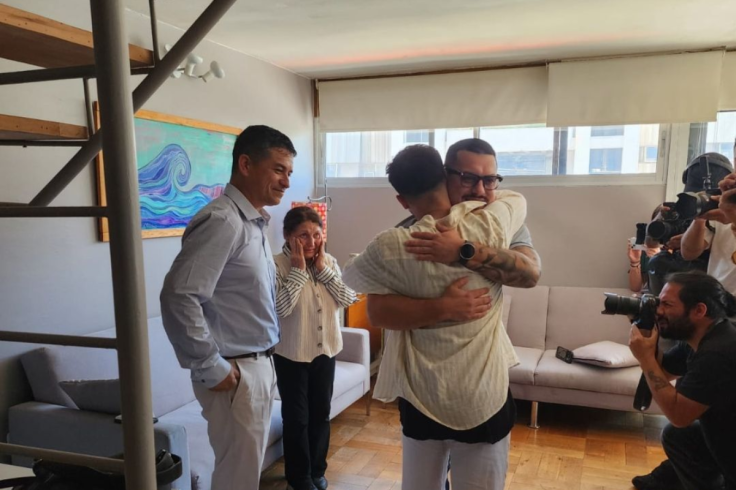
A Chilean mother has reunited with two sons taken from her as babies during Augusto Pinochet's dictatorship, after more than four decades apart. Their 11 November meeting in Santiago also highlighted the continuing search for children removed from vulnerable mothers.
Teresita de Jesús Padilla, 66, embraced Tim Rolnick, 41, and Travis Murdoch, 37, at the offices of family-search organisation Nos Buscamos. Raised in the United States, the brothers knew they were adopted but not how they had been separated.
'God gave me back my children, whom I thought I had lost forever,' Padilla said.
A DNA Test Revealed a Family Left Behind
In 2020, Tim Rolnick began investigating his medical history and took a MyHeritage DNA test. The results connected him with his biological family in Chile. He discovered that he had two brothers, Travis and Chris, who had also been adopted by an American couple, as well as an older brother, Alberto, who had remained in Chile.
Tim had been taken from his mother, Teresita de Jesús Padilla, as a baby. Four years later, his younger brothers, twins Travis and Chris, were also separated from her and adopted in the United States. Tim found Travis and Chris living near his home in Maryland and contacted them. Alberto, meanwhile, had stayed in Chile and helped search for his missing brothers.
Tim and Travis built a relationship before travelling to Chile to meet their mother. Chris could not join them because he had been seriously injured in a car accident in 2013. Alberto had died before the reunion.
Travis said he was nervous before meeting Tim but immediately noticed their physical resemblance. The brothers connected quickly. Tim said meeting Padilla felt as though he had known her all his life.
The Scale of Chile's Irregular Adoption Cases
Their experience forms part of a wider history of children separated from families through forced or irregular adoptions. The full scale remains uncertain because official records are fragmented and estimates count different kinds of cases.
A Chilean government report cited a 2018 judicial estimate of about 22,000 cases. A separate criminal investigation covered approximately 1,100 cases, while civil society organisations have estimated that around 50,000 children were affected. Nos Buscamos has also recorded thousands of people seeking information about their origins. The figures are not directly comparable: they count estimates, investigations, and people seeking help.
The report describes how poverty and a lack of family support left some mothers vulnerable. Accounts include children being removed under misleading medical explanations or through adoption procedures that families did not understand or freely agree to.
Chile Moves to Help Families Trace Their Origins
The Ministry of Justice and Human Rights presented recommendations in February 2026 after an inter-agency review of forced and irregular adoptions. Proposals included a unit to help people trace their origins and relatives, as well as a genetic fingerprint database to support identification.
The measures address a practical obstacle for families: records of births, hospital stays, and adoptions can be scattered across institutions, making it difficult to establish what happened decades later.
For Padilla and her sons, the reunion cannot restore the years they lost or bring every sibling together. But they say they want to build new memories rather than allow the past to define what comes next. 'There's no reason to look into the past too far and from here we can work toward the future,' Murdoch said.
© Copyright IBTimes 2026. All rights reserved.