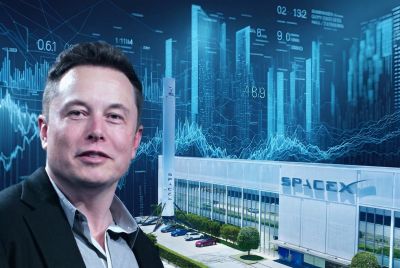
Elon Musk Predicts Mass and Energy Will Replace Dollar: 'Conventional Money Will No Longer Be Relevant'
As Elon Musk imagines a post‑money civilisation built on mass and energy, his Earth‑bound wealth and SpaceX's wild market ride tell a more complicated story about value.
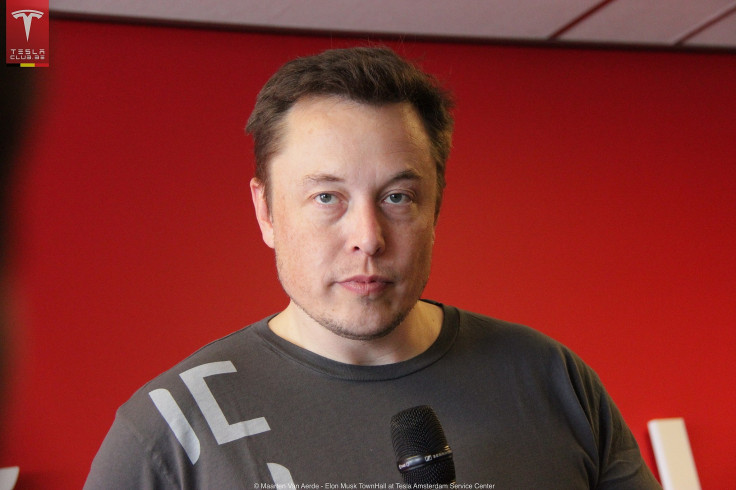
Elon Musk on Tuesday used his social platform X to argue that 'conventional money will no longer be relevant,' predicting that mass and energy will eventually replace dollars as humanity builds lunar factories and taps solar power in deep space to fuel artificial intelligence.
After Musk responded to a thread about how much solar energy would be needed to meet long‑term AI ambitions. In a post seen on X, user James Stephenson asked whether the Earth's orbit alone could provide enough power for the sort of large‑scale AI systems Musk frequently talks about. The billionaire, who runs both SpaceX and Tesla, used the exchange to sketch a future in which financial value is tied less to cash and more to the raw resources and power underpinning an off‑world industrial economy.
In the future, a trillion times a trillion dollars will be spent on making antimatter to travel to other star systems
— Elon Musk (@elonmusk) June 19, 2026
Elon Musk Links AI Ambitions to Lunar Factories
Musk's comments were prompted by a familiar question in space and tech circles: if AI models keep growing, where will all the energy come from? In reply, Musk wrote that it would require manufacturing solar panels and radiators on the Moon and then launching them into deep space using a 'mass driver' a type of electromagnetic launcher long mooted by physicists but never built at scale.
Lunar factories would turn local materials into hardware, avoiding the huge cost of lifting heavy solar arrays out of Earth's gravity well. Those arrays would sit far from the planet, sipping uninterrupted sunlight and feeding colossal AI computing clusters. It is classic Musk territory: a vast, almost cinematic engineering project presented in a matter‑of‑fact sentence.
Lunar Mass Driver: Scaling Space AI Compute from Terawatt to Petawatt
— Lacey (@LaceyPresley) June 19, 2026
Earth cannot lift the tonnage required to expand orbital AI compute by three orders of magnitude.
This is not an engineering inconvenience; it is a hard physical limit on terrestrial launch capacity.
Elon… pic.twitter.com/xLqyfsOr6Q
It was in this context that he pivoted to money. 'Conventional money will become irrelevant long before that point,' he wrote, before adding: 'Mass & energy will take the place of dollars.' Taken literally, it is a radical claim about how value might be measured in a space‑faring economy, where useful material and reliable power matter far more than fiat currencies or even digital assets.
Musk has floated variations of this argument before, suggesting that advanced societies might operate more like closed resource loops than cash economies. None of that is close to being realised there are no lunar factories and no mass drivers so his prediction should be treated with caution. Nothing in his post amounts to a concrete plan, and no independent evidence has been presented that such a system is technically or politically within reach. For now, it is a vision, not a roadmap.
Elon Musk, SpaceX and a Trillion‑Dollar Fortune
Musk is relaxed about money's relevance in the distant future, his own finances in the present are anything but trivial. SpaceX's much‑watched initial public offering and the stock's subsequent surge have combined to push his estimated fortune to around $1.3 trillion, according to the report. On paper at least, that makes him richer than some of the world's most prominent billionaires combined, including Amazon founder Jeff Bezos.
SpaceX itself has, following its IPO, outgrown tech behemoths such as Microsoft and Amazon on some market capitalisation benchmarks cited in the same coverage. For a company that began as a scrappy challenger to the established aerospace giants, it is a remarkable inversion of the old order, and one that gives Musk an extraordinary degree of economic and political influence.

Not everyone is comfortable with how feverish the market around Musk's space venture has become. The SpaceX listing has triggered a rush of retail trading, with the stock's retail turnover reportedly topping $7 million in the first ten minutes of Monday's session alone. That kind of frenzy is usually reserved for buzzy tech debuts or heavily hyped turnaround stories, not a rocket company that still lives and dies by complex launch schedules.
The speed and scale of the rally have sparked questions about whether SpaceX is drifting into meme‑stock territory, propelled as much by internet enthusiasm and Musk's celebrity as by traditional fundamentals. Television commentator Jim Cramer is among those sounding uneasy notes, comparing SPCX's trading behaviour to that of meme names that once rocketed and then crashed back to earth. His warning is not evidence of a bubble on its own, but it captures a jittery mood among some analysts who have seen this movie before.
BREAKING: President Trump publicly rebukes Israel over its war against Hezbollah.
— Fox News (@FoxNews) June 16, 2026
"Israel's fighting Hezbollah too long and too many people are being killed."
Trump said he opposed strikes that destroy apartment buildings filled with civilians and revealed he urged Israel to… pic.twitter.com/sfLxhiWTqA
Musk, for his part, has not directly addressed accusations that SpaceX is trading like a meme stock. Nor has he elaborated on how, in practical terms, 'mass and energy' would supplant dollars in a world where his own net worth is still calculated in conventional currency. Until more detail emerges, both the lunar factory vision and the future‑of‑money claim remain unverified projections. Investors and followers alike may find inspiration in his grand arcs, but they will also need to take them with a grain of salt.
© Copyright IBTimes 2026. All rights reserved.
- Recommended For You