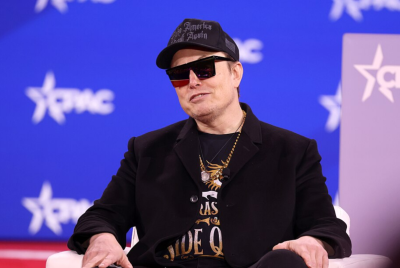
Elon Musk Lost More Than Many Billionaires' Combined Wealth: Yet Nobody Is Within Striking Distance
Elon Musk owns about 4.8 billion SpaceX shares


Elon Musk lost more than half a trillion dollars in over a month. However, Musk, who runs a rocket company among other ventures, remains the wealthiest person with a lead so large that it borders on absurd.
Musk's net worth stood at $715.6 billion on Tuesday, according to Forbes. Note that his wealth stood at $1.45 trillion on 16 June, implying that he lost over $734 billion in 43 days or around $17.06 billion a day.
The magnitude of the wealth Musk recently lost is more than the combined net worth of Larry Page and Sergey Brin. It is also much more than what Jeff Bezos, Mark Zuckerberg, and Larry Ellison have ever cumulatively earned in their lifetimes. Musk's current net worth is five times that of legendary investor Warren Buffett's $141.2 billion fortune.
The massive swing in Musk's net worth could be directly attributed to the SpaceX stock nosediving from its peak of $225 following its June IPO to $110 per share. Now, Musk holds around 4.8 billion SpaceX shares, implying that his wealth drops $4.8 billion every time the SpaceX stock falls by a dollar.
Much of Musk's wealth remains tied to equity rather than cash. Forbes estimated that his ownership in SpaceX, along with stakes in Tesla and other ventures, accounts for the majority of his fortune.
However, not every dollar Musk lost was due to the SpaceX stock. Forbes eliminated $116 billion of restricted Tesla stock from its estimate recently.
SpaceX Stock Declines Despite Starship Progress
SpaceX stock fell over 3% during premarket hours on Tuesday to $110 per share. The decline comes as headlines on Musk's shrinking fortune continued to dominate despite SpaceX making technical progress.
After an aborted launch attempt earlier in July due to an engine issue, the company completed its 13th integrated Starship flight test on 24th July.
During the mission, Starship deployed 20 next-gen Starlink satellites, successfully reignited a Raptor engine in space, and completed a controlled splashdown of the upper stage in the Indian Ocean. However, the Super Heavy booster did not achieve a fully controlled recovery after several engines failed to relight during landing, but SpaceX described the flight as an advancement toward building a fully reusable launch system.
Musk also indicated that Flight 14 could attempt an even more ambitious recovery by catching the upper stage with the launch tower's mechanical 'chopsticks,' which would considerably reduce turnaround times between launches.
The contrast between Musk's personal wealth decline and SpaceX's operational momentum is emerging as an unusual business dynamic. Despite the massive net worth decline, SpaceX continues to launch Falcon 9 missions at a rapid pace, including a recent mission carrying 21 communications satellites for the US Space Development Agency and additional Starlink launches, scheduled for July-end.
The disconnect indicates that fluctuations in private-market valuations do not necessarily reflect day-to-day engineering progress. For investors and industry observers, the coming weeks will be closely watched as SpaceX prepares future Starship flights while attempting to restore confidence following one of the largest paper wealth declines ever recorded for an individual.
© Copyright IBTimes 2025. All rights reserved.
- Recommended For You