Trump Attacks Exxon and Chevron Over $26.5B War Profits While 54% of Voters Blame Him for $4 Petrol
The White House wants pump prices down by autumn, but a majority polled pin responsibility for the rises on the Oval Office
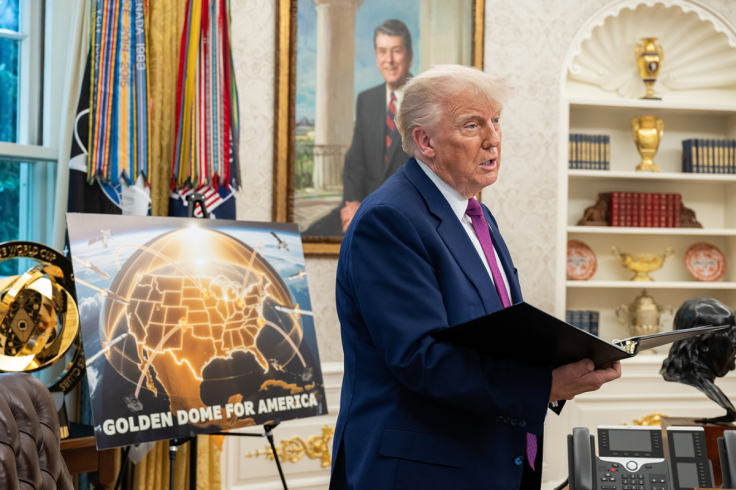
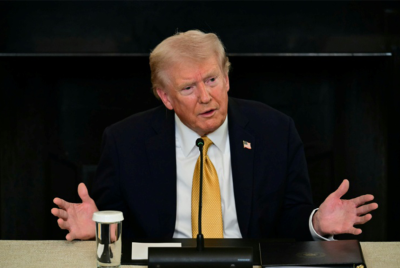
Donald Trump rounded on Exxon Mobil and Chevron on Monday, telling reporters the two oil giants had taken too much out of the Iran war after a combined $26.5B (£19.7B) quarter. Drivers are paying above $4 (£3) a US gallon, and polling released last week found 54% of voters hold the president himself responsible 'a lot' for that.
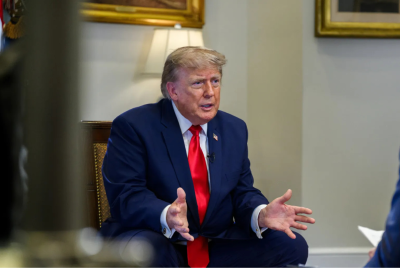
The scolding came during an executive order signing in the Oval Office, from a man who acknowledged being an unlikely messenger, calling himself the biggest free-enterprise advocate there is. The companies, Trump said, 'better cut the retail price, the consumer price.' Fuel would drop through the floor once the war ends, he predicted, in remarks reported as they happened.
The Numbers Behind the Rebuke
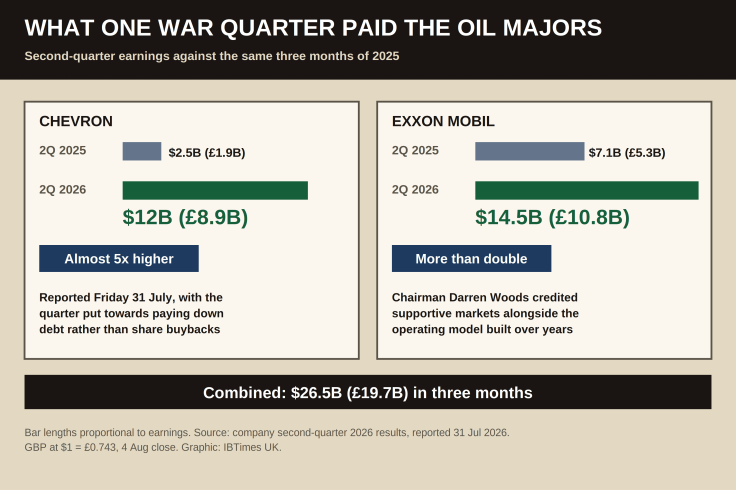
The earnings that provoked him landed on Friday. Chevron reported $12B (£8.9B) for the second quarter against $2.5B (£1.9B) a year earlier, an almost fivefold jump, while Exxon Mobil more than doubled to $14.5B (£10.8B) from $7.1B (£5.3B). Both directed the money at paying down debt rather than expanding share buybacks.
Neither company has answered the criticism publicly, though Exxon's chairman Darren Woods had already told investors 'markets were supportive' while crediting the firm's own operations, as the chart below shows.
The money traces back to 28 February, when American and Israeli strikes on Iran began, and Tehran effectively shut the Strait of Hormuz, the channel carrying a fifth of the world's seaborne crude. West Texas Intermediate (WTI), the US benchmark, averaged $92 (£68) a barrel from April to June, 27% above the first quarter.
The picture is already softening. WTI fell 5.34% on Monday to $80.15 (£60) on hopes for talks between Washington and Tehran, and shares in the two companies slipped after the president spoke. Trump had needled Chevron's chief executive Mike Wirth earlier in the day for not crediting his administration's energy policies.
The Bill at the Pump
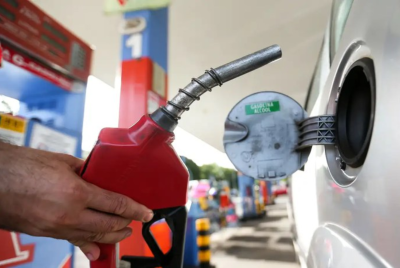
For motorists, the war shows up on the forecourt sign. A US gallon of petrol averaged about $4.10 (£3.05) on Monday, according to the American Automobile Association (AAA). That is nearly 40% above the $2.98 (£2.21) drivers paid on 27 February, the day before the strikes began. British drivers already pay far more per litre, but the same crude price sets the direction on either side of the Atlantic.
Washington has been spending its buffer to hold that line, as the graphic below shows.
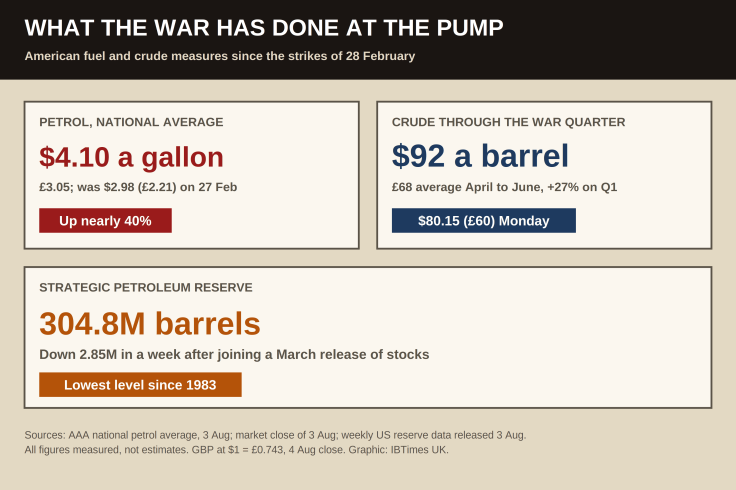
America joined fellow International Energy Agency (IEA) members in March in releasing strategic oil stocks, and the drawdown has continued. The Strategic Petroleum Reserve shed another 2.85M barrels last week, falling to 304.8M, a level last seen in 1983.
The pressure campaign against the industry is not new. A month ago, Trump used Truth Social to say he had told the Justice Department to investigate fuel sellers for 'gouging consumers', naming no companies. Joe Biden ran a version of the same play in 2022, when inflation was biting and oil profits ballooned after Russia invaded Ukraine.
Blame That Will Not Move
The polling explains the urgency. Quinnipiac University found 54% of voters assign the president heavy responsibility for dearer fuel and another 19% some, while 59% believe the economy is worsening. A survey for CNN by polling firm SSRS showed 74% see no clear plan for the conflict, up from 67% in March.
The market offered its own verdict on Monday: crude moved on word of negotiations with Tehran, not on the telling-off. Talks Trump has called Iran's last chance are now the fastest route to cheaper fuel. Whatever they produce will reach British forecourts through the crude price long before any American retail cut does.
© Copyright IBTimes 2026. All rights reserved.
- Recommended For You