300+ Trump Accounts Closed After Anti-Money Laundering Review, Capital One Claims Amid 'Debanking' Lawsuit
Each side now presents a fully conflicting story about the same closures
Capital One has told a federal court that the more than 300 accounts it closed for Donald Trump's family business in 2021 went through a months-long anti-money laundering review first. The bank's new filing asks a judge in Miami to throw out the Trump Organisation's 'debanking' lawsuit, which claims the closures punished the family's politics after the Capitol riot of 6 January 2021.
The 23-page motion landed on Friday 31 July in the Southern District of Florida, where Judge Roy Altman must now decide whether the case dies before trial. Capital One had never explained the closures publicly, and says the litigation now forces its hand, a disclosure that first emerged at the weekend.
What the Bank Told the Court
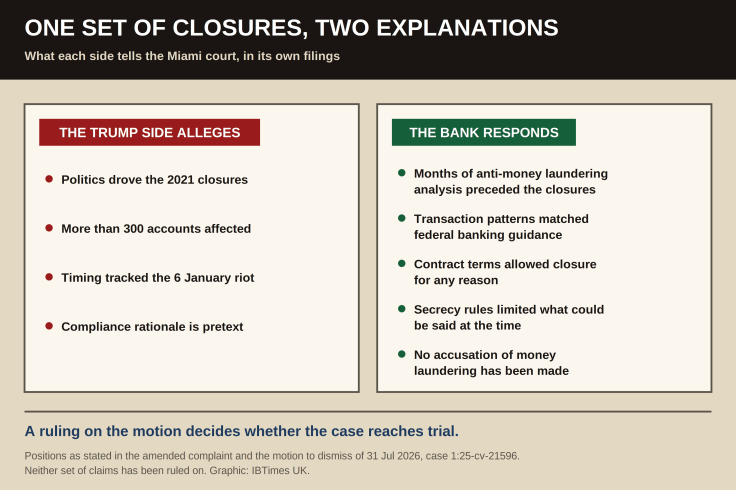
The filing says the shutdowns followed months of analysis by an in-house anti-money laundering team staffed with veterans of law enforcement, working to bank policy and regulatory guidance. The trigger, according to the motion, was a set of transaction patterns 'among the types of activity flagged by federal banking guidance.'
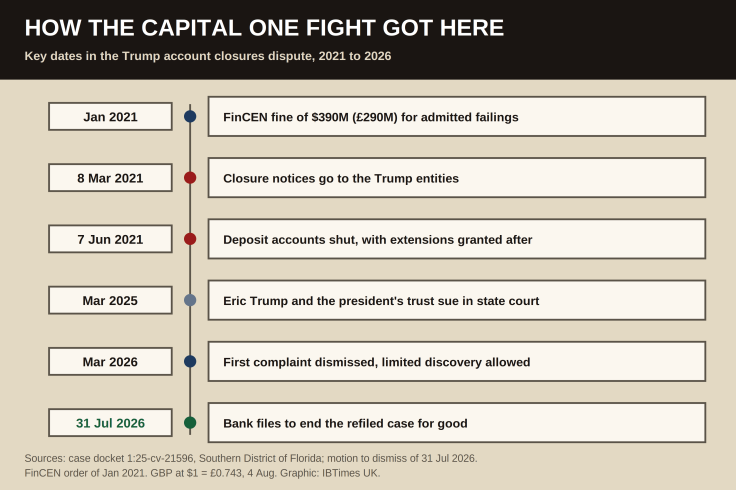
Capital One wrote to the Trump entities on 8 March 2021 and gave them until 7 June to move their deposit business, then granted extensions beyond that, as the timeline below shows.
At no point has the bank accused the Trump Organisation, or anyone connected to it, of money laundering, and no regulator has alleged wrongdoing in the closures. Its lawyers add that federal secrecy rules sitting under the Bank Secrecy Act barred a fuller explanation of the compliance review at the time, whatever the customer wanted to hear.
Two further planks support the motion. The account rules, Capital One argues, permitted closure for any reason, and the plaintiffs' political reading rests on internal documents quoted selectively. The bank had its own compliance troubles then: in January 2021 the Financial Crimes Enforcement Network (FinCEN) fined it $390M (£290M) over anti-money laundering failures it admitted.
The Case the Trump Side Brought
The lawsuit arrived in March 2025, filed first in a Florida state court by the president's son Eric Trump, the Donald J. Trump Revocable Trust, and a cluster of holding companies, before the bank moved it to the federal bench. Their claim is one of debanking, the term for a bank ending a customer relationship outright. The theory is that hundreds of accounts were cut within months of 6 January because of who held them.
Each side now offers the court a complete, and completely incompatible, story of the same closures, as the comparison below sets out.
The case has already died once. Altman, whom Trump appointed to the bench, dismissed the first version in March this year and allowed a limited period of discovery before any refiling, which produced the amended complaint now under attack. Capital One wants the fresh dismissal made final, so that no third version can follow.
The plaintiffs' answer, as the bank's own motion describes it, is that the compliance explanation is pretext dressed up after the event. Neither side has commented publicly beyond the court papers.
A Fight Bigger Than One Bank
The Miami case sits inside a wider campaign. Trump sued JPMorgan Chase in January over the 2021 closure of his personal accounts, seeking at least $5B (£3.7B). An executive order he signed in August 2025 bars what it describes as discriminatory debanking across the American banking system.
British readers have seen the argument before: the word entered everyday use here when Nigel Farage lost his Coutts accounts in 2023, and a banking chief resigned over the affair. Whatever the Florida court decides will not bind a British lender, but the ruling will help settle how far any bank must explain itself when it shows a customer the door.
© Copyright IBTimes 2026. All rights reserved.
- Recommended For You