

Elon Musk Net Worth Falls $612B in 31 Days: More Than Jeff Bezos and Larry Page Have Made Combined
Musk still owns every share he had a month ago, but people who bought SpaceX at the open are down 11%
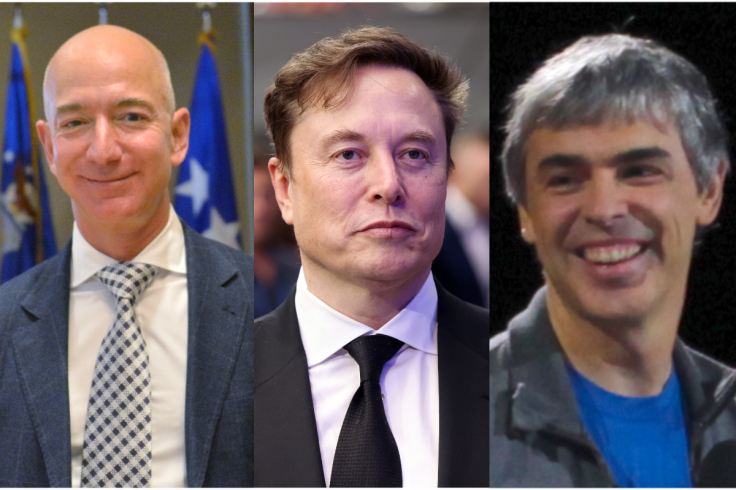
Elon Musk's fortune has fallen by roughly $612B since 16 June, a month in which the value attached to his name shrank by more than Jeff Bezos and Larry Page have built between them across five decades of Amazon and Google. Nobody handed that money to anyone else. It existed as a number on a screen, and the screen changed.
Forbes valued Musk at $1.45 trillion on 16 June, when SpaceX shares peaked at $225.64 and briefly made him the first person on record worth more than a trillion dollars. By Thursday evening the same tracker put him at $838.1B, still comfortably the richest man alive, ahead of Page at $290.3B, Sergey Brin at $267.8B, and Bezos at $258.9B. Add the last two together and the total, $549B, still falls short of what Musk's paper wealth shed in a month.
The arithmetic is brutally simple because his fortune now rests on one asset. Musk holds about 4.8 billion SpaceX shares, roughly 42% of the company, so every dollar the share price moves shifts his wealth by around $4.8B. The stock fell from $225.64 to a close of $131.11 on Thursday, its first finish below the $135 price at which the record $75B float was struck, and it slipped as low as $124 after hours once the company delayed a Starship launch.
Why the Numbers Come with an Asterisk
Not every dollar of the $612B is the market's verdict. Forbes removed about $116B of restricted Tesla stock from its estimate during the same window, a bookkeeping decision rather than a share-price move, and rival trackers reach different totals: one puts him near $875B, while Bloomberg's index excludes unvested options that Forbes counts. Anyone quoting a single figure is quoting a methodology.
The comparison chart below uses one source and one day for every figure, which is the only way the sums hold.
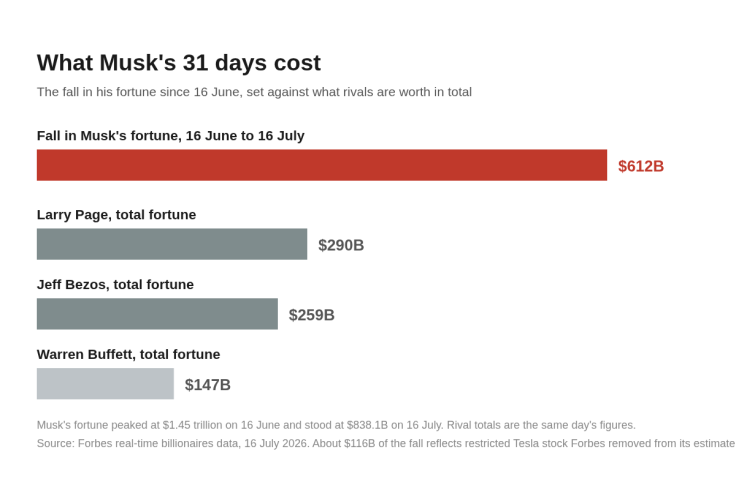
Set against a life's work, the scale gets easier to feel. Warren Buffett spent seven decades building Berkshire Hathaway and is worth $147B today, having given away some $58B along the way; Musk's paper wealth fell by more than four times that in a month. The previous record for wealth destruction was also Musk's, when Tesla's 2022 collapse cost him about $200B, a figure this month has tripled.
The reversal is not confined to him. Larry Ellison has watched roughly $125B evaporate since 1 June as Oracle shares fell 47% on doubts about its AI spending, dropping him from second richest to eighth. The same anxiety, that the enormous sums being poured into artificial intelligence may not pay back soon enough, has run through the market all month, taking IBM down 25% in a single session and squeezing memory chip supplies until phone makers wobbled.
What It Means for People Who Are Not Musk
Ordinary investors bought into this. SpaceX's float was unusually open to retail buyers, and anyone who paid the $150 first-trade price is down more than 11%, with short sellers now sitting on paper bets approaching $4B. The company has also issued $25B of debt since the flotation, and its bonds are trading at levels associated with junk.
Wall Street, for now, is not panicking. Brokers average a target near $236 a share, with Evercore ISI starting coverage at outperform and a $230 target on Tuesday, arguing the slide is a valuation reset after post-flotation euphoria rather than a broken business. Raymond James goes further at $800.
This leaves the strangest fact of a strange month: the richest man in history lost more than the fourth and second richest have ever earned, sold not a single share, and remains richer than anyone alive by a margin of roughly $548B. The money was never in his pocket. It was in everyone's imagination, which is where a great deal of the AI boom still sits.
© Copyright IBTimes 2026. All rights reserved.