

France Protests: 41 Schools Hit by Blockades as Student Leaders Reject Government's Reform Offers
Blockades were reported in Paris, Marseille and Rennes as pupils challenged plans on class sizes, university places, admissions and school renovations
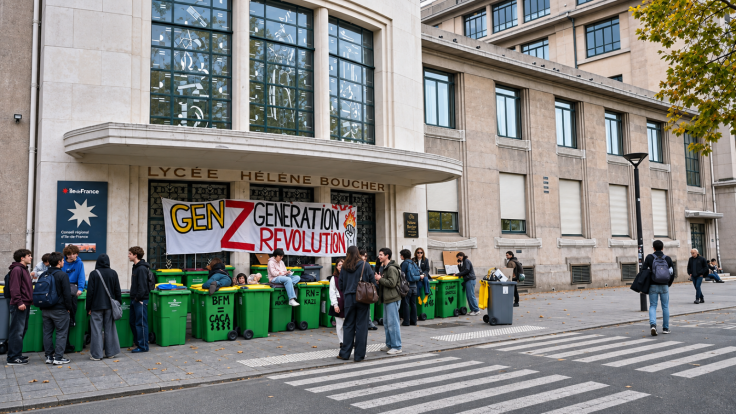
France protests affected 41 high schools by 8.30am GMT on Monday, 2 November, as pupils returned from a two-week break. The Education Ministry said the early tally represented about 1% of schools nationwide.
Blockades or attempted blockades were reported in Paris, Marseille and Rennes. Student leaders have rejected the government's education proposals and called for further disruption on Tuesday and Thursday.
The dispute centres on overcrowded classrooms, ageing buildings and access to higher education.
The renewed action followed weeks of demonstrations that began in the Paris suburbs in September. Hundreds of high schools faced blockades before the holiday, while protests over education widened into a national movement against rising living costs and deteriorating public services.
Trade unions and other activists have since joined rallies, some of which have ended in violence.
France Protests Expose Dispute Over Macron's Education Plans
The government unveiled an education package on 26 October in an attempt to address students' complaints. Education Minister Édouard Geffray and Higher Education Minister Philippe Baptiste proposed changes to university admissions, class sizes and school buildings. Student representatives say the measures do not go far enough.
The package includes €4 billion (£3.3 billion) in preferential-rate loans for renovating high schools, available through 2030. It also proposes creating 15,000 additional higher-education places between 2027 and 2028 and replacing Parcoursup, France's university admissions platform, in 2028.
The government says earlier changes would make admission decisions clearer in 2027.
A cap of 28 pupils would apply to first-year general and technological upper-secondary classes. It would begin in September 2027 at half of the least advantaged high schools and expand to all high schools in September 2028. The plan also includes reducing pupil numbers in some larger classes in later years.
Pierre Sourzat, who heads the Lycéens! student group, argues that the measures fail to address the shortage of higher-education places. He criticised the limited reach of the class-size cap. 'We were asking for all year groups,' he said.
'It's smoke and mirrors,' Sourzat said of the reforms. 'There's a bit of polish on the surface, but once you scratch beneath it, there's nothing there.'
President Emmanuel Macron has urged a calm return to lessons, arguing that 'young people have been heard'. Sourzat countered that 'the president hasn't listened to us'.
France Protests Return to Schools on a Smaller Scale
Monday's blockades were far less widespread than those recorded before the holiday. Reuters reported attempts to obstruct school entrances in several cities, while television footage showed police deployed near some buildings without full riot-control equipment.
Geffray described the level of disruption as 'very marginal' in an interview with France Inter. He said demonstrations were permitted but preventing pupils from entering schools was illegal. His comments reflected the government's efforts to restore classes even as student organisations pressed ahead with their campaign.
The limited disruption also contrasted with the scale of earlier demonstrations, when hundreds of France's more than 3,000 high schools were affected. Students have demanded improved facilities, more teachers and additional university places, alongside changes to an admissions system they consider socially unfair.
On Sunday, Sourzat told broadcaster RMC that the renewed mobilisation would build during the week. 'It will be more significant from Tuesday, but we know that some schools will be blocked as early as tomorrow,' he said.
France Protests Continue Amid Wider Unrest and Fresh Blockade Plans
The dispute over education is part of a broader movement that has brought large crowds onto French streets for three consecutive weekends. The Interior Ministry estimated that 320,000 people joined demonstrations nationwide on Saturday, 31 October.
A coalition of youth unions put attendance at approximately 500,000.
Some of Saturday's demonstrations ended in clashes. Paris prosecutors opened an attempted-murder investigation after an incendiary device exploded at a gendarme's feet, setting his protective clothing alight.
Prosecutors said reported injuries included second-degree burns while medical assessments were ongoing. The investigation concerns the weekend demonstrations, not Monday's school blockades.
The Interior Ministry recorded 565 arrests and 116 injured law enforcement personnel during Saturday's demonstrations. A further 214 arrests and 43 injuries were reported during Halloween activities later that evening. Those figures cover separate periods and should not be interpreted as totals for school protests alone.
Meanwhile, Student Union spokeswoman Sabrine Kharbach has called for school and university blockades on Tuesday, 3 November, and Thursday, 5 November.
The Thursday action is also expected to coincide with a broader demonstration linked to a strike called by workers' organisations.
The planned action will provide another indication of whether the student movement can regain momentum after Monday's limited disruption. Although the government has outlined changes to school funding, class sizes and university admissions, student representatives maintain that the proposals fall short of their demands.
For Macron's administration, the immediate challenge is keeping schools accessible while responding to calls for wider education reforms. Student organisations have announced further demonstrations, with the next mobilisation scheduled for Tuesday as pupils continue their return to classrooms.
© Copyright IBTimes 2026. All rights reserved.