

Washington Declassifies Evidence of Chinese Underground Nuclear Blast as Arms Race Fears Mount
Washington claims China conducted a secret nuclear test in 2020, escalating global arms control tensions.
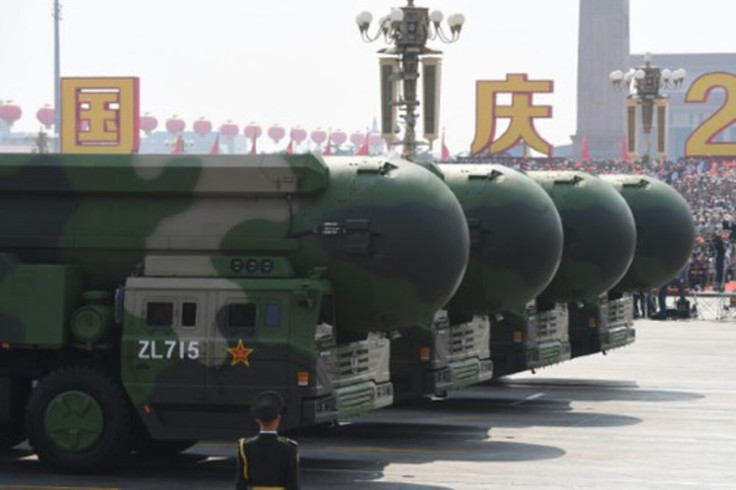
A senior United States official has presented what Washington describes as declassified evidence of a secret Chinese underground nuclear test conducted in 2020, intensifying an already fraught global arms control debate. The disclosure, made at the United Nations-backed Conference on Disarmament in Geneva on Monday, came just weeks after the last remaining nuclear arms treaty between the US and Russia expired — a development that has left the world's major nuclear powers operating without formal limits on their arsenals for the first time in decades.
Christopher Yeaw, Assistant Secretary of State for the Bureau of Arms Control and Nonproliferation, pointed to a magnitude 2.75 seismic event detected on 22 June 2020 by an international monitoring station in Kazakhstan. Yeaw said the signals originated from China's Lop Nur underground test site in western China, describing it as 'a probable explosion based upon comparisons between historic explosions and earthquakes' and stating that 'the seismic signals were indicative of a single fire explosion, not typical of mining explosions.' Beijing has firmly denied the allegation.
A Test Designed to Stay Hidden
Yeaw said China attempted to conceal the test through a method known as 'decoupling,' in which a device is detonated inside a large underground chamber to reduce the magnitude of the shockwaves it sends through surrounding rock. Speaking separately at the Hudson Institute in Washington, Yeaw went further, stating: 'I can reveal that the US government is aware that China has conducted nuclear explosive tests, including preparing for tests with designated yields in the hundreds of tons.'
The assistant secretary claimed the 2020 test was a 'yield-producing' nuclear test, meaning it had triggered a runaway chain reaction in nuclear material. He declined to specify the scale of the explosion but stressed that the evidence left little room for alternative explanations. 'I've looked at additional data since then. There is very little possibility I would say that it is anything but an explosion, a singular explosion,' said Yeaw, adding that the data were not consistent with mining blasts.
Independent experts offered a more cautious view. Ben Dando, head of seismology and verification at NORSAR, a Norwegian organisation that monitors for possible nuclear tests, said the ratios of different seismic waves are consistent with an explosion, though he did not immediately agree with the full US assessment. Tong Zhao, a senior fellow at the Carnegie Endowment for International Peace who studies China's nuclear weapons programme, said he takes the US claims seriously: 'It may be backed up by some secret US intelligence analysis and it appears consistent with the very active status of China's Lop Nur nuclear testing site over many years.'
Beijing Pushes Back Hard
China's ambassador to the Conference on Disarmament, Jian Shen, rejected the allegations outright. Shen told the Geneva gathering that Beijing 'resolutely rejects the unfounded accusations' by the US and accused Washington of 'continued distortion and smearing of China's nuclear policy,' arguing that the claims were being used as cover for Washington's own ambitions: 'The US accusation that China conducted a nuclear explosion test is completely unfounded and is merely a pretext for resuming its own nuclear testing.'
Russia stood alongside Beijing. Kremlin spokesman Dmitry Peskov told reporters that 'neither the Russian Federation nor China has conducted any nuclear tests,' adding that the claims had been 'firmly rejected' by China.
Who is building nuclear reactors?
— Jason Smith - 上官杰文 (@ShangguanJiewen) February 18, 2026
China leads, and its not even close. pic.twitter.com/RyHR2MhmfB
A Growing Arsenal and a World Without Treaties
The backdrop to these exchanges is a rapidly shifting nuclear landscape. Until as recently as 2019, China was believed to have around 200 warheads. Today, according to the Pentagon, China's arsenal is closer to 600, and the nation has a goal of 1,000 warheads by 2030. Yeaw told the Geneva conference that Washington believes Beijing 'has deliberately, and without constraint, massively expanded its nuclear arsenal' despite prior assurances otherwise, and warned that 'we believe China may achieve parity within the next four or five years.'
Satellite imagery has revealed an expansion of equipment areas and housing for personnel at Lop Nur in recent years, with at least one new tunnel dug, according to Zhao. A Center for Strategic and International Studies analysis of satellite imagery concluded that the imagery 'did not provide any conclusive findings to support or disprove the recent US allegations,' though it acknowledged a test could have taken place at a location not captured by the reviewed images.
🚨🇨🇳 DID CHINA SECRETLY TEST A NUKE?
— Mario Nawfal (@MarioNawfal) February 21, 2026
U.S. intel thinks China may have pulled off a covert nuclear explosive test in June 2020 while working on a new generation of advanced nuclear weapons.
Assistant State Sec. Christopher Yeaw said the data looked exactly like what you would… pic.twitter.com/0xoA2sNBuA
The expiry of the New START treaty this month left the US and Russia without any formal limits on their nuclear arsenals for the first time since the early 1970s, when the first Strategic Arms Limitation Talks agreements were signed. With Washington now publicly pressing China over alleged covert testing—and Beijing and Moscow jointly dismissing those claims—the prospect of a new multilateral framework appears distant. For the international community, the Geneva exchanges signal just how precarious the foundations of global nuclear stability have become.
© Copyright IBTimes 2026. All rights reserved.