

2,000-Year-Old Bog Body Reveals Chilling Evidence Of Possible Rare Female Ritual Killing In Iron Age Europe
An educational coronial exercise examined the remains of the Ballymacombs More Woman, whose death may fit a rare pattern of Iron Age ritual killing
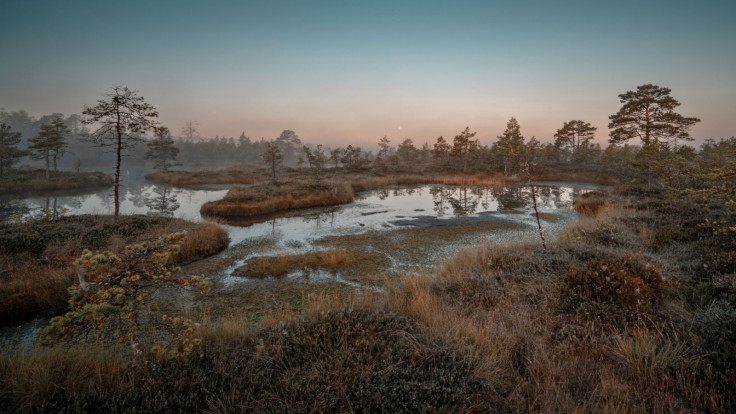
A coroner-style investigation in Northern Ireland has concluded that a young Iron Age woman whose remains were unearthed from a peat bog was deliberately decapitated more than 2,000 years ago.
Although chaired by Northern Ireland Coroner Joe McCrisken, the event was not a formal inquest or judicial determination. Instead, it was an educational exercise using modern coronial methods to examine the archaeological and forensic evidence.
It applied modern coronial methodology to establish who the young woman was, as well as when, where and how she died.
Researchers, forensic specialists and museum professionals presented findings from a two-year international research programme led by National Museums Northern Ireland, concluding that her death may fit a rare pattern of female ritual killing or sacrifice in Iron Age north-western Europe.
Forensic Findings of a Violent Death
Commercial peat workers from Bulrush Horticulture first uncovered the remains in bogland near Bellaghy, County Londonderry, in October 2023 alongside a woven plant-based artefact. Researchers estimated she was between 15 and 22 years old at death.
Earlier radiocarbon analysis placed the remains within the Iron Age, approximately between 343 BC and 1 BC. Researchers at the University of Glasgow subsequently dated the associated woven plant-fibre material to between 363 BC and 160 BC, a range consistent with the body's estimated age.
The acidic wetland environment preserved partial skin, fingernails, toenails, and brown hair, though her skull was never recovered. 'She died a violent death at the hands of a third party,' McCrisken said during the hearing.
Scientific analysis of the surviving neck vertebrae indicated that she had been deliberately decapitated, most likely from behind using a bladed weapon.
Theories of Iron Age Ritual Sacrifice
Archaeologists and historians participating in the inquiry noted that female bog bodies from the Iron Age are exceptionally rare, making the discovery particularly significant among the region's better-known prehistoric preserved remains, many of which belonged to men.
Niamh Baker, curator of archaeology at National Museums Northern Ireland, stated that cut marks on the neck indicate an intentional killing at the wetland site. 'It may be that she falls into a pattern of ritual and sacrifice that took place across north-west Europe in the Iron Age period,' Baker said.
Researchers also considered possible explanations for her death, although no definitive motive could be established.
Commemorating the Discovery Without Displaying Remains
The Ballymacombs More Woman represents the first authenticated prehistoric bog body discovered in Northern Ireland, prompting an international two-year research project involving experts from Ireland, England and Denmark.
Local residents in Bellaghy have named the young woman Áine after a mythical Irish goddess, and several members of the village's historical society attended the Belfast proceedings.
Hannah Crowdy, head of curatorial at National Museums NI, said the research would inform new interpretation planned for the Ulster Museum's Early Peoples gallery. Crowdy said the woman's remains would not be put on public display.
'We have all this amazing research so we can tell a really detailed story about her and we're looking at creative ways to tell that story, through illustration and poetry, for example,' Crowdy said.
© Copyright IBTimes 2026. All rights reserved.