

Learjet 60 Crash: Key Tail Evidence Found Miles Away as ATC Audio Reveals Warnings About Storms
Investigators have found key Learjet 60 parts miles from the Florida crash site, while air traffic control audio reveals pilots were warned about a storm
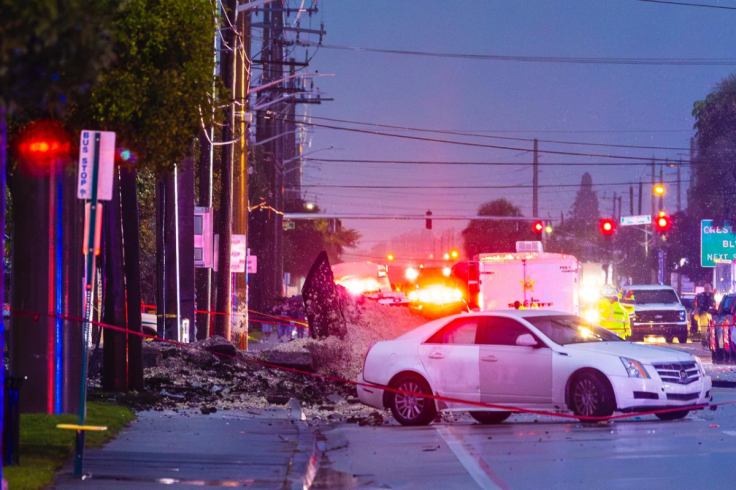
Parts of the Learjet 60 that crashed in Palm Beach County, Florida, on 1 November have been found up to 3.8 miles from the main wreckage, as air traffic control audio reveals that controllers warned the pilots about severe weather before the aircraft went down. All nine people aboard died.
National Transportation Safety Board (NTSB) member Tom Chapman said at a press conference on Tuesday, 3 November, that investigators had recovered most of the aircraft's left elevator, a control surface on the tail that helps control the plane's pitch and move its nose up or down.
It was found in three pieces between 1.3 and 3.8 miles from the crash site. Chapman described the elevator as a 'very significant piece of evidence'.
'It tells us that at least some components, some pieces of the aircraft, important pieces of the aircraft separated before the impact,' he said.
What the Tail Evidence Means
Investigators say the discovery of tail components from the Learjet 60 does not yet explain why the aircraft crashed. National Transportation Safety Board (NTSB) investigator Chapman said it was unclear whether the separated parts had any direct connection to the accident.
He said he was not sure whether the elevator would have been effective in helping the pilots regain control, even if it had remained attached, given the aircraft's speed.
Chapman noted that evidence of something breaking away before impact is not, on its own, evidence of what caused it to separate.
According to Chapman, the NTSB has collected a substantial amount of material. However, the destruction was so extensive that some fragments were too small for officials to identify.
As of Tuesday, 3 November, investigators had not begun searching the impact crater. Chapman said work there was expected to begin on Wednesday, 4 November. He said the work would require considerable effort but added that he was confident in the investigation team.
'I feel confident they're going to find the evidence they need,' he said.
Storm Warnings in Air Traffic Control Audio
A separate air traffic control recording has provided additional information about the crew's route decisions before the crash. In the exchange, a controller warns the aircraft, registered as N722BD, that the turn towards Freeport 'looks pretty bad', citing moderate to extreme precipitation ahead.
'There is moderate to extreme precipitation 11 o'clock and 25 miles, 100 miles in diameter,' the controller says.
A crew member acknowledges the warning and indicates that the pilots will consider the information. The crew subsequently discusses routing via the FEMID waypoint before continuing towards Freeport.
The controller later instructs N722BD to 'descend and maintain FL350'. The controller also tells the crew that deviations to the left or right of the planned course are approved, with Freeport remaining an option when able.
These communications indicate that air traffic control warned the crew about precipitation along the proposed route and discussed options for changing course.
Separate audio of the aircraft's final emergency communications has also circulated publicly. In those transmissions, the crew reports icing and moderate turbulence, requests a climb and subsequently declares an emergency as the aircraft descends rapidly.
The publicly circulated recordings should be treated as reported audio material rather than an official NTSB transcript. Investigators have not established whether the weather or any particular flight decision caused the crash.
Who Was on Board
The Learjet was flying from Austin, Texas, to North Eleuthera in the Bahamas when it crashed in Florida on 1 November. Nine people were killed: two pilots and seven passengers.
The passengers included technology entrepreneur Adam Robinson, his wife, Helen Sharp, and their two children, Emma and Charlie. Their family nanny, Anita Maria Cetina, was also aboard.
Family friends Rachael Reed and Charmi Fehr were among those killed. The two pilots were captain Jeff Gregory and co-pilot Nathalia Gadelha Filgueiras.
The deaths of the seven passengers and two pilots have brought considerable attention to the investigation as officials work to establish what happened during the aircraft's final moments.
Why the Route Decision Matters
Aviation expert Justin Crabbe told the New York Post that, in his view, the pilots should have avoided the storm by changing course. Crabbe said he did not know why the pilots continued towards Freeport but suggested that a desire to reach their destination in the Bahamas may have influenced their decisions.
'They certainly should have gone around the storm,' Crabbe said. 'Air-traffic control gave them the flexibility to deviate around that weather.'
His comments are an expert interpretation and not an official finding. The National Transportation Safety Board (NTSB) has not established why the pilots made their routing decisions or whether weather conditions contributed to the crash.
Available air-traffic control (ATC) communications indicate that controllers warned the crew about precipitation along the proposed route and discussed options for deviating around the weather. Investigators have not established how those communications influenced the pilots' decisions or whether the weather contributed to the accident.
The scattered elevator components are among the items being examined in the investigation, along with radar information, flight data and other recovered wreckage. Investigators are also working to determine whether the aircraft's cockpit voice recorder can be recovered.
At this stage, investigators have confirmed that important components of the aircraft separated before impact, while the crew had been communicating with air-traffic control about weather conditions.
Whether the elevator separation contributed to the loss of control, whether the weather played a role and what happened during the aircraft's final moments remain questions for the NTSB to resolve.
© Copyright IBTimes 2026. All rights reserved.