

Why Did a Florida Learjet 60 Leave a Massive Crater? Expert Explains the High-Speed Impact Pattern
An aviation expert explains why the Florida Learjet 60 crash left a massive crater and scattered debris miles from the site, killing all nine aboard
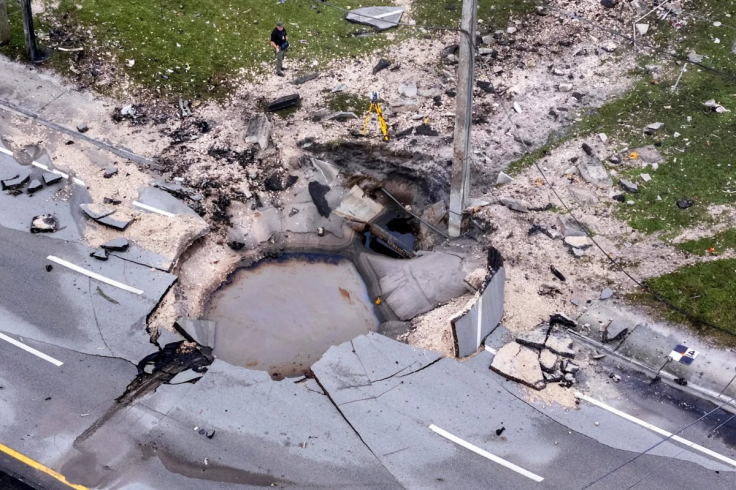
A crater 'the size of a swimming pool' gouged from a Florida neighbourhood marks the spot where a Learjet 60 slammed into the ground at extreme speed, killing all nine people on board.
Aviation safety expert Anthony Brickhouse says the wreckage pattern points to a steep, high-velocity impact, after co-pilot Nathalia Filgueiras reported the aircraft was descending at 20,000 feet per minute in her final radio call.
The aircraft had departed Austin-Bergstrom International Airport in Texas and was bound for North Eleuthera Airport in the Bahamas. The Federal Aviation Administration said the crash occurred at approximately 12.50pm Eastern Time in a residential area of Greenacres, Palm Beach County, north of Miami.
In audio recorded by LiveATC.net and reviewed by People, Filgueiras initially told air traffic controllers that the crew was experiencing 'light, clear ice that is manageable and moderate turbulence'. Less than three minutes later, she declared an emergency, saying: 'We're descending 8,000, mayday, mayday, we're descending 10,000 feet per minute.'
Why the Wreckage Spread So Far
Aviation safety expert Anthony Brickhouse, who has nearly 30 years of industry experience, described the crash as a 'high angle, high velocity-type crash'.
He said the aviation community sometimes informally refers to such incidents as 'smoking hole' accidents, a term used to describe extremely destructive impacts that can leave little recognisable aircraft wreckage at the main impact site.
Brickhouse explained that an impact crater need not be perfectly circular because an aircraft may strike the ground at an angle rather than directly at 90 degrees. He said debris may remain inside the crater, while other fragments can travel in the aircraft's direction of flight, contributing to a wider debris field.
'It may not be perfectly circular because the aircraft wasn't necessarily coming down at 90 degrees, but you're going to get debris inside of that crater and then other debris will spray in the direction of travel. So this debris field is pretty massive,' Brickhouse said.
Brickhouse said aircraft components may have separated during the descent, scattering wreckage beyond the main impact site.
On Tuesday, 3 November, National Transportation Safety Board member Tom Chapman confirmed that investigators had located pieces of the aircraft's left elevator, a component of its tail assembly, as far as 3.8 miles from the crash site.
What Investigators Must Establish
Investigators are working to establish why the Learjet entered a rapid descent. Possible explanations include an aerodynamic stall, mechanical problems or a combination of factors, but the NTSB has not determined what caused the aircraft to lose control.
Brickhouse explained that exceeding an aircraft's maximum operating speed can place excessive stress on its structure and potentially cause damage.
'In normal operations, you don't really get close to that maximum speed. And the problem is once you go beyond it, it's pretty easy to do structural damage to an aircraft,' he said.
However, investigators have not established whether overspeed contributed to the Learjet's structural damage.
Some structural damage may not be immediately visible, while severe forces can cause an aircraft to break apart in flight. Chapman said investigators had evidence of a possible in-flight breakup.
The discovery of pieces of the aircraft's left elevator as far as 3.8 miles from the main impact site provided further evidence that parts may have separated before impact. Investigators have not established what caused the separation.
The cause of the crash remains undetermined. The crew reported icing and moderate turbulence, while the aircraft was also operating in an area of precipitation. The NTSB is examining weather conditions and other possible contributing factors, but investigators have not established what triggered the rapid descent.
The Final Minutes
The emergency recording documents the sequence of events in the final minutes. Filgueiras, who was 20, initially described the weather conditions to air traffic controllers. In subsequent communications, she reported an overspeed condition and a rapidly increasing descent rate.
'We are in an overspeed condition descending 20,000 feet per minute,' she said, before stating: 'We're going to crash into the ground.' The final words audible in the recording were 'we're out of 10', apparently referring to the aircraft's passage through 10,000 feet.
Brickhouse said the recording was difficult to hear. 'I've heard a lot of recordings during my 28-and-a-half years doing this, and it was chilling to listen to,' he said. 'You can't help but think about the two pilots and what they're thinking, and the fact that they're doing everything that they potentially could and yet they don't have control.'
The Victims and Those Left Behind
The nine people killed were co-pilot Nathalia Gadelha Filgueiras and captain Jeff Gregory. The seven passengers were technology entrepreneur Adam Robinson, his wife, Helen Sharp, their children, Emma, four, and Charlie, two, family nanny Anita Maria Cetina, and family friends Rachael Reed and Charmi Fehr.
The aircraft was operated by Aurora Aviation, doing business as Upper Jet, which said it was cooperating with local, state and federal authorities.
The company's director of operations, Thomas Noetzel, said: 'Our hearts go out to everyone impacted by this tragedy. We are committed to supporting the families of all those who lost a loved one yesterday, and are praying for them as we grieve together.'
Approximately 600 people from a nearby mobile home community were evacuated following the crash, according to local authorities. One person on the ground sustained a minor injury, according to officials.
Investigators are examining the wreckage, mapping debris locations and reviewing available flight and air traffic control information to establish what happened. They are considering weather conditions, structural failure, an aerodynamic stall and other possible factors, but no cause has been determined.
The crater is described by investigators as the most visible sign of the impact, and debris scattered miles from the site is being assessed for information about the aircraft's final moments.
© Copyright IBTimes 2026. All rights reserved.