

'Masked Thugs Snatched a Nun': Critics Warn of Trump's Alleged 'Constitution-Free Zone' as App Details Emerge
Critics argue the incident underscores the dangers of expanded immigration enforcement and government surveillance.
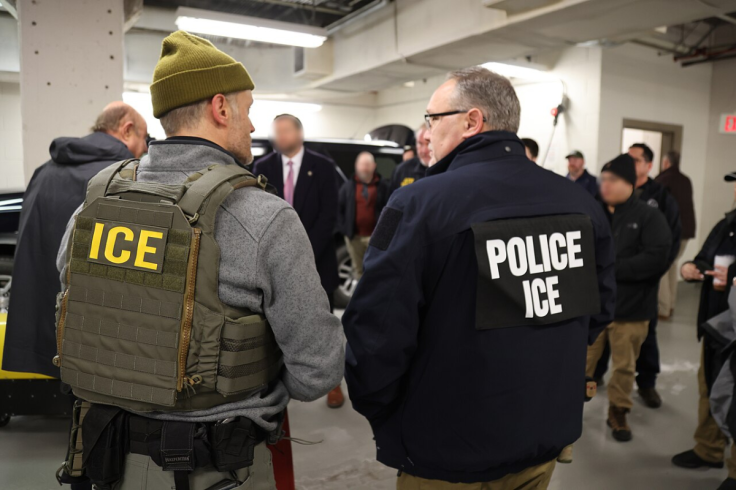
The reported detention of a nun by masked Immigration and Customs Enforcement (ICE) officers has sparked fresh criticism of United States President Donald Trump's immigration policies, with critics warning the incident underscores the dangers of the so-called 'Constitution-free zone' inside the United States.
The case has also drawn renewed attention to allegations that an official White House app could collect users' precise location data, fuelling broader concerns over government surveillance and civil liberties.
The woman, described as a nurse wearing a full religious habit, was reportedly handcuffed by masked and armed ICE agents in Texas before being placed in immigration detention. Critics allege she was targeted because she was allegedly brown-skinned, presenting the incident as an example of what they describe as increasingly aggressive immigration enforcement extending well beyond the nation's borders.
Critics argue the detention should not be viewed as an isolated incident but as part of a broader expansion of ICE's authority through interior checkpoints, enhanced surveillance powers and closer co-operation with state and local law enforcement agencies.
They also point to researchers' findings that an official White House app developed for Trump supporters reportedly contained code capable of requesting users' precise location despite privacy disclosures allegedly indicating that no such information was collected.
Critics Say Nun's Detention Reflects Expanding 'Constitution-Free Zone'
The reported detention has intensified concerns over immigration checkpoints operating within 100 miles of US land borders and coastlines. The zone, established under a 1953 federal regulation, now covers roughly two-thirds of the US population, including major metropolitan areas such as New York and Los Angeles.
The libertarian Cato Institute has described the area as a 'Constitution-free zone', arguing immigration officers possess broader authority to stop motorists and question people about their citizenship, weakening Fourth Amendment protections against unreasonable searches and seizures.
Critics argue the nun's reported detention illustrates the real-world consequences of those expanded powers, warning immigration enforcement is increasingly reaching people far removed from traditional border crossings.
ICE has reportedly expanded operations by working alongside state and local police while conducting enforcement at airports, bus stations, train terminals and courthouses. Critics also cite a checkpoint established on the only highway serving the Florida Keys, where more than 300 arrests were reportedly made, as an example of interior immigration enforcement.
Another reported incident involved a construction worker whose vehicle was surrounded by ICE agents during a traffic stop before officers questioned passengers about their immigration status and reportedly detained two of them. Critics cite the case as further evidence that immigration enforcement has expanded beyond traditional border operations.
Critics also argue immigration enforcement has moved beyond what the US Supreme Court authorised in its 1976 ruling in United States v. Martinez-Fuerte, which permitted only brief citizenship questioning at fixed checkpoints. They further point to a more recent Supreme Court decision they claim allows immigration officers to consider factors including appearance, language and occupation when deciding whom to stop, heightening concerns among civil liberties advocates.
App Allegations Deepen Surveillance Concerns
Concerns over immigration enforcement have also expanded into the digital sphere following reported findings involving an official White House app developed for Trump supporters.
Researchers reportedly found the application contained code capable of requesting users' precise location data, even though its privacy disclosures allegedly stated no such information was being collected. The app also reportedly routed much of its internet traffic through third-party servers, raising additional privacy concerns.
Although researchers reportedly did not observe the application actively transmitting users' location data during testing, they concluded its underlying code possessed the capability to do so. Critics argue the apparent discrepancy between the app's stated privacy practices and its software has fuelled wider concerns over digital surveillance.
Beyond the app, critics point to ICE's growing use of facial recognition technology, biometric tracking, automatic number plate recognition, mobile phone location databases, spyware and drones following increased federal funding. They also cite reports that some of those surveillance tools have been used to monitor anti-ICE protest networks, including investigations involving US citizens.
Taken together, critics argue the reported detention of the nun, the expansion of the so-called 'Constitution-free zone' and the alleged capabilities of the White House app point to a widening expansion of immigration enforcement and government surveillance under the Trump administration. They say those developments have intensified calls to restore Fourth Amendment protections and re-examine the scope of federal immigration powers inside the United States.
© Copyright IBTimes 2026. All rights reserved.