Trump Attacks Longtime FIFA Pal Gianni Infantino Over Predatory Ticket Costs in Scathing Rant Against World Cup Greed
The Trump-Infantino alliance faces strain as ticket prices for World Cup 2026 spark controversy.
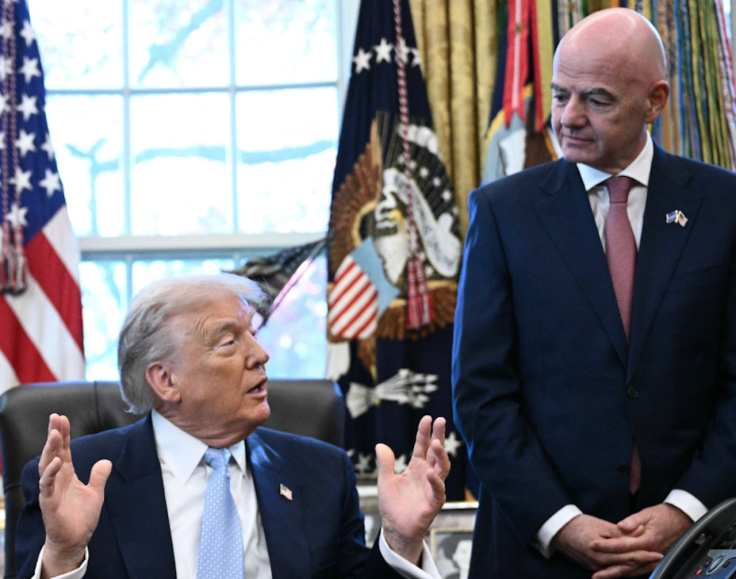
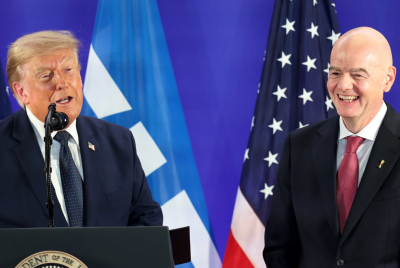
Donald Trump has publicly broken with FIFA president Gianni Infantino, his close political ally, by declaring that World Cup 2026 ticket prices are simply too high, even for him.
The remarks landed just days after Infantino stood at the Milken Institute Global Conference in Beverly Hills to defend prices that have left millions of fans locked out of a tournament ostensibly being held on their own soil. Trump told the New York Post, 'I wouldn't pay it either, to be honest,' referring to the £796 ($1,000)-plus prices for World Cup matches, adding, 'I did not know that number.' It is one of the sharpest public divergences yet between the two men, who have cultivated a conspicuous friendship in the lead-up to the tournament.
The Trump–Infantino Alliance And Its Breaking Point
The relationship between Trump and Infantino has been an unusually close one for a sitting American president and a global sports administrator. Infantino, who describes himself as Trump's friend, visited the Oval Office last November to jointly unveil the 'FIFA Pass' visa programme easing travel for international fans. He has attended White House events and positioned himself as both a collaborator and a beneficiary of American political goodwill in the run-up to the tournament.
That goodwill now has a visible crack running through it. Trump also hinted that the US government might examine the pricing structure, saying, 'I haven't seen that, but I would have to look into it,' stressing that he wanted his supporters to be able to attend matches. The suggestion that federal scrutiny could follow represents a significant pressure point for FIFA, whose commercial model depends on American institutional co-operation throughout the tournament.
President Donald Trump has responded to ticket prices for the USMNT’s World Cup opener against Paraguay in June by saying he “wouldn’t pay it either”.
— The Athletic | Football (@TheAthleticFC) May 7, 2026
FIFA has been widely criticised for ticket prices at this summer’s tournament, with the cheapest ticket in its three main… pic.twitter.com/6aLRM1l4pP
Infantino's Defence And How It Unravelled
Just days before Trump's rebuke, Infantino had mounted an emphatic public defence of FIFA's pricing at the Milken Institute. 'We have to look at the market, we are in the market in which entertainment is the most developed in the world, so we have to apply market rates,' Infantino said at the Milken conference. He added that even if face-value prices were lower, resale markets would push them higher regardless, and that FIFA's own marketplace was simply a reflection of that reality.
'In the U.S., it is permitted to resell tickets as well, so if you were to sell tickets at the price which is too low, these tickets will be resold at a much higher price,' Infantino said. 'And as a matter of fact, even though some people are saying that the ticket prices we have are high, they still end up on the resale market at an even higher price, more than double our price.' It is worth noting that FIFA operates its own official resale platform and collects a 30 per cent commission on every transaction, an arrangement that gives FIFA a direct financial interest in elevated resale prices.
Infantino's comparison between World Cup tickets and American college football games drew particular scorn. 'You cannot go to watch in the U.S. a college game, not even speaking about a top professional game of a certain level, for less than $300,' Infantino said. 'And this is the World Cup.' That claim was quickly dismantled: several College Football Playoff games at neutral sites fell well short of the £79 ($100) mark, and the most expensive was only £174 ($219).
The Numbers Behind The Anger And A Growing Legal Fight
The price data that prompted Trump's comments is staggering in its own right. When tickets first went on sale in late 2025, the cheapest category was priced at £96 ($120), with the final topping out at £6,273 ($7,875). By April 2026, the maximum price for a final ticket had climbed to £8,748 ($10,990), nearly seven times higher than the £1,234 ($1,550) maximum promised during the North American bid process. Four seats to the final were listed on FIFA's own official resale marketplace at just under £1.83 million ($2.3 million) each. For context, the most expensive ticket to the 2022 World Cup final in Qatar was approximately £1,274 ($1,600).
Football Supporters Europe calculated that a fan attending every match from the group stage through the final faces a minimum outlay of £5,494 ($6,900), nearly five times the equivalent cost at the 2022 Qatar World Cup. That figure excludes accommodation, flights and the transit surcharges of between £64 ($80) and £79 ($100) per match that attendees face at American host cities.
🗣️ President Donald Trump to @nypost on the $1,000 FIFA World Cup ticket prices for the USMNT’s opening match against Paraguay:
— USMNT Otaku 🇺🇸 (@USMNTOtaku) May 7, 2026
"I did not know that number. I would certainly like to be there, but I wouldn’t pay it either, to be honest with you." pic.twitter.com/iorV2Kycrj
A Tournament Already Under Pressure
The economic pressure on fans arrives at a moment of broader political and logistical tension around the tournament. Trump's candid admission broke with the line his own White House had maintained. In January, Monica Crowley, Trump's US chief of protocol and the administration's point person on the World Cup, dismissed fan anger on Fox Business by saying: 'Understand this is a supply and demand situation here.'
FIFA has faced searing criticism over the cost of World Cup tickets, with fan organisation Football Supporters Europe branding the pricing structure 'extortionate' and a 'monumental betrayal.' Despite Infantino's claims of record demand, FIFA has received in excess of 500 million ticket requests for 2026, compared with fewer than 50 million combined for the 2018 and 2022 World Cups, games including the United States' opener against Paraguay have not sold out on official channels, with tickets available above the £793 ($1,000) threshold weeks before kick-off.
The tournament runs from 11 June to 19 July 2026. FIFA has not responded publicly to Trump's remarks. Whether the President's stated intention to 'look into' the pricing structure translates into any form of regulatory or executive action remains to be seen, but for now, the world's most powerful sports administrator and his most prominent political ally are, for the first time, singing from very different hymn sheets.
© Copyright IBTimes 2026. All rights reserved.
- Recommended For You