

Trump Unleashes 'Receipts' on Black Americans' Gains as Stephen A. Smith Challenges Him Over Midterm Backlash
Stephen A. Smith questioned why Trump's claimed gains failed to win over voters
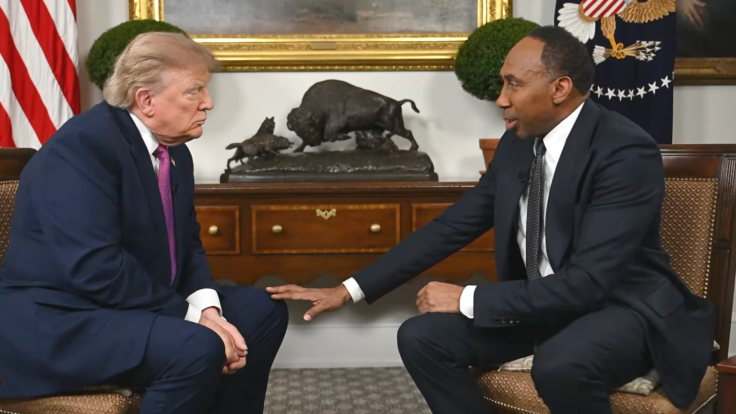
President Donald Trump arrived with three pages of accomplishments when Stephen A. Smith challenged him to explain what his administration had done for Black Americans. Smith asked why those policies hadn't translated into stronger political support in the midterm elections and asked him to account for voters' apparent dissatisfaction. Trump cited HBCU funding, criminal justice reform, tax cuts and healthcare initiatives, insisting Black Americans had been among the biggest beneficiaries of his presidency.
Trump Lists HBCU Funding and Criminal Justice Reform
During Smith's 'Straight Shooter' interview, Trump referred to his prepared list of achievements.
He cited a $438 million (£331 million) investment in historically Black colleges and universities (HBCUs), along with another $174 million (£131 million) the Department of Education announced in September 2026. Trump said additional funding above congressional allocations exceeded $612 million (£462 million) over two years.
He also pointed to an April 2025 executive order restoring the White House HBCU initiative.
Trump defended his role in securing the First Step Act, arguing previous administrations had failed to deliver criminal justice reform.
Trump Highlights Tax Cuts and Sickle Cell Treatment Access
Trump listed economic and healthcare policies he said benefited Black Americans.
They included making Opportunity Zones permanent, an initiative developed with Republican Senator Tim Scott, and tax provisions eliminating federal taxes on qualifying overtime earnings.
He also highlighted Trump Accounts, which provide $1,000 (£756) in government funding for eligible newborns, and a $1,776 (£1,342) tax-free 'warrior dividend' for eligible military personnel.
On healthcare, Trump cited expanded Medicaid access to gene therapies for sickle cell disease, which disproportionately affects Black Americans. Trump said the coverage applied in states accounting for about 84% of Medicaid beneficiaries.
He also claimed a 70% reduction in the VA benefits backlog.
Trump Cites Alice Marie Johnson's Pardon
Trump discussed Alice Marie Johnson, whose life sentence for a drug-related offence he commuted before pardoning her, describing her case as an example of his commitment to criminal justice reform.
Johnson had served 22 years in prison when her case was brought to Trump's attention. Trump later appointed her as his pardon czar.
Johnson later helped identify other prisoners for possible clemency, including inmates he believed had received disproportionately harsh sentences.
Stephen A. Smith Challenges Trump's HBCU Funding Claims
Smith challenged Trump's account by comparing HBCU funding across administrations.
He cited approximately $2.4 billion (£1.81 billion) under former President Barack Obama, around $1.9 billion (£1.44 billion) during Trump's first administration in 2019 and more than $17 billion (£12.85 billion) under former President Joe Biden when broader funding was included.
Trump disputed the comparison, arguing HBCUs had faced financial uncertainty because Democratic administrations required college presidents to repeatedly request funding. He said he secured longer-term financing after HBCU leaders complained about annual funding requests.
Trump Defends Record Amid Midterm Backlash
Smith questioned why Trump's claimed accomplishments had not generated stronger support from Black voters in the midterms.
He recalled Trump's 2016 campaign appeal, when he asked Black voters, 'What have you got to lose?'
Trump maintained that the Black community was the biggest beneficiary of his administration's work and criticised Democrats over their opposition to some initiatives.
Trump complained he had received little credit for criminal justice reform, referencing activist Van Jones.
© Copyright IBTimes 2026. All rights reserved.