Your Gas Tank vs. Their Nuclear Bomb: How the Failed US-Iran Deal Just Triggered a Global Economic Meltdown
When nuclear red lines harden, it is often ordinary people far from the negotiating table who end up paying the price.

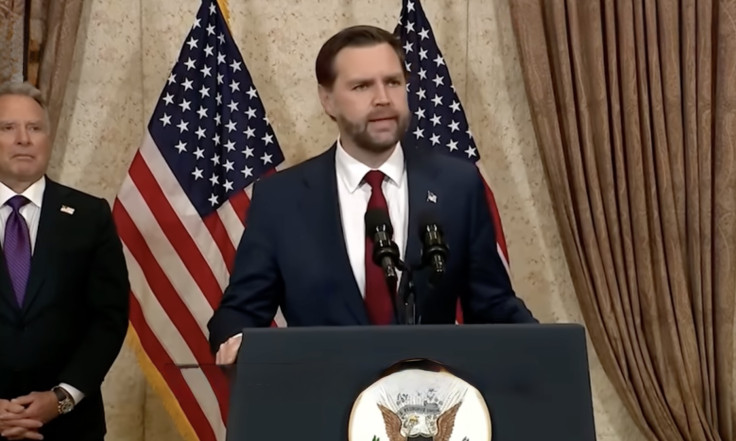
U.S. Vice President JD Vance confirmed in Islamabad on Saturday that the United States and Iran have failed to reach a nuclear deal after 21 hours of talks in Pakistan, raising fresh doubts over the fragile ceasefire in the six-week war that has disrupted the Strait of Hormuz and sent global energy markets into turmoil.
The news came after a brief, uneasy pause in fighting that began on 28 February, during which oil flows through the narrow Strait — a chokepoint for global shipping — were squeezed and traders began pricing in the risk of a wider conflict. The talks in Pakistan were billed, at least in diplomatic circles, as the best shot at preventing a local war and a nuclear dispute from bleeding directly into the global economy.
Vance walked into a packed briefing room at Islamabad's Serena Hotel with a message that felt at once blunt and oddly clinical, given the stakes.
'The bad news is that we have not reached an agreement,' he told reporters, standing behind a lectern still draped with a U.S. flag. 'They have chosen not to accept our terms. So we go back to the United States having not come to an agreement.'
Nuclear Deal Standoff Leaves Strait of Hormuz in the Balance
For context, Washington's central demand was clear and, by Vance's own account, non-negotiable: an 'affirmative commitment' from Tehran that it would not develop a nuclear weapon and would not seek the technology to build one. The Iranian side, led by Parliamentary Speaker Mohammad Baqer Qalibaf and Foreign Minister Abbas Araqchi, refused.
That single impasse sits atop a tangle of other disputes. Iranian officials, in their own statement on X shortly before Vance spoke, said the agenda in Pakistan included the Strait of Hormuz, war reparations, lifting sanctions, a complete end to the war and 'the nuclear issue.'
Tehran has for weeks been pushing a maximalist line, insisting on full sovereignty over the Strait, no limits on its ballistic missile programme, the right to enrich uranium and compensation for war damage. U.S. negotiators under the Trump administration, meanwhile, prioritised reopening the strait to restore the free flow of oil and, in Vance's words, 'crushing Iran's nuclear enrichment programme' to block any path to a bomb.
The language from Tehran after the collapse was unyielding. Iran's statement vowed it would 'not forgive the heinous crimes' of the U.S. and Israel, referring to the latter as the 'Zionist regime.' The country would, it said, use 'all tools, including diplomacy, to secure national interests,' but stressed that success depended on the other side dropping 'excessive demands and unlawful requests' and accepting Iran's 'legitimate rights.'
Vance, for his part, tried to cast Washington's position as measured. He said President Donald Trump had instructed him to 'make your best effort' and negotiate 'in good faith.' The U.S. side, he claimed, had been 'quite accommodating.'
Still, he offered little detail on what flexibility, if any, had been put on the table. Instead, he said the U.S. team was leaving Pakistan with a 'very simple protocol' representing its 'final and best offer', and suggested the ball was now in Tehran's court.
Failed US-Iran Nuclear Deal Talks Stoke Fears of Ceasefire Collapse
Andrea Stricker, deputy director of the Nonproliferation Program at the Foundation for Defence of Democracies, said she was not remotely surprised that the nuclear file had wrecked the talks. Speaking to the New York Post, she argued that uranium enrichment and 'maintaining a nuclear weapons pathway' are tied to the ideology of Iran's regime.
'This shows the U.S. is not negotiating with chastened regime pragmatists, but the same old Islamic Republic,' she said, adding that the ceasefire is 'likely going to collapse unless the regime has an eleventh hour turnaround in its approach.' In her view, the U.S. team 'meant business and did not budge on their nuclear red lines, and should be commended.'
It is an unabashedly hawkish reading, but it chimes with the hard edges of the U.S. demands as described by Vance. It also underscores what is really in play here, beyond the deadlock over centrifuges and enrichment levels.
The failure to reach a nuclear deal leaves the Strait of Hormuz in limbo. For oil-importing economies, from Europe to Asia, that waterway is less a line on the map than a vein. Each hint that it might close tightens markets. Each rumour of progress loosens them. Now, with no agreement and no clarity on whether the ceasefire still holds, traders and governments are left trying to interpret both U.S. silence and Iranian rhetoric.
There is a certain surreal quality to the backdrop. Vance said he had been in 'constant communication' with Trump and U.S. Secretary of State Marco Rubio throughout the all-night negotiations, speaking 'about a dozen times.' Both men were attending UFC 327 in Miami as the vice president announced that talks had failed.
For those on the front lines, that disconnect may sting. For consumers far from the Gulf, it may translate into something more prosaic: a higher bill to fill the car, heat the home or keep a small business running, all linked back to a row in Islamabad over what Iran can and cannot do with uranium.
Decade-High Hopes Fade
The Pakistan talks were the first time in more than a decade that American and Iranian officials had sat in the same room to grapple with the nuclear question, since the Obama-era 2015 deal. That in itself raised expectations that something more than posturing might emerge.
Instead, both sides are now locked into positions they have spent years rehearsing. Iran invokes history, loss and sovereignty. The U.S. invokes security and precedent. Neither appears ready to admit that, without movement, the cost of this standoff will not just be counted in regional casualties but in the more mundane arithmetic of global prices.
Israel and Lebanon are due in Washington next week for their own talks at the State Department. Those meetings may yet produce something concrete on that front. On the nuclear issue and the Strait of Hormuz, however, nothing is confirmed until one side blinks in public, not just behind a hotel door in Islamabad.
© Copyright IBTimes 2026. All rights reserved.
- Recommended For You